
Arctic Circle Trail History, Tips, Context – That Aren’t About Hiking!
Purchases made through some links on this page may provide The Detour Effect with commissions (at no extra cost to you). Thank you!
I’ve just completed my solo hike of the 100-mile (160 km) Arctic Circle Trail in Greenland! I thought about writing a day-by-day trail report, but I find that when I’m researching to prepare for a long-distance hike myself, these aren’t always the most useful pieces of content because I don’t want to learn every single twist and turn of the trail in advance. Unless there are any major hazards or obstacles that require special consideration, letting on-the-trail surprises remain unknown until I reach them is part of the adventure.
However, there are plenty of things I would have liked to know when planning my Arctic Circle hike that are not even hiking-related! The official Arctic Circle Trail website is full of great information about getting to and from the trail, leaving no trace, temperatures and conditions, and what amenities are available in the huts, but I was also curious to learn about the history and archaeology of the region, how to plan my post-trail experience in Ilulissat, and general tips about life in West Greenland. Throughout my trip, I ended up learning interesting tidbits about wildlife, sled dogs, and the old Inuit religion that I think would be fun for hikers to be aware of in order to build greater context around their trekking adventure.
I will throw a few hiking-adjacent tips into the mix, but for the most part this post is about everything else you may enjoy knowing while planning for the Arctic Circle Trail. If you are not hiking the ACT and are doing a tour that includes Kangerlussuaq, Sisimiut, and Ilulissat such as the Albatross Expeditions Disko Bay tour, you may also find this useful!
If you’re looking for more hiking-specific tips, check out my ACT Solo Hiker Gear Packing List, where I included information about the types of conditions I ran into and offered advice about the trail itself, and Cost Breakdown: Solo Hiking the Arctic Circle Trail.
Greenlandic Language
Generally you will encounter people in Greenland who speak Greenlandic, Danish, and/or English, with English being the least common. Some locals you interact with may have very broken English and some of the museums and restaurants don’t have English translations posted on signs or in menus. If you don’t speak Greenlandic or Danish, come prepared with the Google Translate app downloaded!
I was pleasantly surprised by this and I think it’s awesome that the Greenlandic language is widespread in the places I visited. I assumed colonization might have resulted in more erasure of indigenous culture. One of my tour guides in Ilulissat said that when she was young, her teachers admonished her for speaking her native tongue and forced her to speak Danish. She didn’t relearn how to speak Greenlandic until she was in her 30s, and she found the experience triggering because she associated the language with punishment and negativity. She said that conversely, Danish immigrants to Greenland do not feel any pressure to learn to speak Greenlandic, and may not even bother to learn how to say “thank you” in Greenlandic.
“Thank you” is “qujanaq,” pronounced like “Koo-yuh-nock.”
History of the Arctic Circle Trail

As I began hiking, I realized I had no idea who started the Arctic Circle Trail or when. I had absolutely zero context about the creation and history of the trail!
If you’re paying attention, though, you quickly learn throughout your time in West Greenland that the region encompassing the Arctic Circle Trail has always been an ancestral hunting ground. The trail intersects with a UNESCO property called Aasivissuit – Nipisat which is recognized as the backdrop of 4,200 years of human history.
On Day 4 of the ACT (if you do the typical 8-day itinerary starting in Kellyville), if you do the bridge detour instead of crossing the river, you will come across an ancient Inuit camp called Itinnerup Tupersuai which is still in use today. The day I arrived, no-one was there, but I talked to other hikers who were greeted by Inuit at this camp.
“Itinnerup Tupersuai is an ancient camp near the head of the Maligiaq fjord. The area is still used by families and hunters as a temporary camp in the spring and late summer when the char fishing is at its best. In ancient times, Inuit used umiaq (women’s boats) and qajaq (kayak) to travel up the river to Itinnerup Tupersuai where they stored or portaged their boats on their journey to lake Tasersuaq. The only difference today is that motorized boats are used to cross lake Tasersuaq. During the winter, the lake and river freeze and Tasersuaq becomes a ‘highway’ for dog sleds and snowmobiles traveling inland to hunt or to visit Kangerlussuaq.”
– Info plaque, “UNESCO Aasivissuit – Nipisat, Inuit Hunting Ground between Ice and Sea,” located at the bridge.
I loved visiting the Sisimiut Museum after my hike because they had even more information about these migrations throughout the river valley – click the photos I snapped at the museum to zoom in and read more details about Aasivissuit summer camp and Arajutsisut winter camp:


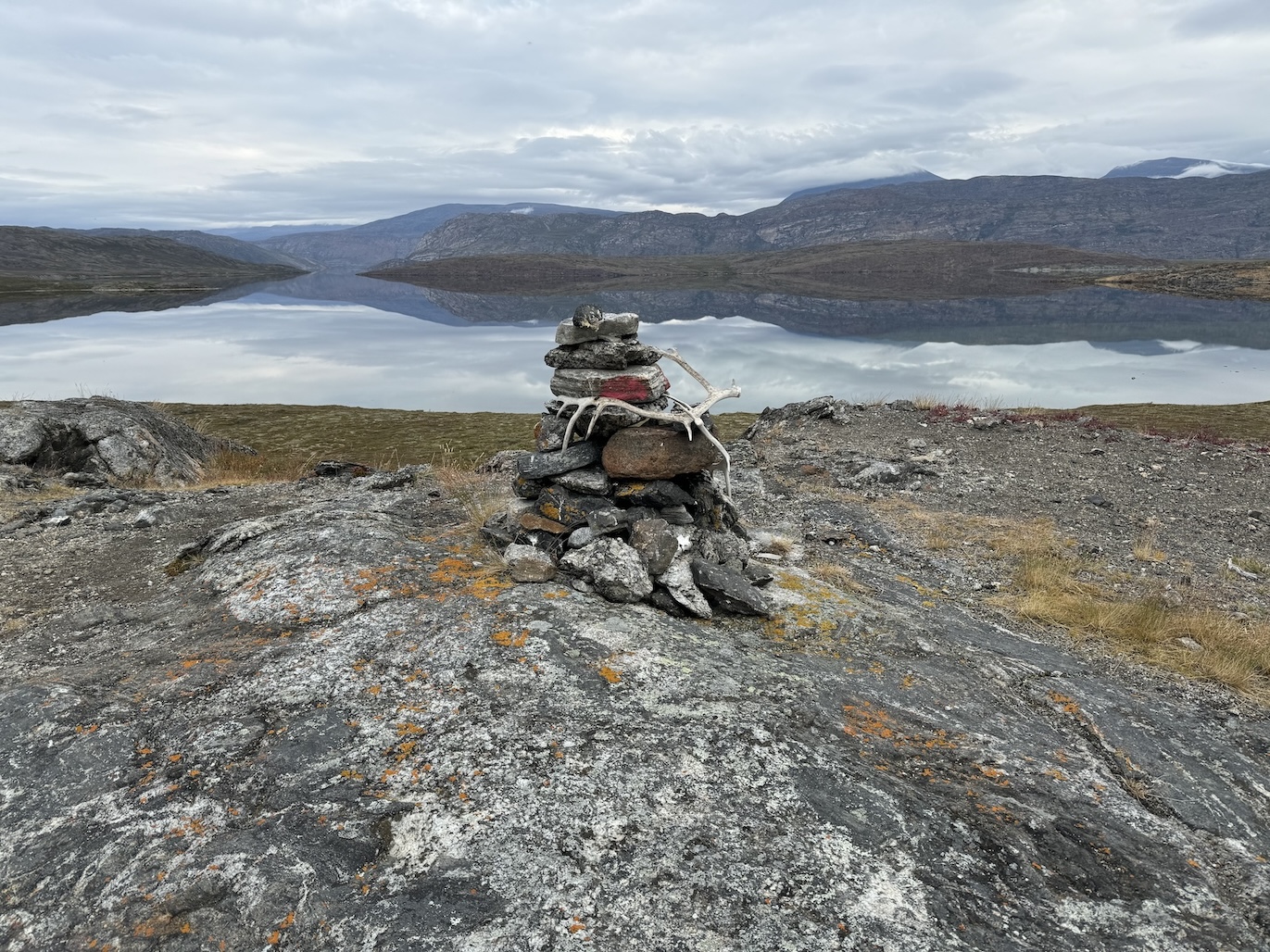
However, people throughout history didn’t necessarily use the exact route of today’s Arctic Circle Trail. There is one cairn along the trail that dates to ancient times, but the rest are modern.

It seems that the trail as we know it today was routed in the 1970s. In Sisimiut I visited a souvenir shop called Mersortarfik Panigiit which is run by one of the original creators of the Arctic Circle Trail, Bjarne Ljungdahl – or at least that’s what he told me! It is difficult to find more information online about the building of the trail. He said that after completing the Kungsleden trail in Sweden, he thought Greenland ought to have something similar.
Ljungdahl is a geologist, surveyor, professor, and author whose 17 books are for sale at the shop (one of them is in English, a collection of fiction short stories set in this region of Greenland). He pointed to the foreword of one of his books, Hiking Routes in West Greenland (actually: Vandreruter i Vestgrønland) published in 1979, which lists the names of the rest of the “Committee for Hiking in Greenland.” He said these people were also involved in the creation of the Arctic Circle Trail: Hans Christian Olsen, Fartato Olsen, Jette Stepputat, Axel Mortensen, Morten Jørck, Lykke West Petersen, Lisbeth Laybourn, Ove Rosing Olsen and Anne-Marie Goul Nielsen.
If you get a chance to swing by the shop, it’s fun to chat with Ljungdahl and he’s very open to answering questions! This is also where you can buy the ACT sew-on patch attesting that you’ve completed the trail.


Archaeology and Ethnography of West Greenland
In every place I travel to, I love seeking out museums and archaeological sites that will help me understand the way people lived over time. How did different cultures interact with this unique landscape? What would my life have been like if I lived here hundreds or thousands of years ago? After experiencing the conditions of the terrain on the ACT hike, some artifacts at the museums start to make a lot of sense, like the design of the shoes and the use of water repellent seal skin for almost everything.
There are incredible opportunities for Arctic Circle Trail hikers to explore these topics at the National Museum of Denmark in Copenhagen, the Sisimiut Museum, the Icefjord Center in Ilulissat, the Ilulissat History Museum, and by taking day trips out from Sisimiut and Ilulissat to nearby settlements. You may also enjoy the Kangerlussuaq Museum, but it mainly focuses on the town’s history in relation to the US Air Force Base.
(In case you are in the early stages of your planning and these town names are sounding confusing, as a reminder, most hikers fly from Copenhagen or Reykjavik, start hiking in Kangerlussuaq, end in Sisimiut, and then take a ferry to visit Ilulissat after their trek. Others hike west to east, starting in Sisimiut and ending in Kangerlussuaq).
There is an awesome online class on Coursera called Arctic Peoples and Cultures. It’s offered by the University of Alberta and UiT The Arctic University of Norway, but you don’t have to be enrolled in any school to get access to the course; Coursera classes are available to the public. Although, it spends more time on the Sámi and Nenets cultures of Norway, Sweden, Finland, and Russia.
National Museum of Denmark in Copenhagen


At the National Museum of Denmark in Copenhagen, where you may be flying to and from to reach Greenland, there are multiple exhibits about Greenland. One of them on the second floor is called “Arctic Treasures,” on the first floor there is “People of the Arctic,” and in the Viking wing (currently part of the Viking Sorceress interactive exhibition) there are a few artifacts from the Viking age in Greenland, such as decorative pieces carved from walrus tusks hunted in Disko Bay. You will visit Disko Bay yourself if you make a trip to Ilulissat.
The Arctic Treasures wing is confusing and honestly a bit frightening. There are very few informational signs explaining what you’re looking at, so it comes across as a giant collection of bones and animal hides and grotesque masks all piled together like a scene out of Deliverance. There is a massive skin suit and some sort of harpoon attachment with an unidentified animal foot sticking out. I visited prior to my flight to Greenland and figured surely my death is imminent. But then…
Sisimiut Museum


…at the museum in Sisimiut, there were English-language explanations about some of the artifacts I had seen back in Copenhagen! Mysteries solved!
“Whale hunters had special clothing to help protect them during the whale hunt. The ‘atallaaq’ was a waterproof seal skin suit that kept the wearer dry. This ‘dry suit’ enabled the lancer to crawl on the back of the whale to deliver the death stroke and begin the flensing. Once dead, the whale was towed to shore where a more thorough processing of the meat and blubber would begin.”
– Sisimiut Museum
“A harpooner would stand in the stern of an umiaq with a large harpoon attached to heavy bladder floats. When the harpoon met its mark these floats would slow the whale’s escape, restrict its ability to dive and allow the boat crew to chase the whale down as it became weaker and weaker from the chase and loss of blood. When the whale was near total exhaustion, the hunting party could approach and strike the killing blow.”
– Sisimiut Museum
The Sisimiut Museum is housed in some of the oldest European buildings from the town’s colonization in the 1700s, but inside you will find displays about the Saqqaq, Dorset, and Thule people who inhabited Greenland during and after the Bronze Age (or what they’d call the Bronze Age on a European timeline). It is likely that each separate culture migrated from Siberia and across the Bering Sea into Alaska, Canada, and finally Greenland.
Saqqaq: 2300-900 BC
Dorset: 500 BC-1200 AD
Thule: 900-1700 AD
Modern Inuit in Greenland are thought to be mostly descended from Thule people. DNA analysis shows that each of these ancient groups are quite dissimilar to each other, with Saqqaq people having no relation to Thule people.
The Sisimiut Museum also has an exhibit about the old Inuit religion and shamanism. It’s here that I learned about “Inua,” the soul that is present in all things, including inanimate objects. Stones, plants, animals, tools, and everything in the physical world all had Inua and should be just as respected as man. The museum in Copenhagen briefly touched on this as well, highlighting that hunters did their best to maintain a good relationship with the souls of animals by performing rituals, wearing amulets, and decorating their hunting tools with symbolic ornaments. According to Mythical Monsters of Greenland by Maria Bach Kreutzmann, if things started to go wrong, an angakkoq, or shaman, would communicate with spirits and mythical creatures to try to assuage or tame them.
Sisimiut Day Trips/Nipisat
From Sisimiut it is popular to take boat tours or hike to an abandoned settlement called Assaqutaq or another called Sarfannguit (if you are hiking the Southern Route of the ACT instead of the classic Northern Route, you will hike to Sarfannguit anyway), but a fellow traveler who spends most of her time sailing in the Arctic recommended a visit to Nipisat Island instead since I am keen on ancient ruins.
“On this excursion, we will sail to Nipisat Island to learn more about both the ancient and more recent history of the Arctic Circle Region. From the vast reindeer hunting areas used by the Inuit during the past 4,500 years to the Dutch and Danish/Norwegian whalers in more recent times, we will talk about the full history of the area and visit one of the biggest ruins from earlier times.”
UNESCO Classic Cruise excursion, Guide to Greenland
They did not have an available departure during my time in Sisimiut, unfortunately, but if I had known about this tour prior to my trip, I might have rearranged my whole ACT schedule to fit it in! According to the Sisimiut Museum, it is “there that the oldest traces of the Saqqaq culture were found. It is possible that the region around Sisimiut, including Nipisat, is the area of Greenland where the Saqqaq people survived the longest…Prehistoric dog remains found on Nipisat are furthermore involved in Qimmeq – a large interdisciplinary research project on the genetic and cultural history of the Greenlandic sledge dog.”
In Sisimiut, you can also easily walk down to Teleøen, or Tele Island, near the ferry docks to check out 4,500 year-old ruins. I didn’t go because a hiker told me it is difficult to make out any sort of shape or form from the earthworks that remain, so I thought it might be less of a “must” and more of an “if you have time.” Of course, later a different hiker told me it’s worth the walk. If you decide to go, Guide to Greenland has an interactive self-guided map and links to guided walks.
Ilulissat Day Trips/Sermermiut and Qasigiannguit


After completing the Arctic Circle Trail, many hikers take the overnight ferry with Arctic Umiaq Line to reach Ilulissat in order to see the breathtaking UNESCO icefjord. I would highly recommend this trip and am so glad I made the effort to come here; Ilulissat is truly magical. If you get a couchette bunk instead of a private cabin on the ferry, it’s actually affordable. Like in the rest of Greenland, you can even camp for free on the outskirts of Ilulissat if you don’t want to splurge on accommodation. Some of the hotels and AirBnBs are situated directly on the shore with views of icebergs, though, which is pretty dang cool.
In Ilulissat, the boardwalk trail that leads from the Icefjord Center to the actual icefjord goes right through the ancient settlement of Sermermiut. The ground here is permafrosted, preserving organic material that can be recovered by archaeologists. Artifacts found here have taught us that Saqqaq, Dorset, and Thule people all passed through Sermermiut. Inside the Icefjord Center, there is an interactive display pointing out where you should be looking during your walk down the boardwalk to notice the remains of ancient graves and turf homes.
From Ilulissat you can take a boat tour to Qasigiannguit, a village that features the Qasigiannguit Museum and, on summer Sundays, a “Living Settlement” where volunteers re-enact life on a settlement using the old techniques and tools.
I went the first week of September and the Living Settlement was sadly not being held anymore, but the museum visit was guided by an extremely knowledgeable employee who explained the significance of the Saqqaq artifacts for over an hour. The town itself was not the most exciting place to visit, but this museum tour was pretty sweet, especially considering the signs were not in English and I wouldn’t have understood the artifacts by myself. I learned that any time you see an artifact made of wood, it’s driftwood that floated to Greenland from other countries like Russia, and the sinew-like material used to bind stone points to wooden handles is actually baleen from a whale.
During the trip to Qasigiannguit, one of the guides taught me about Inuit games where people compete to test their strength via the stick pull, finger pull, and various kicks and jumps! Read about the Arctic Winter Games.
Caribou, Fox, Sled Dogs, Oh My!
All I knew about the wildlife of the Arctic Circle Trail before I started hiking was that I might see reindeer, Arctic fox, musk ox, or Arctic hare (and that polar bears live in Greenland, but I’d have to be extremely unlucky to see one on the ACT). You may be more informed than me and already know these facts, but here are some things I learned about the animals during the course of my trek and my Greenland trip that I didn’t know before!
Wildlife

There are no ants in Greenland! Great news for hikers.
The fur of Arctic fox changes color between summer and winter. The one I spotted on the first day of the trail was a dark charcoal color, blending with the rocks, but all the photographs on Google Images show white Arctic fox because they change in the winter to camouflage with the snow.
Reindeer and caribou are basically the same thing. Do most people go through life already knowing this? Some sources say that reindeer are domesticated caribou and there are differences in size, but ultimately they are the same species. When you hear these terms in Greenland, they will be said interchangeably. Although, the cashier at one of the souvenir shops told me that “the word ‘reindeer’ is for the fictional ones, like Santa Claus” lol. I don’t think that’s totally true, but I suppose her point was that caribou might be the more appropriate term to use when talking about these animals in Greenland.


The birds in Greenland sound absolutely insane. If you hear any kind of weird, creepy, funny, maniacal, or ghostly animal call during your hike, it’s always a bird. I kept thinking that some of them sound like coyotes!
Musk ox enjoy Johann Sebastian Bach…? When I did a day trip to Russell Glacier in Kangerlussuaq prior to beginning my Arctic Circle Trail hike, my guide told me that there is a massive herd of musk ox that is often seen around Russell Glacier and gave me a few anecdotes about them. One thing he said was that they are known locally as “Man Face” because of the lips and human-like features. Another thing he said, and maybe I misunderstood his thick Greenlandic accent, was that researchers play classical music for the musk ox because it calms them and attracts them? Bach in particular. I may have completely misunderstood this story, in which case we can file it under a funny example of “lost in translation.”
Sled Dogs


On my “Meet a Sled Dog” tour with Diskobay Tours, who have 53 of them, I learned a ton of sled dog facts!
Did you know that in Greenland, when attached to the sled, dogs are arranged in a fan shape rather than in rows of 2? This is better for sea ice and for going up mountains, whereas rows of 2 are better for forested locations.
There are only 10,000 sled dogs left in Greenland, which is a huge decrease in recent years due to climate change and the greater cost of keeping dogs vs. using snowmobiles. Many Inuit are dedicated to keeping the sled dog culture alive, though. There is evidence of symbiotic relationships between humans and dogs in Greenland dating back over 4,000 years, and in Siberia, nearly 10,000 years!
Other dog breeds are not allowed north of the Arctic Circle because they want to keep the Greenlandic breed pure.
Greenlandic sled dogs come in many colors, although I got the feeling the “blonde” and short-haired look is most common. Some dog owners think the fluffier long-haired look you see on some dogs is a mutation, but others argue back, saying that those people just don’t want to put the effort into grooming long-haired dogs.
Sled dogs must be chained up after 6 months of age because of the pack mentality; they may attack each other, or even children or drunk people, if not chained. This is why young puppies run up to you in the street for snuggles, but you will not have this experience with adult dogs. The dogs trained for hunting can be particularly aggressive and you should always ask the owner if it’s ok before you pet an adult dog, even though you’ll walk near dog camps frequently in towns like Sisimiut and Ilulissat and it may be tempting to say hello. Sled dogs are not kept at the home and need to be chained on land at the outskirts of town; they are working dogs and not pets. For those of us who consider dogs a member of the family, this can be hard to accept!
The Diskobay Tours dogs are “trained” for tourism and they said this training involves a lot of cuddles! This is why I felt ok about participating in this tour, and the Diskobay dogs seemed to be happy, playful, and jumping about. I really liked the friendly, knowledgeable folks who run this company and I learned a lot from them, not just about dogs but about Inuit culture and Greenland. They are very proud of their dogs and Nivé said that the tradition helps her keep in touch with her heritage.
That said, some of what you read about Greenlandic sled dogs may make you feel conflicted. They will be chained all summer and lose a lot of muscle mass, and then as winter approaches, they will gain it back within about 6 weeks of sled training in the snow (sounds like me before/at the start of hiking season!). Tourists flinch at the chains, but on the other hand I know this is not my wheelhouse and I should defer to local experts. I suppose lots of house dogs are couch-dwellers and don’t do much running around either. If you feel strongly about either not supporting the sled dog tradition or only supporting the dog owners who treat their animals well, be discerning about where you invest your tourist dollars.
Don’t Rely on Other Hikers’ Advice
Ironic, I know, because I am currently giving advice.
The official Arctic Circle Trail Facebook group can be a great resource if you want to check in with recent hikers about what conditions have been like – is it a particularly wet year? How high was the river last week? – but otherwise I think it’s important to trust yourself more than you trust the people in this group, and that’s probably true of any hiking trail forum.
When I chose to hike the ACT, the decision was based on my research, experience, and intuition which told me that I would be capable of such a trail. I have hiked many long trails before and encountered all manner of conditions, and I’m from a country that has true wilderness where I’ve had to be self-sufficient. Despite the trail’s remoteness, I felt pretty confident – until I joined this group and started to second guess myself.

Some hikers are very pleased with themselves, imagining that having completed the trail makes them some kind of Bear-Grylls-esque wilderness survival expert. They assume everyone else is a newb who has never stepped foot on a trail before and will get themselves killed, and they make this contempt known no matter how well researched and valid your posted question is. There is a lot of snark. The trail certainly has its challenges, but if you’re a somewhat experienced hiker, it’s really not like you’re going to be a member of the Donner party struggling for your life. These guys need an Elle Woods to tell them, “what, like it’s hard?”
In general, you never know where other people are coming from. Perhaps someone who carries on about how it’s “the hardest trail of my life” has not done as many trails as you, or experienced very rugged or boggy trails before. Maybe people who say that the trail is super easy lucked out with incredible weather for their entire trek. Either way, take these protestations with a grain of salt. Research, be cautious, and be honest with yourself about your abilities, but don’t let any old heads make you feel like you’re going to die because you’ve never built a log cabin or fought a bear with your bare hands before.
SIM Cards and Maps
Even if you’ve got your hiking and camping gear dialed in and don’t have any questions about what to pack for the Arctic Circle Trail, I would still recommend reading my ACT Packing List for the section about eSIMs and maps. Some of the usual phone applications I use were not the best choices for West Greenland.
Book Sisimiut Accommodation in Advance
As per my ACT cost breakdown, I thought I would tent camp in Kangerlussuaq at the start of my Arctic Circle Trail hike to save money, but at the last second I decided to book a walk-up reservation at the Kangerlussuaq Youth Hostel. There was plenty of space and it was no problem to book last minute (maybe this is not always the case).
Contrastingly, if your initial plan is to tent camp in Sisimiut at the end of the trail, maybe rethink this if there’s any chance you might change your mind upon arrival. It can be hard to get a last minute reservation anywhere in town and Tine at the Sisimiut Youth Hostel (one of the only budget options) can only do so much to help you out if things are full! You do not have to pay in advance, you simply email to reserve a spot.
Tine really goes above and beyond to provide for hikers. I kept thinking that I would not be the right person for this job because I get frustrated with needy people. I bet every single east-to-west hiker arrives at the end of the ACT with some kind of problem that they want Tine to help them solve, including some issues caused by their own negligence or bad planning and which they have now made into her problem. But Tine really takes care of everybody and does it with an enthusiastic smile (I was not paid or asked to write this review lol).

I arrived in Sisimiut a day earlier than I had a reservation for. As I was walking in the pouring rain on the last stretch of road to reach the hostel, Tine was walking the opposite direction, probably trying to leave for the day. She stopped and asked if I was headed for the hostel, and when I said yes, she said she works there and would turn around and come check me in. When I explained I was a day early, she said she would look at the schedule and find a way to get me in there. I was so incredibly grateful – after days of freezing rain and wind and being completely soaked through to my bones, I really wanted to get inside, get dry, clean, and warm, do laundry and not be in my tent. After rearranging some things and checking me in, she showed me to the boiler room where I could hang all my wet clothes – a godsend!
A few days later the hostel was totally booked full and she ran out of space to accommodate other hikers in a similar boat who had schedule changes. Flights out of Sisimiut had been cancelled due to weather, which complicated things for every lodge in town. When two hikers arrived without a reservation after hiking in the snow, one of them having fallen into the freezing rivers twice, there were no bunks left but she set up rollaway beds in the hallway at the back of the hostel and hung blankets up to create a little private corner for them.
🏨 I’ve heard from hikers that the other hostel in Sisimiut is also good. Hotel Sisimiut and Hotel Søma are popular hotel choices in Sisimiut, but they are more expensive and book up even faster than the hostels. Hotel Søma has a special “recovery deal” for ACT hikers that includes spa time!
The Romance and Cinema of the Arctic Desert/Tundra


This section is to give you an abstract frame of reference about what to expect from the Arctic Circle Trail, and a way to collect my final thoughts on the experience. If you’re nervous about wet conditions and hazardous weather and feeling intimidated, maybe this can be a reminder of all the magic that’s in store too.
The trail is perpetually blanketed with autumn colors, blueberries, and crowberries, eliciting that crisp feeling of possibility that always comes with fall.
The first few days it seemed that the animals I saw on the trail were almost guiding me, like toornat helper spirits of Inuit myth. Someone always seemed to come along right when I needed them. Reindeer walked ahead of me down the trail, never running off but instead beckoning me into their domain. An Arctic fox teased me through the rocks, and at one uncertain fork, a raven stopped to squawk me in the correct direction. I’m not a religious or superstitious person, but I started to understand where some of the Greenlandic legends come from.


I’ve often heard the landscape of the Arctic Circle Trail referred to as tundra, and if the definition of tundra is a “vast, treeless Arctic region where vegetation growth is hindered by frigid temperatures and short growing seasons,” then this best fits the ACT. But my Russell Glacier guide used the phrase “Arctic desert,” and I spent a lot of time poetically fixating on that phrase. I don’t think it’s quite as accurate for the ACT as it would be for other parts of Greenland because “desert” suggests low rainfall, but my favorite hiking terrain back home in the United States is the desert Southwest, and the ACT similarly spoke to me. No trees, low shrubs, a vantage for miles and miles around, a beautiful “wasteland” that is actually teeming with life.
Everything is so still and unmoving that you can’t fathom the landscape could ever change, but it does change every second. On the Arctic Circle Trail I was taking my jacket off, putting it back on, and taking it off again every hour, and then the rain would start and stop, the bugs would come and go.
Of course it’s also not like my home desert because it’s wet and cold. If years from now someone asks, “what’s the coldest you’ve ever been?”, I’ll get a faraway look in my eye, take one wistful puff of my pipe, squint through my monocle and say, “It was Day 6. Day 6 of 8 on the Arctic Circle Trail, Greenland, August of ‘24”. My pupils will grow wide and wild for a brief moment of remembrance before I return to this dimension, and though I usually look unassuming, in that moment you will understand I deserve to be feared 😂
“He was starving and he was delirious, and out there in this ocean of scrub, he found religion…”
– The Revenant
I think the ACT is what I wished the West Highland Way had been. When I did WHW in 2019, I wanted to feel like a Highlander of yore, back in time roaming the ancient hills. I never truly achieved this because the trail was so populated and crosses through so many villages and roads. The Arctic Circle Trail is like the real deal; you don’t know what year it is. It could be 2024 AD or it could be 2024 BC. During the hard times on the trail when I was cursing under my breath, I found myself invoking Odin and the Old Gods.
If you’re looking for a good movie to put you in the mindset of primordial stillness and similarly striking landscapes, check out Valhalla Rising! I couldn’t stop thinking about this movie during my ACT hike.
I feel like this trail was meant for me, like I was exactly where I was supposed to be, and like I regained something I’d lost for awhile. It reminded me of what I love about hiking, and why I live an unstable, precarious lifestyle. Thanks to the Arctic Circle Trail for beating me up, showing me beauty, and setting me straight.
Related:


Pin It:

My dream is to write travel and hiking content full-time. All of my guides and itineraries are free and my travels are self-funded. If you enjoy my site and would like to support, you can donate any amount to my Ko-fi page. Thank you!!
I am embarking on my ACT hike today and am reading this at the airport. Thank you for your candid advice on both the hike and cultural aspects of the area!
Oh hooray, good luck and have fun!! Jealous, wish I was there
I’m in Denmark right now where it’s raging for the first time in my 7 weeks in Scandinavia. And it’s only 16C. Your ACT descriptions and today’s rain remind me how much I don’t like being cold and wet these days.
I usually hate the cold with all my being, but oddly after Greenland I find myself missing it. Maybe I’m a whole new person. Still pretty anti-rain though!