
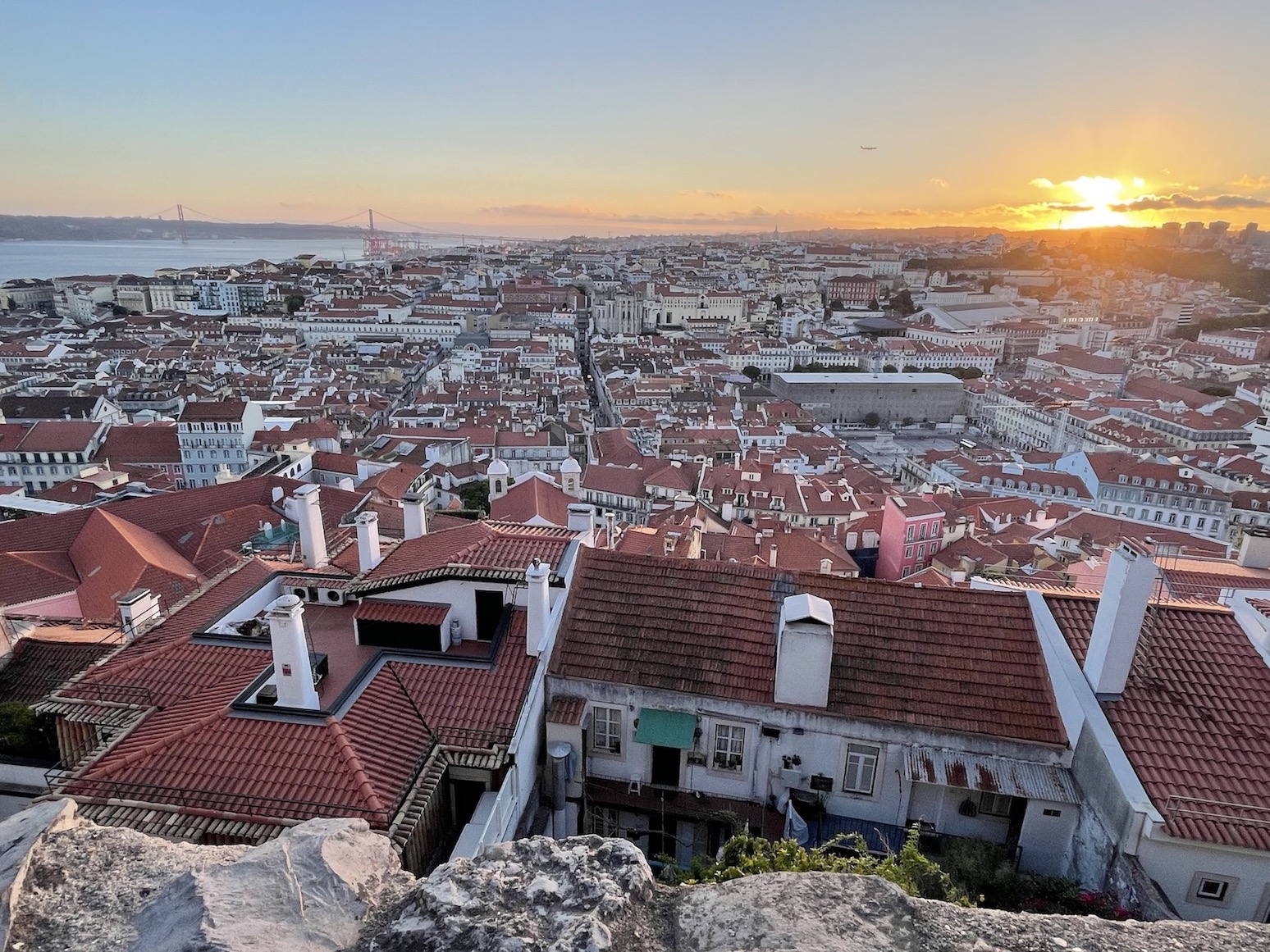
One Week Lisbon and Porto Portugal Itinerary
Purchases made through some links on this page may provide The Detour Effect with commissions (at no extra cost to you). Thank you!
When I decided to visit Portugal, influenced by other travel bloggers’ incessant protestations that I would “fall in love”, I hoped I would come away from the experience with a unique perspective that doesn’t match theirs. Maybe I would garner insight that the popular tourist haunts in Lisbon and Porto are not what they seem, meanwhile you should really be visiting other lesser known sites. Alas, it turns out everyone is right. The popular spots in Portugal are popular for a reason, and I did especially fall in love with Lisbon. This is one situation where trying to be contrary or special as a traveler won’t serve you – no matter how “basic” it may seem, do not skip out on the “top things to do in Lisbon and Porto” during your visit to Portugal.

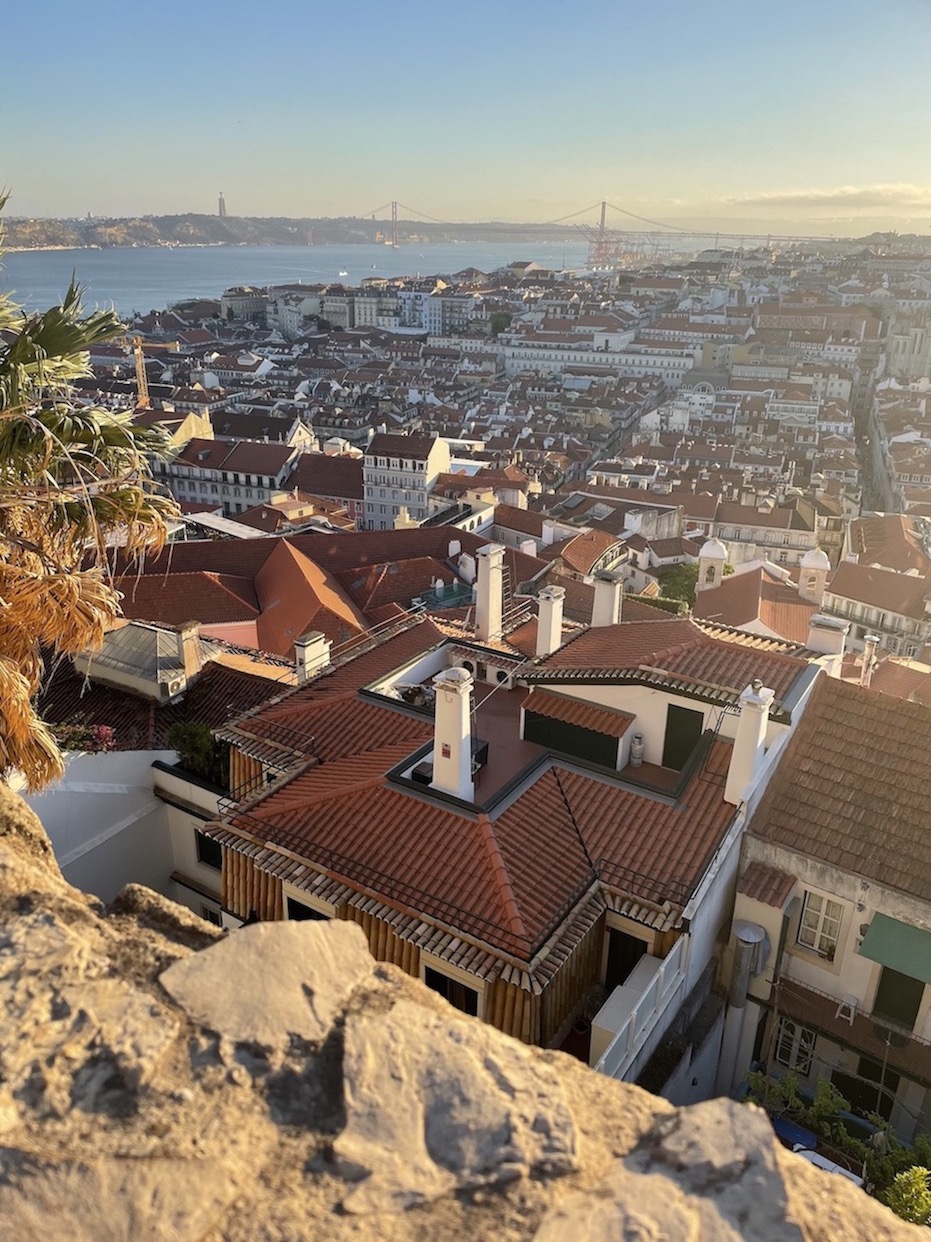
Lisbon or Porto?
If you have to choose only one city, make it Lisbon. I thought Porto was beautiful, but there is only one small section that tourists really explore. Porto sprawls out much further than the city center and Vila Nova de Gaia, but it feels as if visitors are being encouraged and corralled to only visit those central locations and to leave the rest of Porto alone. Shops, public transportation, and amenities are all situated in such a way as to keep you centralized. All neighborhoods of Lisbon, meanwhile, are equally accessible and each have their own points of interest. To be lost is Lisbon is just as full of surprises and beauty as it would be to fully plan your stops, and you get to weave yourself into the ambiance and daily goings-on of the city. In Porto I was always keenly aware of being “the other”, a tourist (which is what I was, and it’s not a bad thing, but it was harder to get a true concept for what local life is like). That said…
Why Not Both? One Week Lisbon and Porto Itinerary
I actually spent an entire week in Lisbon and then an entire week in Porto, with day trips out from each. However, as a digital nomad I was getting some work done during these trips, so half of my time was not spent exploring. With non-working tourists in mind, I’ve condensed the timeframe down to create this itinerary for one week in Lisbon and Porto. If you are a digital nomad, take special note of the “Where to Stay in Lisbon” and “Where to Stay in Porto” sections, as these were great for my lifestyle. Tenha uma boa viagem!
Note – the days of the week obviously don’t have to match my itinerary, but I chose these days in order to accommodate for when some of the museums, restaurants, and markets are closed.
Day 1 Thursday: Alfama
Arriving in Lisbon and Public Transportation

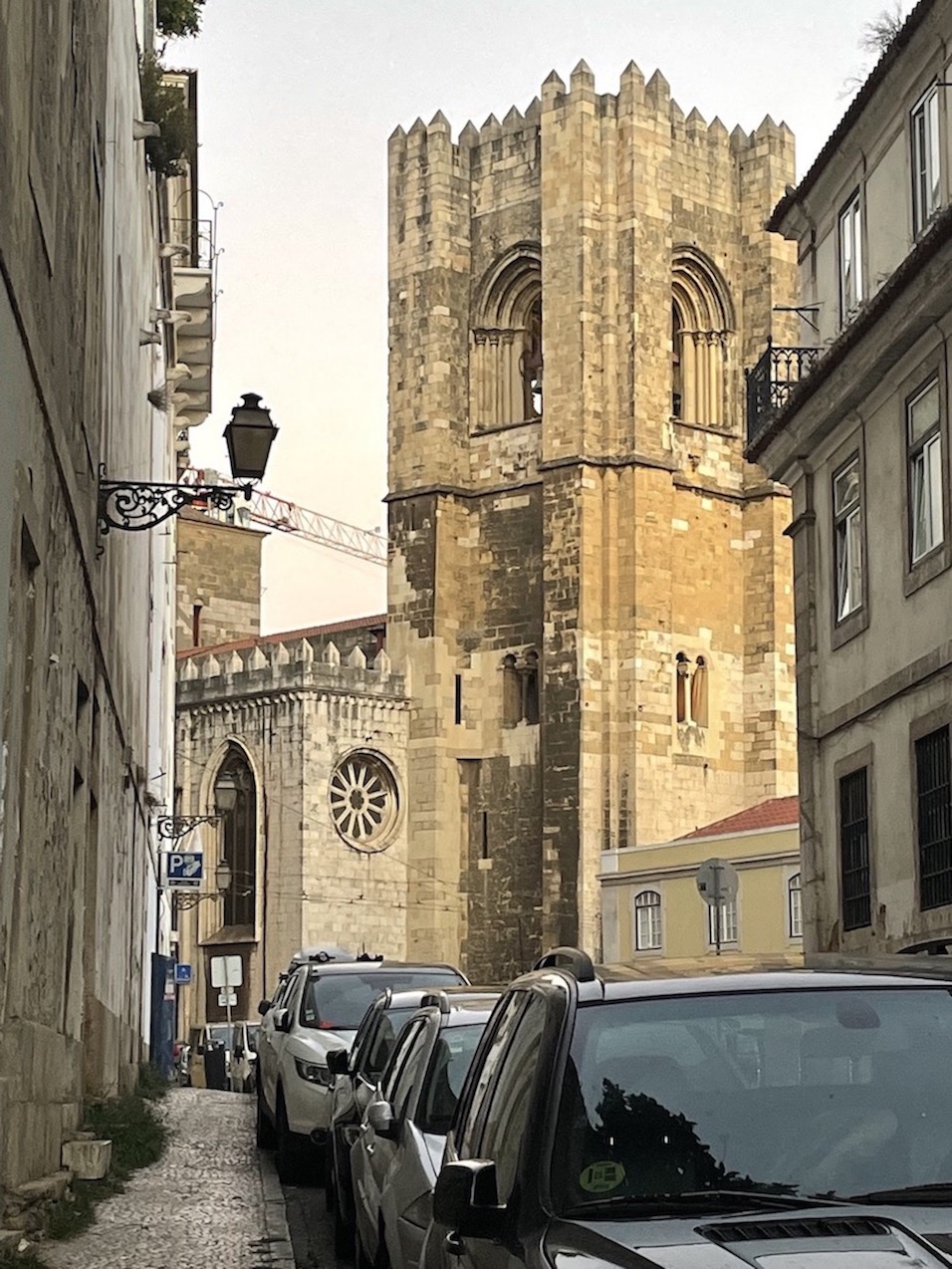
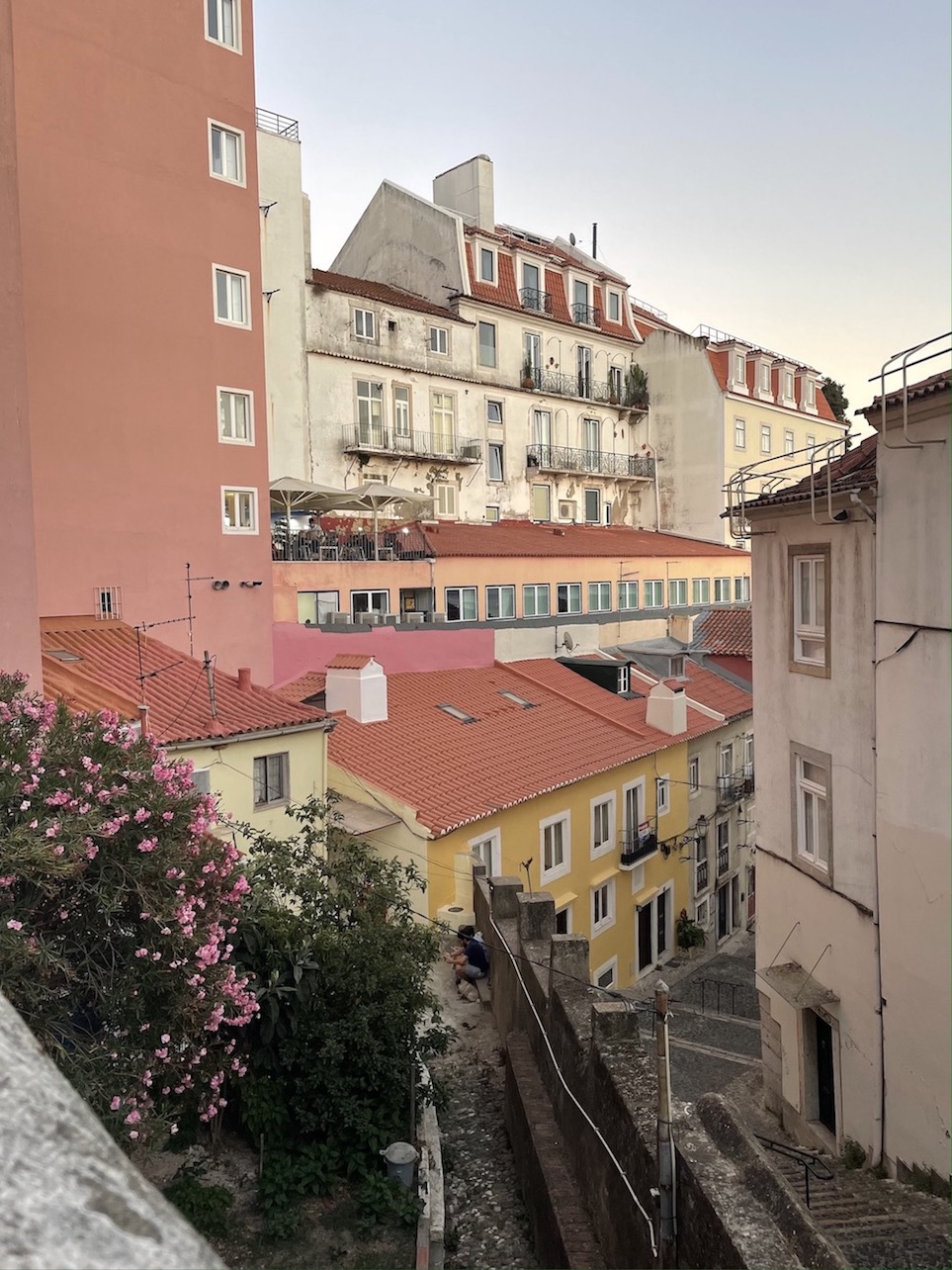

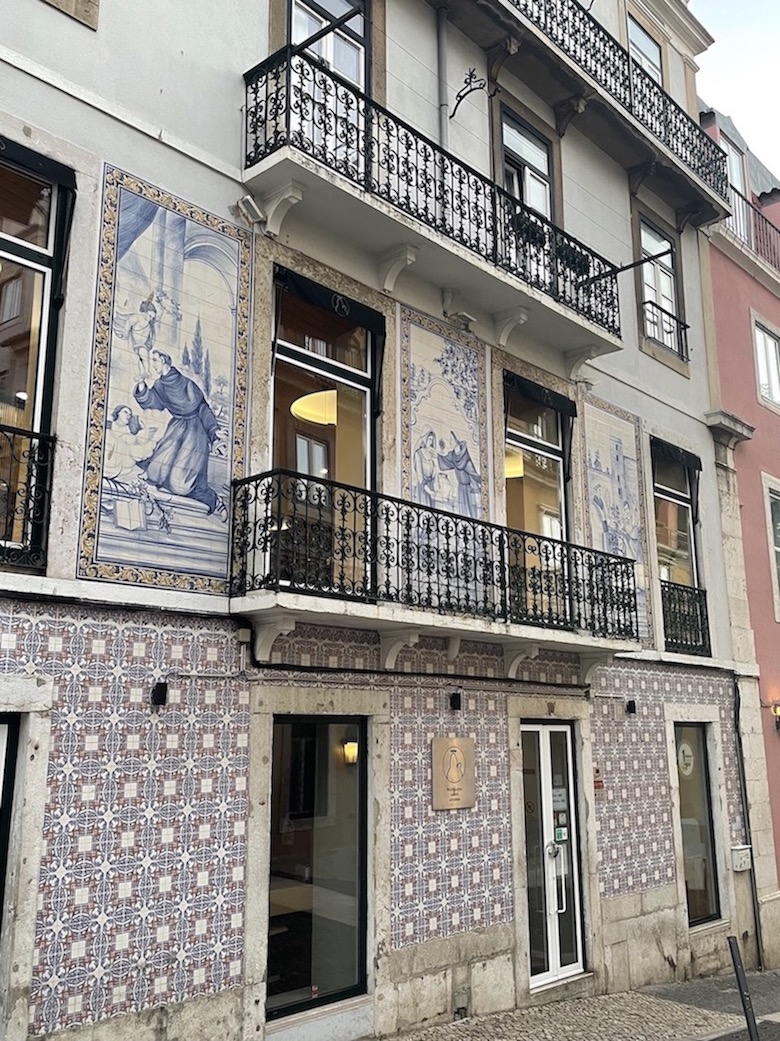
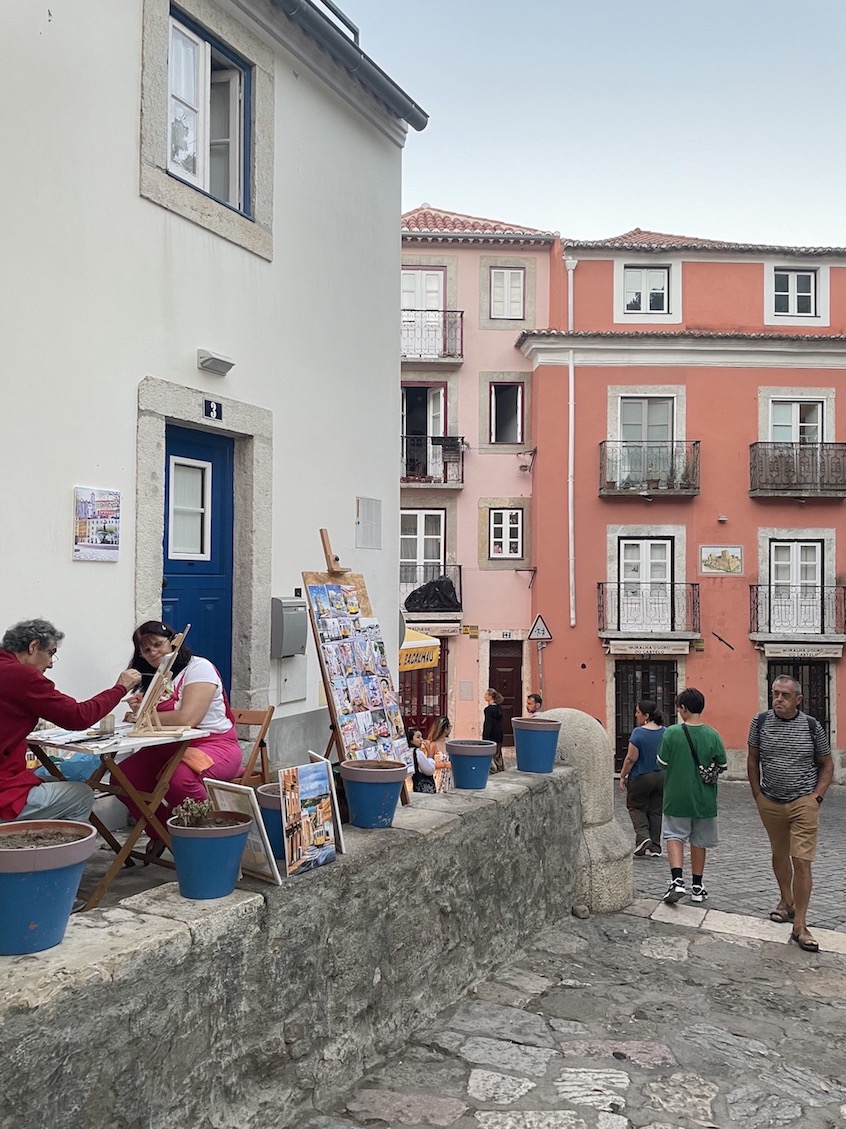
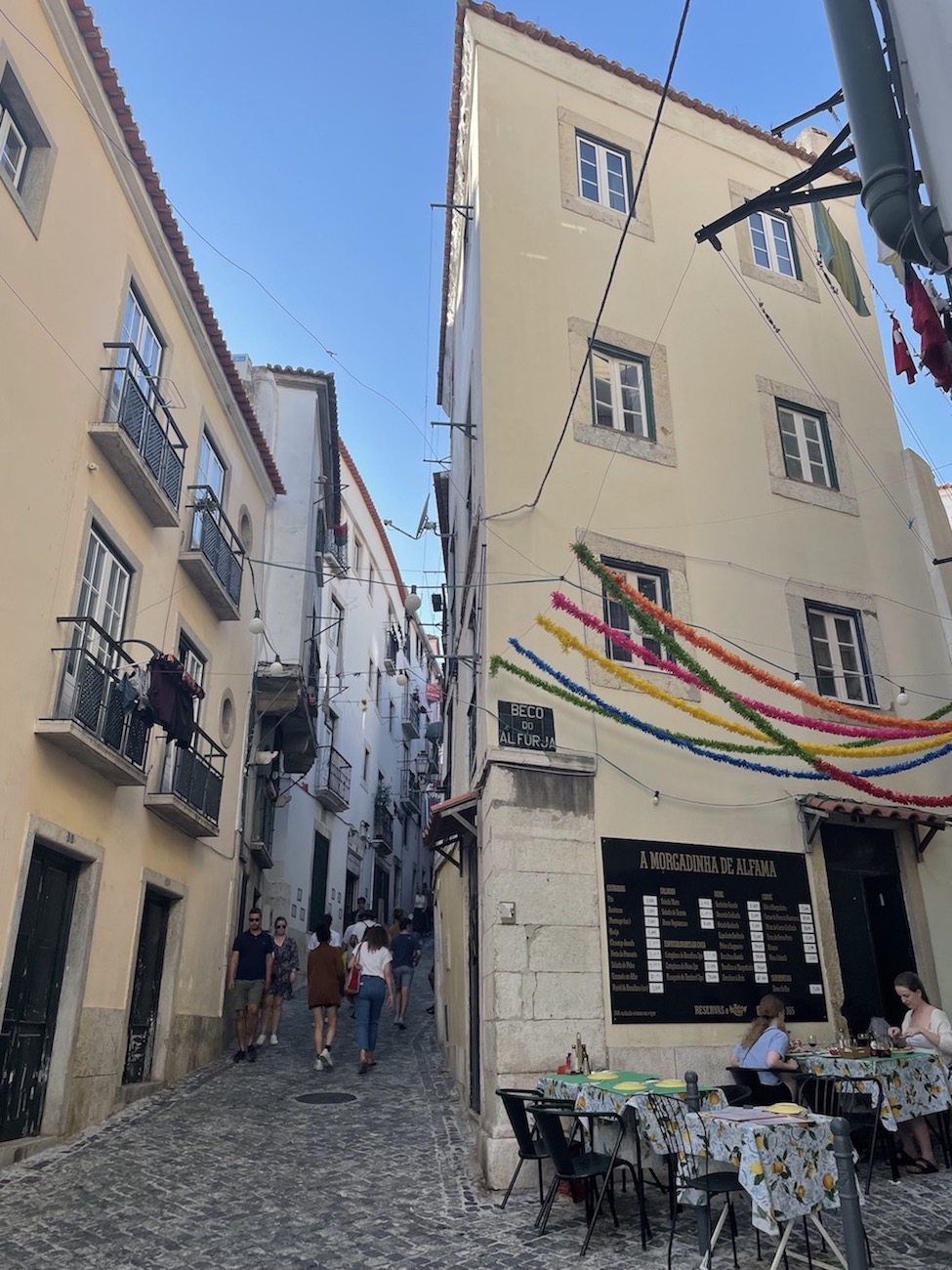
The first day you fly into Lisbon, you’ll likely arrive in the afternoon and spend some time finding your accommodation. As you exit the Lisbon airport, head down into the underground subway station (just outside of baggage claim and near all the bus stops) to buy your Via Viagem public transportation card. There are machines and attendants lined up to help you. They call loading money onto your metro card “zapping”; zap maybe €20 onto it. Each time you board a bus or train, tap your Via Viagem over the motion sensor to pay. If you end up using up your €20 (or however much you loaded) allotment, to top up you’ll need to find another metro station with Via Viagem machines so you can “zap” more money onto your card. As far as I know this is not possible online. Don’t be too intimidated by this; I found the entire process extremely easy. It’s similar to a metro card in New York City or a Navigo in Paris.
A great alternative is to purchase the Lisboa Card, which lets you ride all forms of public transportation and also provides entrance to tons of museums in Lisbon. However, it’s only offered as a 24-, 48-, or 72-hour pass.
Once you’ve got your Via Viagem or Lisboa Card, you can proceed to board a subway train or to exit the station to wait for a bus outside.
Where to Stay in Lisbon
I chose Amoreiras Studios (not in Alfama) because it’s an affordable apartment all to yourself. When I travel, it’s important that I have my own place instead of a shared hostel because I sometimes have to talk on the phone or take zoom meetings for work, which can be disturbing to roommates. Amoreiras was the perfect place to work remotely in Lisbon. The wifi was reliable and fast, the apartment includes a bedroom, kitchen, bathroom, and sunroom, and it’s in a great location in the Amoreiras neighborhood next to public transportation, grocery stores, and cafes. Hugo who runs it was also very communicative.
Staying here made me feel like a true member of the community. I loved popping out from my azulejo tiled building each morning and grabbing an abatanado at the coffee shop across the street. Regular hotels don’t give you the same vibe.
I read this article on How to Order Coffee in Portugal Like a Local before popping into the local cafes!
To get to Amoreiras Studios from the Lisbon airport, you’ll wait for the 783 bus which drops you off at the Amoreiras stop (Amoreiras is an outlet mall and this bus stop is a 3 minute walk from the apartment). I like to watch my bus’ progress on my maps app on my phone so I know when to hit the stop button and deboard.
If you don’t require the same specifications as me for your accommodation, find budget hostels in Lisbon here or standard hotel options here. The Lookout Lisbon! Hostel, room007 Lisboa Hostel, and Be Lisbon Hostel Intendente are near the cool Alfama district.
Get an Airalo eSIM for your trip to Portugal so you don’t have to find a physical SIM card at the airport. That way your maps and other phone applications will have data and work immediately upon landing. Read how eSIMs work here:

How to Use an eSIM for Easier International Cell Coverage
Sunset at Castelo de São Jorge
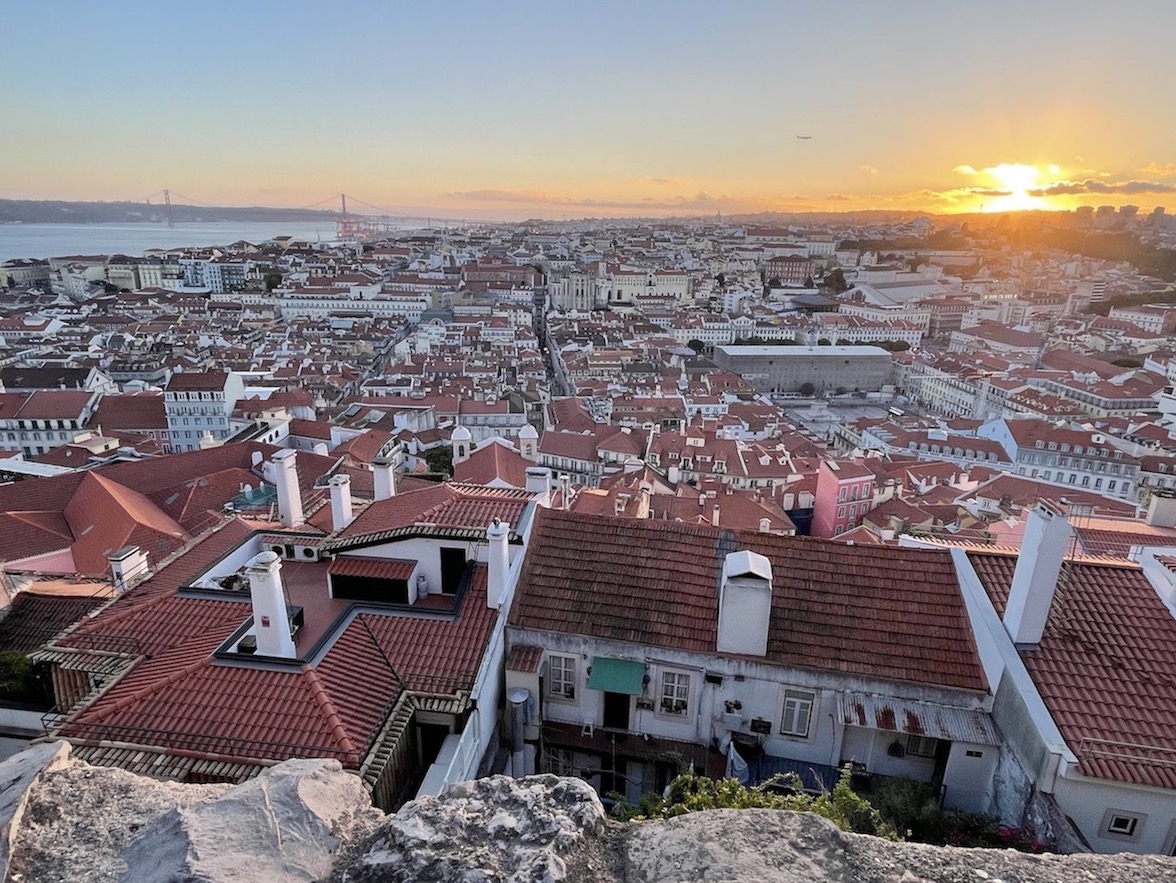
After getting settled, it’s time to choose a late afternoon/evening activity for your first night in Lisbon! I recommend taking in the city skyline by watching the sunset from Castelo de São Jorge, or St George’s Castle. It’s open 7 days a week from 9am-9pm. Obviously the sunset times in Lisbon change seasonally; check the sunset times for your travel month here.
You can buy tickets to visit the castle online in advance or purchase them onsite. Arrive an hour or two before sunset so you can explore the castle grounds and walk the ramparts before the sun goes down. The castle itself is interesting, but it’s truly the terrace and miradouro looking out at the ocean and the entire city that takes your breath away. In my opinion, the Castelo de São Jorge terrace provides the best view in Lisbon, and is a knock-your-socks off introduction for your first night in the city. It really sets the tone for the rest of your stay.


The castle is in the Alfama district of Lisbon, which is full of colorful buildings and quirky street life moments. If you enjoy wandering the streets when you visit a new city, this neighborhood is a great start. Depending on when your flight got in, if you have some extra time before visiting the castle, go for a wander in Alfama and be sure to stop at Pastelaria Alfama Doce for a famous Portuguese pastel de nata pastry! They are open from 8am-7pm (but are closed on Sundays) so you’ll want to stop here prior to the castle instead of after sunset.


While the pastel de nata is the most famous pastry in Portugal, this place also had another tart made with almond and lemon, if memory serves, which I liked even more.
Did you know you can find Portuguese pastéis de nata in all of these cities around the world?
Day 2 Friday: Sintra
There are many day trip options from Lisbon, most famously Cascais and Sintra. I am not a huge beachgoer and don’t really know what to do with myself in beach towns, so this time I skipped Cascais, but you could probably do both in the four day timeframe I’m allotting in this itinerary for Lisbon. If you combine Days 3 and 4, or your flight gets in early on Day 1, then you’ll free up enough time to do more day trips.
It’s best to go on a weekday if you can. Sintra is incredibly busy all the time, and you want to give yourself the best possible chance to cut down on crowds. Mid-week is probably even better than a Friday, so you might spend a Tuesday-Friday in Lisbon instead of visiting for a Thursday-Sunday as I’ve laid out here. However, if your trip covers a weekend in Lisbon you will have more opportunities to visit farmers markets and events.
The colorful city of Sintra is a spectacle, especially Pena Palace, Castle of the Moors, and Quinta da Regaleira. Read my guide for visiting Sintra (hopefully on a better weather day than mine) here:

Visiting Sintra, Portugal in Bad Weather
Day 3 Saturday: Lisbon City Center
Today we really get to dig into the nooks and crannies of Lisbon. The list below includes my top picks, but obviously you may want to mix and match based on your interests. I’m not personally that into art museums, for instance, but there are plenty if that’s your bag. The supposed “World’s Oldest Bookstore” is also located in Lisbon, which seems insane considering it’s only dated back to 1732.
9AM: Pink Street

Rua Nova do Carvalho, now often called Rua Cor de Rosa, is a street in the Cais do Sodre neighborhood in Lisbon. This used to be the Red Light District. Today it’s home to an exciting bar scene and to this popular Instagram spot where the street is painted pink and rainbow umbrellas hang skyward.
Get to Pink Street early in the morning before too many pedestrians flood your photos, but not so early that the trash is still being swept up from the evening before. More information on visiting Pink Street is in this helpful guide.
10AM: Carmo Convent


Carmo Convent is walking distance from Pink Street, so it makes sense to pair these together. It’s open from 10am to 6pm or 7pm seasonally. It’s closed on Sundays. Check current hours and prices here.
You’ll wait in line to buy a €5 ticket and then enter via the ruins of the convent. To understand the city of Lisbon, it’s important to learn about the devastating earthquake of 1755, which changed the landscape forever. It both destroyed culturally significant relics of the past, but also made way for new constructions that we admire today.
One casualty of the earthquake was Carmo Convent. Arches still hover over the grounds, but most of the ceiling collapsed. The ruins are beautiful in a haunting sort of way. Artifacts that survived are on display in the museum, which you enter after passing through the ruins. Also featured in the museum are pieces brought back to Portugal by explorers who traveled to South America, such as the creepy Peruvian mummies in my photo gallery.
12PM: Santa Justa Lift and Rossio Square


When leaving Carmo Convent, with your back to the entrance door, head to the left and around the back of the building. That’s where you’ll find the iconic Santa Justa Lift, an Industrial Age elevator that brings tourists up seven stories from Baixa to Bairro Alto. It was built by Raoul Mesnier de Ponsard in 1902, who was inspired by Gustave Eiffel (of the Eiffel Tower in Paris).
Lisbon is known for its seven hills. It’s a walking city, but asks more effort of its pedestrians than other flatter walking cities. Wear good shoes, and remember that streets can be a bit slippery because of the calçada (small square stones in a mosaic pattern), especially in the rain.
Innovations like the Santa Justa Lift, funiculars, and trams were all designed to help ease the struggle of getting around the hilly city.
Riding the lift didn’t sound worth it to me since the best part is just getting the view from the top, which you can walk to from Carmo Convent. If you decide to take the ride, it costs €5.30 and opens from 7am daily (closing between 9pm-11pm depending on the season).
While looking out over Lisbon from the top of Santa Justa Lift, you’ll notice Rossio Square below. You might be enticed to walk down to the square to check out the beautiful mosaic calçada, statue, and fountain. There are a lot of restaurants surrounding Rossio Square but it’s very crowded, so you’re better off walking at least a few streets over for lunch.
3PM: Panorâmico de Monsanto


If you’re interested in Lisbon street art, you’ll love Panorâmico de Monsanto. According to Atlas Obscura, it “was inaugurated in 1968 in the Monsanto Forest Park. The restaurant was comprised of five floors, complete with a 360-degree panoramic view of the city. It was conceived by Chaves Costa. However, it only existed as a restaurant for two years and is now a municipal viewpoint.”
Like any good abandoned building, local graffiti artists have repurposed it. It’s now a portal into a steampunk Narnia, still providing views over Lisbon but with an edgier backdrop. I don’t want to give too much away in regards to what you’ll see there, but my photo gallery provides a taste.
From Amoreiras Studios, take the 711 bus 3 stops to the Av Tenente Martins stop and walk ten minutes to Panorâmico de Monsanto. During this walk you might be inspired to explore the other walking trails throughout Parque Florestal de Monsanto (Monsanto Forest Park)! Panorâmico de Monsanto is free to enter and open from 9am-6pm or 7pm seasonally.
Day 4 Sunday: Belém
This day is all about Belém. If Day 4 falls on a Monday for you, swap it with Day 3 because almost everything in Belém is closed on Mondays. If it falls on a Sunday, you can attend the Belém Antiques and Crafts Market, which should be the first and third Sunday of each month.
The Belém district to the west of Lisbon pays homage to Portugal’s Age of Discovery (ie, age of world colonization). The main attractions are the Monument of Discoveries (a statue which is free to visit), the Jerónimos Monastery (10am-5pm, closed Mondays), the Tower of Belém (10am-5:30pm, closed Mondays), and of course the Pastéis de Belém patisserie (8am-8pm daily).
You can either take a train, bus, or ride Tram 15 to Belém. None of the transportation options should take longer than 30 minutes. I heard on a podcast to avoid the tram because the ride was slow, crowded, and unscenic compared to the train, but I accidentally ended up taking that option anyway and it was perfectly quick and easy. If your accommodation is located close to the Cais do Sodré Station though, then the 7 minute train ride is obviously your fastest option.
9AM: Padrão dos Descobrimentos and Pastéis de Belém


If you arrive in Belém before the monastery and tower are open, check out the Monument to the Discoveries first and grab a pastry at Pastéis de Belém. The line for the pastry shop can be outrageous later in the day, so this is the best call anyway.
10AM: Jerónimos Monastery


The Jerónimos Monastery beautifully showcases Manueline architecture. This impressive late Gothic style is one of my favorite features of Portugal; I wasn’t knowledgeable about it before my visit and was sufficiently blown away by the intricate details of the facades. If you only have time to visit one site in Belém, choose the monastery.
I neglected to purchase tickets in advance and I wish I had. Even though I was in line before they opened, tons of people were already in front of me and it was a long wait. There are two separate lines, one for tickets (€10) and one for people who pre-purchased. After you buy tickets from the first line, you then go get in the back of the second line and wait again for entry.
When you enter, you’ll wander the corridors and cloister of the monastery. If you’d also like to go inside the church (free entry), check out the mass schedule on their website. It seemed like tourists weren’t really supposed to be wandering in and out of the church once mass had started, regardless of whether you bought a ticket for the monastery.
There is an Archeology Museum attached to the Monastery, but it’s closed for remodeling until 2025.
12PM: Tower of Belém
After the monastery, I waited in line for tickets for the Tower of Belém for a long time, wondering if it was really worth the price. As I stood there Googling “is it worth it to go inside Tower of Belém?”, I overheard someone asking a nearby vendor the same question. He replied no, there’s not much of interest inside. You might as well just take photos of the pretty exterior and save €6. I took his advice and admired the building from the outside. If you do decide to go in to both the monastery and the tower, buy a combination ticket for €12 instead of doing the separate €10 and €6 tickets.
If you buy the Lisboa Card, this includes access to Jerónimos Monastery, Tower of Belém, plus a zillion other museums and use of public transportation, including Carris metro, buses, trams, and cable railways, CP trains between Cais do Sodré and Cascais, and trains between Oriente, Rossio, and Sintra.


When walking to Tower of Belém from the monastery, walk along Praça do Império which turns into Rua Bartolomeu Dias. Here you’ll fine a cool 3D piece by street artist Bordalo II titled “Big Racoon”. He uses found junk to create animal sculptures as a statement about pollution and endangered species. His works are considered “trash art”.
All of these things can be completed rather quickly, and then you’ve still got the rest of the afternoon free. If you’re still enjoying Belém, you might throw in the National Coach Museum, Palácio Nacional da Ajuda, or one of the art museums from this One Day in Belém Guide. Otherwise, it’s a quick tram, train, or bus ride back to Lisbon central, where you can spend your last night in Lisbon having dinner at a fado music joint, hitting the bars in the Bairro Alto neighborhood, or gearing up for your trip to Porto. Personally I would also use this opportunity to hit up the Museu Nacional do Azulejo.
2PM: National Tile Museum
Museu Nacional do Azulejo has tiles dating back to the 15th century and delves further into the history of the ornate decorative motifs which you’ve no doubt become obsessed with by this point in your trip. I love museums that are highly specific to what makes the local culture special, as opposed to generic natural history museums or zoos that you could find anywhere. For a unique perspective on Portuguese history and art, check out Museu Nacional do Azulejo for €5 sometime between 10am-1pm or 2pm-6pm (closed on Mondays).
Day 5 Monday: Vila Nova de Gaia
Say goodbye to beautiful Lisboa, we’re headed to Oporto!

Porto is world famous for the port wine cultivated around the Douro Valley. When the English were fighting with the French in the 17th and 18th centuries and not receiving French wine exports, they looked elsewhere and started importing from their Portuguese allies. To fortify the wine for the long trip to England, the Portuguese added aguardente, similar to a brandy. This stops the fermentation, leaves residual sugar in the wine, and increases the alcohol content. Port might age in wood barrels, or some varieties age in the bottle. My personal favorite is the tawny port, which ages in oak barrels. As you stroll along the docks in Porto, you’ll notice the cool looking rabelo boats still floating along the Douro River. These were originally used to transport the wine.
Public Transportation from Lisbon to Porto
It’s very easy to take public transportation from Lisbon to Porto. I took the Alfa Pendular train from Lisboa – Santa Apolonia station in Lisbon to Vila Nova de Gaia-Devesas station in Porto. This is because I was staying at an AirBnB in the Vila Nova de Gaia area; you might get off at a different stop if you’re staying elsewhere. Buy a train ticket online via CP Comboios de Portugal here. To get to the train station in Lisbon, you’ll use your Via Viagem card to ride the 712 bus from Amoreiras Studios.
Consider your check-out and check-in times for your accommodation when choosing your train time. I couldn’t check into my place in Porto until later in the afternoon and was carrying a massive backpack plus a couple smaller bags, so if I had arrived in Porto too early to check in, I would have been hauling those things around all day while exploring the city. I decided instead to take my time leaving Lisbon and get a noon departure train, which arrived at 2:46pm in Porto. Upon arrival in Porto, there will be taxis waiting outside the train station. I chose to walk to my AirBnB, about a 25 minute walk.
Where to Stay in Porto
I chose an AirBnB listed as “Pretty Studio in typical Gaia/Porto neighborhood” in Vila Nova de Gaia, right off the Douro River. It was less expensive, quieter, and more private than the accommodations on the other side of the river in Porto center, but still a great location and had all the amenities I needed to work remotely. This is an especially great place to stay in Porto as a digital nomad.
If you’re not into AirBnB, check out budget hostels in Porto here or standard hotel options here.
Waterfront Promenade

After finding your apartment and dropping off your bags, walk down to explore the riverfront on your first evening in Porto! Along Avenida de Ramos Pinto there will be vendors set up on the promenade selling clothes, food, and souvenirs while buskers play guitar. They’re situated next to cafes with outdoor terraces where you can sit and soak in the ambiance of lively Vila Nova de Gaia. Keep an eye out for signs offering a port wine tasting menu. The first thing I did was order a selection of five wines for €5 (where I learned that tawny is my favorite variety, and the rosé port probably my least favorite). If you’re up for spending a bit more, book a full wine cellar tour at one of the many locations dotting the docks of Vila Nova de Gaia, such as Cálem, Taylor Fladgate & Yeatman, Sandeman, or Real Companhia Velha.

Throughout Portugal, seafood and especially cod dishes are on the traditional menus. In Porto, the francesinha sandwich is another local…delicacy (see: monstrosity). It features layers upon layers of every manner of meat and cheese, finally covered with beer gravy. This behemoth is not for the weak, and was not really for Anthony Bourdain either.
If you’re looking for something lighter, I found a good vegan restaurant inside the Mercado Beira-Rio called daTerra Baixa. If you haven’t quite satiated your new pastel de nata obsession yet, check out this Guide to Pastel de Nata Cafes in Porto which ranks the options.
Up a side street from the Vila Nova de Gaia promenade you’ll find another street art piece by Bordalo II called “Half Rabbit”.
It’s a bit difficult to find an actual grocery store in this area. The big one near the Mercado is wholesale only (I watched many tourists attempt to enter, only to be turned away). There are lots of smaller shops for essentials, but if you need a large market, the best one I found was at Arrábida shopping mall about a 20 minute walk from the AirBnB. There is also a post office there.
Day 6 Tuesday: Porto City Center
Days 6 and 7 are interchangeable, but sometimes I find it more fun to explore my immediate surroundings before gallivanting off on a day trip.

Everything you’re seeing today will be across the Luís I Bridge on the other side of the Douro River. Most of these are simply pretty things to look at, to be honest. You don’t need to spend money or time to go inside for a tour, except at the Igreha de Santa Clara or Livraria Lello. For that reason, you can do these in pretty much any order that suits you.
I’ve embedded a map where the purple pins are cool street art locations, the blue pins are beautiful examples of azulejos tiles, the yellow are good sunset spots, the dark green are my favorite picks (but go ahead and include the azulejos category alongside that; I love tiles! The Igreja de Santo Ildefonso was the most beautiful, in my opinion), and the red are things I didn’t prioritize myself but that you might find cool if you have extra time. Use this as a general Walking Tour of Porto guideline, but know that as you wander Porto, you’ll likely bump into a lot of these without even trying. Your plan doesn’t need to be concrete; see where your curiosity takes you! If you do prefer more of a set itinerary, you could join a Porto Food and Walking Tour on this side of the river.
To cross the river, you can simply walk down to the promenade from the AirBnB and then over the lower part of the bridge. When you’re returning back to Vila Nova de Gaia in the evening, you could take the higher part of the bridge to mix things up, and even ride the cable car (Teleférico de Gaia) down from there!


This area is so walkable that I didn’t feel the need to figure out the public transportation metro card situation. I took the bus only a couple times, and just paid in cash (never more than €2 for a ride). If you’d like to get a metro card, the options are either the Porto Card or Andante Pass. Read more about these here.
• Igreja de Santa Clara is a church with an extremely ornate golden interior. If you only go inside one church, pick this one. It’s is open 9am-12:30pm and 2-5:30pm; on Tuesday and Saturday they close at 4:30pm. The cost is €4.
• Livraria Lello is open 9am to 7pm daily and will have an extremely long, slow line. I took one look at it and said “nope”. It does look beautiful from the pictures, though, and if you’re a big Harry Potter fan, you can’t miss this spot that inspired JK Rowling. Read up on the ticketing rules for visiting the bookstore here.
• You will use São Bento Station for your trip to Braga if you follow my itinerary, so there’s no need to make a separate trip here.
Day 7 Wednesday: Braga
While I was really keen on trying to make it to Peneda-Gerês National Park as a day trip from Porto, the logistics are such that you should really try to spend at least a couple days there, and it would be better to have your own car so you can reach some of the coolest trailheads for hiking. It can be done as a day trip on public transportation, but not well. It’s probably better to pay for a guided day trip to Peneda-Gerês. Other interesting day trip ideas from Porto include the towns of Guimaraes or Aveiro, or doing a guided Douro Valley wine-tasting trip, but I ultimately bent to the hype and went with Braga, Portugal’s third-largest city.
Getting to Braga from Porto is easy on public transportation. You’ll head to São Bento Station and buy a ticket for a train operated by Comboios de Portugal. It’s €3.25 one-way and the ride takes about an hour.
Braga is best known for The Sanctuary of Bom Jesus do Monte, a shrine that watches over the city from the top of a hill. It’s a pilgrimage site with 577 steps to the top, which people supposedly once climbed on their knees. Today you can still climb the steps, or you can take a funicular to reach the church at the top. The funicular runs every day from 9am-7pm or 8pm seasonally and costs €1.50 one-way or €2.50 roundtrip. Remember to also factor in taking bus number 2 from Braga city central to the foot of the Sanctuary, which shouldn’t cost more than €2.


Once at the top, there’s not much to do, honestly. The church is beautiful and the view is nice, but if you’re not religious or hungry to eat a snack at the cafe, you’ll likely return back down soon after arriving. It’s also pretty crowded.

I had more fun wandering the town of Braga, where you’ll find the beautifully tiled Raio Palace (it’s not worth the price of going inside though), Castelo de Braga, and Braga Cathedral. My favorite part of the day was trying pudim abade de priscos at a local restaurant!
Abbot of Priscos pudding is a rich crème caramel Portuguese dessert created in the 19th century by Father Manuel Joaquim Machado Rebelo, the Abbot of Priscos. It’s unique in that it contains bacon, tawny Port, and fifteen egg yolks. It’s made into a bundt shape, but to save you the fat content they’ll only bring a small slice. This thing was absolutely delicious and I wish I could find it at home! The restaurant where I ordered it was called Cozinha da Sé.
When you’re ready, hop back on the same train line returning to São Bento station in Porto and then take a bus or walk to your accommodation. The trains are frequent, so if you miss one it shouldn’t be the end of the world to wait for the next.
One week is the perfect length of time for a first-timer’s visit to Lisbon and Porto. While locals no doubt attest that you could explore these cities endlessly, a weeklong itinerary will accomplish visiting the main attractions, some day trips, and maybe even discovering a few unexpected detours of your own. Then if you decide to visit Portugal again one day, you’ll have a base to jump off from and can dig even deeper.
If you use my one week itinerary for Lisbon and Porto, I’d love to hear how it goes! Which city was your favorite of the two? Did you visit any other towns outside of the main tourist track?
Pin It:


My dream is to write travel and hiking content full-time. All of my guides and itineraries are free and my travels are self-funded. If you enjoy my site and would like to support, you can donate any amount to my Ko-fi page. Thank you!!