
The Most Beautiful (and Skippable) Stages of the Tour Du Mont Blanc
Purchases made through some links on this page may provide The Detour Effect with commissions (at no extra cost to you). Thank you!
We all hope to complete a long trek like the Tour du Mont Blanc mile-for-mile, but life happens. You may decide it’s best to skip a section of the hike due to dangerous weather conditions or a nagging injury. You may intend to do every stage as planned, but find yourself worrying that you’re missing out due to a foggy, viewless forecast. When taking real-time obstacles into account and considering your plan of action, it’s helpful to know which stages of the Tour du Mont Blanc are the most scenic and which stages are a bit more…skippable.
For Reference: My Tour du Mont Blanc Itinerary
Last week I finally completed my circuit of the Mont Blanc massif through the French, Italian, and Swiss Alps. Back in 2019 when I aimed to complete five long-distance solo treks back-to-back, my Tour du Mont Blanc attempt was foiled by the Planpincieux glacier scare. I was determined to come back and finish it the next year, but then COVID happened. Now in 2022, I’m grateful to be able to finish what I started.
I completed 100 miles in 10 days going anti-clockwise, starting from Les Houches. I camped most nights and carried a large backpack full of camping gear, but also stayed at two refuges (Bonatti and Elisabetta) and one hotel (Hotel Ottoz in Courmayeur; two hotels if you count the final night after I was done hiking back in Chamonix). I am now officially qualified to offer my opinion on which stages have the best views on the Tour du Mont Blanc, as well as the sections that were my least favorite.
💸 Read my cost comparison of how much you’ll spend on a self-guided Tour du Mont Blanc hike via tent camping vs. booking hotels, hotels, or refuges.
There are many alternative variations you can choose to take on the TMB. I didn’t plan all my navigational choices out in advance. When I was in the midst of my hike, sometimes I would consult my guidebook, other hikers, or Google for opinions on the best course of action for the following day, especially if it looked like we might have bad weather or if I was hoping to avoid piling stress onto my temperamental knees. I hope this article will be an asset to other hikers approaching their TMB in the same manner.
In comparison to other long hikes, I think it’s very important to have a bit of flexibility on the Tour du Mont Blanc. The alpine weather can change on a dime and the forecasts are not always correct. It’s also essential to be kind to your body in light of the repeated and sometimes grueling ascents and descents so you don’t burn out too quickly. On the TMB, almost every day you will go up, up, up over a mountain pass, and then down, down, down back into a valley. By Day 9 I was losing some of my enthusiasm for this pattern.
For reference, my Tour du Mont Blanc itinerary looked like this:
Day 1: Les Houches to Les Contamines (camping at Le Pontet)
Day 2: Les Contamines to Les Chapieux (camping for free in the field)
Day 3: Les Chapieux to Refugio Elisabetta
Day 4: Refugio Elisabetta to Courmayeur (Hotel Ottoz)
Day 5: Courmayeur to Refugio Bonatti
Day 6: Refugio Bonatti to La Fouly (camping at Camping des Glaciers)
Day 7: La Fouly to Champex (camping at Camping Les Rocailles)
Day 8: Champex to Col de la Forclaz/Trient (camping at Hotel de la Forclaz)
Day 9: Trient to Tré-le-Champ (camping at Auberge La Boerne)
Day 10: Tré-le-Champ to Chamonix (Hotel La Chaumière Mountain Lodge)
*If you don’t have time to complete the entire 10-day trek but still want to see some of the best views of the Tour du Mont Blanc, check out my article for France Today about day hikes you can reach along the TMB via public transportation.
The Most Beautiful Stages on the Tour du Mont Blanc
You’ll notice a pattern in my selected favorites; I really enjoyed the Cols, or mountain passes, and generally any high points along the trail.
The first half of Day 4 (Refugio Elisabetta to Courmayeur)


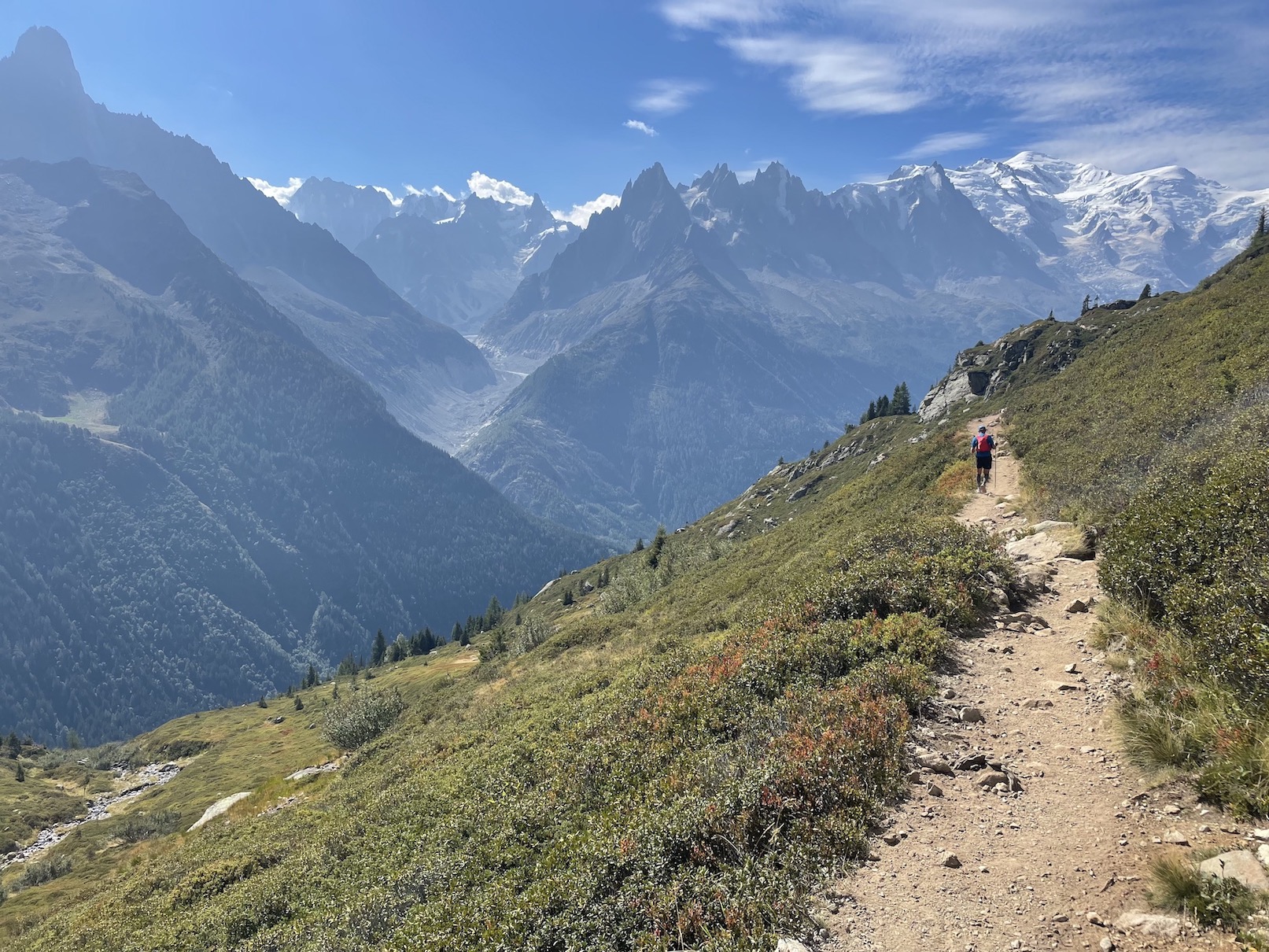
Upon descending to the valley from Refugio Elisabetta, you’ll have a flat, relaxing road walk, which is a surprisingly peaceful start to a day on the TMB. Then you’ll start climbing up towards Mont Favre, the high point of the day. The sweeping panoramic views will change with each step, giving you a million opportunities to stop and take photos from different perspectives. Towards the east the rolling green hills nourish sheep and cows. A shepherd who lives on the hillside during the summer will come out to greet you and chat about the ibex and wolves he’s seen this year. Towards the west, the dramatic Mont Blanc massif is unrelenting in its stark and imposing beauty. You’ll behold Mont Blanc itself, supported by surrounding peaks which shelve glaciers and expel waterfalls from the melt. All of this combines to make the first half of Day 4 one of the best stages of the Tour du Mont Blanc.
There is one section of downhill switchbacks with loose rock where you’ll want to be careful with your steps, but at a certain point you are not really going up or down much anymore, just traversing mountainside meadows and enjoying your surroundings. I was impressed all the way until we reached a forested area where it’s time to descend towards Maison Vieille. From here you’ll meet with a lot of day hikers and the landscape becomes less and less wild. Once at Maison Vieille, you have the option to take a chairlift down into Courmayeur, which is what I advise below under “Least Rewarding Stages”.
Day 3 Col de la Seigne

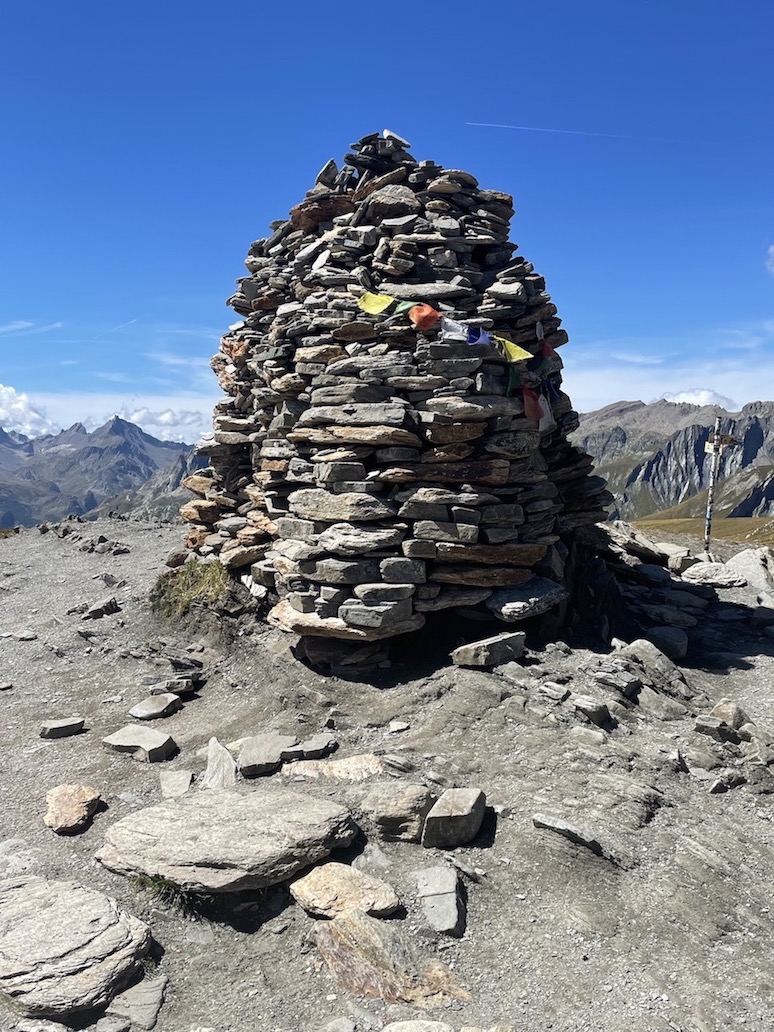


The journey to Col de la Seigne is long and arduous, but stunning and worth the effort. You might be leaving from the Col des Fours variation the previous day, which means you’re starting around Refuge des Mottets. If you’re starting from Les Chapieux like me, there is a long, straight walk from there to Mottets first (as a side note, please take the actual TMB for this section. It’s a lovely grasslands walk. I don’t understand why I was the only one who followed the TMB sign to get off the road while everyone else walked on the highway from Chapieux to Mottets, how boring!).
From Mottets you begin a series of endless switchbacks up into the mountains. It blurs together, but there are a few distinct places where you finally leave one series of switchbacks, walk a flatter section that will bring you around a bend to a different mountain view than you had before, and onto….another series of switchbacks. Rinse repeat. I liked that new views were provided with each new cluster of switchbacks, slowly winding you further into the fold of the mountain range. Just don’t get too excited when it appears that your current set is ending; most likely, you have not yet reached the Col. There is one particularly cruel cairn of rocks about 15 minutes prior to the actual Col that I was working towards for a long time, believing it to be the end. At least it wasn’t too far off!
The vistas throughout the ascent are so elegant that eventually I stopped minding how hard my lungs and legs were working and simply surrendered to the process. I would not conquer the mountains, only witness them. I would not fly through them effortlessly, but take many breaks. Perhaps this is the stage that set a much-needed tone of reverence for the rest of my Tour du Mont Blanc.
Reaching the Col is a moment for the scrapbooks because you are officially crossing from France into Italy. It really struck me how immediately the language changes; it wasn’t five seconds after crossing the Col that everyone on the other side was suddenly speaking Italian instead of French. It’s also at this point that you see Mont Blanc for the first time (unless you’d done an alternate variation previously), and the view into Italy is picturesque. At Col Ferret a few days later, the view into Switzerland is not especially jaw-dropping (that day has other things to offer). At Col de la Seigne the view into Italy does give you a nice pat on the back.
I included some pictures of Refugio Elisabetta in the gallery as well. The descent from Col de la Seigne to Elisabetta wasn’t much to write home about, but the glaciers around the refugio itself were pretty special.
Day 6 Col Ferret

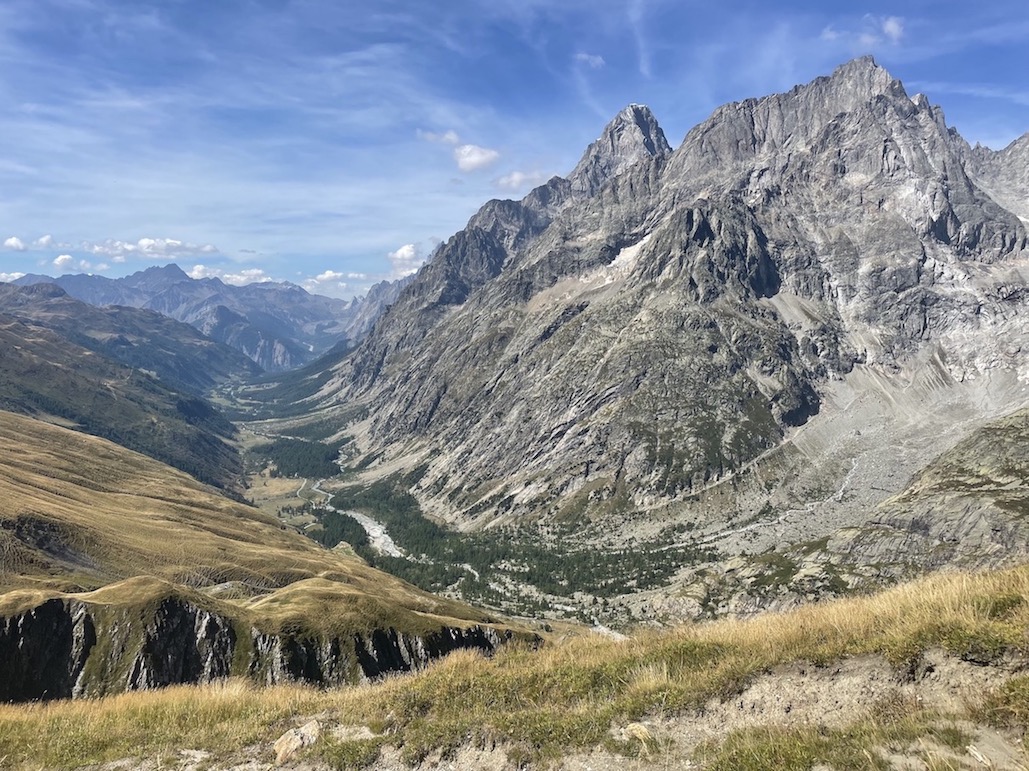


To begin Day 6 there is a long descent away from Refugio Bonatti leading to Refuge Elena. After Elena, the fun begins. It’s time to ascend up to Grand Col Ferret. At first the views are mainly back towards the way you came and not particularly exciting, but as you continue uphill you’ll become immersed in the rolling hills of your more immediate vicinity, which I loved. Each one forms a new layer in front of the last, like a collage. I felt enveloped by the land, less of an observer and more a part of it.
By this point I was used to the ascents, so my memory of the journey to this Col is that it wasn’t any more difficult, neither physically nor psychologically, than those of the previous days. I’m sure I was breathing hard and taking breaks, but in retrospect nothing particularly strenuous sticks out to me. It’s just a good challenging day without any hiccups, with some of the best views on the Tour du Mont Blanc. When you finally reach Col Ferret, it feels hard earned. Swaths of hikers and runners rest at the pass to gear up for the descent down the other side into Switzerland. Like at Col de la Seigne, knowing that you’re standing on the border between two countries adds an extra layer of accomplishment and novelty to the pass. Hikers greet each other with “Welcome to Switzerland!” or “Bienvenue en Suisse!”.
Note that the ascent to this Col from Elena is all completely exposed to sunshine with no shade, and it gets very hot (at least when I was there in August). Everyone I spoke to commented on it. I suppose my hikes in the desert southwest of the United States had prepared me well because I didn’t feel particularly stressed about the heat, but it was still noticeable. It’s a good idea to start hiking early on this day to get some mileage under your belt before noon.
Day 2 Col du Bonhomme


The stage from Les Contamines to Les Chapieux I completed both in 2019 and 2022. In 2022 it was rainy and misty all day and I couldn’t see farther than my own two feet, so I am really glad I remember what Col du Bonhomme was like when it’s clear. The gallery above is 2019 and mainly features the world class views seen directly from Col du Bonhomme. The gallery below is 2022 and features surrounding areas (I didn’t take too many photos in 2022 until the fog finally started to clear. If I had attempted to recreate the photos from 2019 it would have just been a wall of fog). In good weather, you can see out over vast expanses of mountains on both sides of the pass and take in some of the best views on the Tour du Mont Blanc. Arriving at the Col is already a feat, but then to see a whole new world awaiting you on the other side is quite the reward. Then you have new views again once you reach Col de la Croix du Bonhomme.


Something about the little wooden hut at the Col really adds some character to this pass. It’s a keeper of memories. In 2019, when I arrived at the hut it was only me and one Frenchman who shared his hot coffee with me as we attempted to communicate in broken Franglais. It served as a perfect vantage point and a gathering place for like minds. In 2022 it was freezing at the pass, so the hut was able to serve its intended use as a refuge from the elements. I piled inside amongst other shivering hikers as we pulled jackets out of our backpacks, discussed the best route to take from there, and pondered whether the haze would lift. The hut at Col du Bonhomme is my horcrux.

Travel Fails: When Weather Obscures Famous Viewpoints
Day 10 Tré-le-Champ to La Flégère


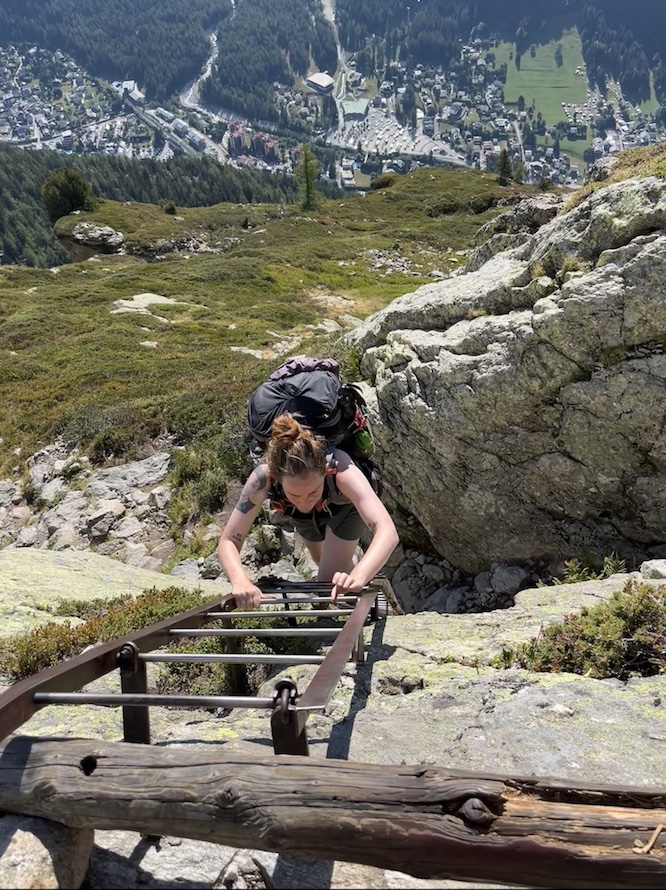


I was a bit nervous about the ladder section because a large pack tends to shift your gravity, and because for 9 days prior, every time I checked the weather forecast it said we were expecting rain for this day. Thankfully it cleared up completely and was gorgeous outside, so I decided to go for it with the ladders instead of taking a variant. In practice I found the ladders to be fun and exciting, and completing them gave me a sense of triumph.
The views throughout this entire section, especially after Tête aux Vents, rivaled everything from the rest of the trip and make Day 10 one of the best stages of the Tour du Mont Blanc. It felt like a reward for all my hard work and a welcome back to the Chamonix valley. The word “aiguilles” will pop up often during the Tour du Mont Blanc, as it’s the moniker of different mountains or sections of mountain ranges – Aiguilles Rouges, Aiguillette des Posettes, Aiguille des Glaciers. “Aiguilles” means “needles” or “spires”, which makes sense when you see the peaks this name describes. They have sharp, jutting angles that look quite forbidding. As you leave Tête aux Vents and head towards La Flégère, these climactic formations tower before you and remind you the true scale of the Alps.
I would have liked some extra time at the end to check out more viewpoints. From La Flégère I took the cable car down into Les Praz and then the train to my hotel in Chamonix. To truly complete the circuit, I would have needed to continue hiking past La Flégère towards Le Brévent and down into Les Houches. Initially this was my plan, but it would have been an extremely long day (and another knee-grinding downhill) and I needed to clock in for a work meeting back at my hotel at 5pm. Le Brévent is supposed to be beautiful though, and there is another cable car opportunity there. Another stunning option from Tête aux Vents is to take a variant up to Lac Blanc. With enough time I would have done both. I am not too disappointed though because on my final day, I was both tired and pleased with everything I had accomplished, and adding more on would have felt like I was just ticking boxes. I’m not sure my heart would have been in it, but if I were to return to the area again, I would visit these locations as day hikes.
If you’re worried about burning out towards the end, I might recommend beginning somewhere other than Les Houches so that this final stage near La Flégère and Le Brévent is in the beginning or middle of your trip where you can fully appreciate it. I did meet many hikers who started somewhere other than the “classic” start point, including someone who began in Trient and someone who began in Courmayeur.
The Least Rewarding Stages on the Tour du Mont Blanc
If you’re a purist like me, the idea of skipping a stage of the Tour du Mont Blanc is initially unthinkable. Perhaps it’s an American thru-hiker mentality; you must walk every single mile! No zero days! If you have a healthier mentality, you balance this ambition by reminding yourself that a backpacking trip is supposed to be fun and awe-inspiring. We are not paid athletes competing under a set of rules. If there is a section that’s widely known for not being scenic while also being treacherous or physically brutal, there is no shame in deciding to bypass it to save your energy for the other more rewarding sections to come. This is especially true if you’re already nursing an injury or feeling like you need a bit of a break; if you have to skip something, clearly you’d want to pick a less exciting section to skip, if you can. The following sections of the Tour du Mont Blanc were my least favorite and I personally feel that you wouldn’t be missing much if you needed to skip them.
The second half of Day 4 (Refugio Elisabetta to Courmayeur)

This is a stage of extremes. While the first half of the day was one of my favorite sections of the entire Tour du Mont Blanc, everything past Maison Vieille was reported to be brutal, and, quite frankly, ugly. I read online that it was other hikers’ least favorite part of the trail because it’s nothing but steep and relentless downhill through a scarred and manmade ski lift area. People advised that it would be a good idea to “save your knees” by taking the chairlift past this section and straight down into Courmayeur. Remembering how painful my knee problems can get when I don’t have enough respect for sections like this, I decided to take the chairlift down.
I felt guilty and like I’d copped out, but over the next few days it became apparent that I’d made the right decision. One hiker bloodied her knee by taking a fall during this section. Another hiker said she must have overextended muscles or tendons in her knees because she proceeded to be plagued by knee problems for the entire rest of the trail. Knowing my own past issues with steep downhills, I have no doubt I would have experienced something similar.
Day 8 Champex to Forclaz/Trient


My guidebook made Day 7 to Champex sound like it might be boring; it said the day was mostly through a flat meadow. In actuality it has much more variation than expected. You’ll follow along a riverbed, go through cute Swiss alpine villages, and climb up through a forested area before arriving at the peaceful lakeside village of Champex. Instead, it was the next day from Champex to Forclaz that I found to be lacking in points of interest.
This day is mostly under the cover of forest and it is extremely humid and buggy. I did enjoy the views from Alp Bovine, but likely because of the cows, this section is filled with flies that would not leave me alone for even a moment. Views elsewhere along this stage are not particularly breathtaking. Through the trees you will have some glimpses of mountains, but they do not come close to rivaling the striking vistas found throughout the rest of the trek. I rushed very quickly through this stage to be able to make camp before some expected rain, and I don’t feel bad about it.
I really liked camping at Hotel de la Forclaz, which has a backdrop of glaciers, although my fondness for it may be circumstantial. I’d made some friends by this point in the trek that I enjoyed camping with at the end of the day. We cheered for UTMB CCC runners as they passed through town and then ordered Swiss fondu at the hotel restaurant. One member of our roving gang of gypsies took a train and two buses (or was it two trains and a bus?) to join us here from Champex because she wasn’t feeling well enough to hike that day, and I think she got the best out of the day by doing this. She didn’t miss much by skipping the hike, but got to partake in the evening festivities.
If you walk a bit further past Forclaz and towards Trient you can camp for a cheaper rate at Le Peuty, which supposedly has less amenities. This was my original plan and would have saved me the fondu money too, but honestly the fondu was the best part of Day 8. Camping at Le Peuty might have made the whole day a wash (though of course I might have made new friends at that campsite and had an entirely different fun experience, who knows?). If you do camp at Le Peuty you will have a bit of a jump on Day 9. From Forclaz you ramp up to the day by hiking along a flat bit and then downhill to arrive at Le Peuty. From Le Peuty the trail immediately starts going upwards towards Col du Balme.
Day 6 Variant to La Fouly

I obviously can’t speak to every single variant opportunity, but this one seems like a popular choice. On Day 6 from Refugio Bonatti to La Fouly, I mostly did the main route for the entire day, right up until the last moment. Once you reach La Peule, you now have two options. You could take the farm road the rest of the way to La Fouly, which is straightforward, if a little boring. I hate road walking, so I opted for the “high route” variation. This variation is supposed to give you prettier scenic views of the mountains.
I actually have an old version of the Cicerone guidebook from 2015 which describes the variant as being the new recommended “main route” while the farm road is the old route. A friend has a newer version of the book which has flip-flopped back to calling the farm road the “main route”. Now I understand why.
The variant has a couple sections that are washed out, perhaps from some kind of landslide or rock fall. It made the trail very skinny, slippery, and full of loose rocks, right next to a cliffside drop. This kind of thing makes me nervous, especially with my large pack. I had be be extra careful where I chose to put my feet, and a few times I crouched down so I could scoot and get my hands on the rocks to steady myself better. I got that feeling in my chest where my breath seizes up from fear of falling. Looking back it really wasn’t that bad, but in the middle of it I was worrying that this might be a sign of worse things to come. I knew there was supposed to be a long, sharp descent towards the end of the variant that brings you right down into La Fouly; if that part was going to be on a cliff edge too, I knew I wouldn’t like it. Thankfully that downhill was not treacherous at all, so really it’s just 3 or 4 brief points earlier on the trail that you have to get past and then it’s smooth sailing.
The views of the mountains on the variant were indeed beautiful, but I’m not sure they were enough to make the dicey trail worth it. The campsite already has great views of these same mountains. If you’re looking for excitement you will probably enjoy this variant, but if you have any hesitancy about exposure then it’s not ideal.
>> Note on Route Variations
What I learned throughout the Tour du Mont Blanc, and heard reinforced by other hikers who took various alternative routes, is that as long as you stick to what’s described as the “main route”, you’re fine. It’s really not a technical trail at all (except for the ladder section on Day 10) and there are rarely any spots that should make you nervous about exposed edges. As soon as you choose a variant, though, all bets are off. It might be just as simple as the main route, but it might not, and guidebooks don’t do a great job of explaining the obstacles you could encounter on these sections (likely because alternate routes are not often maintained and conditions are always in flux).
Another friend did a variant on Day 6 as well, but much earlier in the trail. I believe it was an alternate trail option starting from Col Ferret. The further they got into it, the less defined the trail became, until they couldn’t even spot it anymore. They became disoriented and needed to consult the map often to find their way back.
That said, it does sound like some variants are worth it. Other hikers mentioned how glad they were to have taken the variant from Col de la Croix du Bonhomme to Col des Fours instead of descending down to Les Chapieux. One person said their favorite part of the entire hike was a variant on Day 1 from Les Houches to Les Contamines which avoided the boring uphill the trek starts with. Speaking of…
Day 1 Les Houches to Les Contamines

I’ve now done this section twice, god bless me. In 2019 I did it in sunshine and in 2022 I did it in pouring rain. Both times it wasn’t particularly scenic. A lot of it is under forest cover and you haven’t entered a wilderness area yet; you are crossing through villages and road walking a lot. However, it is a great ramp-up and introduction to the Tour du Mont Blanc and for that reason I think it’s important to actually hike the entire thing and not take the chairlift up to Col de Voza. It’s the first taste of what’s to come in terms of a relentless ascent up to a Col to start each day on the TMB. At least for me personally, it was important to get my ass kicked on Day 1. I needed this kind of welcome to get my head in the game. If you are really just looking to see only the best possible views on the TMB route though, or you’ve had some kind of travel issue pop up and delay your start, you could skip this entire day and not miss much.
Another hiker said Day 1 was their favorite because they took some kind of variant that was more beautiful. This must be the route to Col de Tricot and Refuge de Miage (which is not advised in bad weather, according to my guidebook).
The Stage I Regret Missing


Besides taking the cable car from Maison Vieille to Courmayeur, the only other time I felt like I copped out was on Day 9. From the start of my TMB, the weather forecast had always predicted that the last 3 days would be rainy. As a result I had it in my head that I would do the easier variant on Day 9 down from Col du Balme to Le Tour instead of taking the main route from Col du Balme to Aiguillette des Posettes.
When Day 9 rolled around, it was actually perfect weather and I could have changed my plan and done the main route. Unfortunately I was feeling extra tired during the ascent to the Col that day, and I think I didn’t eat enough breakfast to fuel me. I had also read on someone else’s blog that Aiguillette des Posettes isn’t a good idea for anyone who gets scared on exposed cliff drops, and I still remembered being nervous a few days prior on the variant to La Fouly. It just wasn’t in me that day, so I proceeded via the Le Tour variation, which was nice at first but mostly rather boring. My friends who did the main route said it was spectacular and had some of the best views of the whole hike. When I asked if it was a narrow trail with sharp drops on both sides, they said not really, there was plenty of space and they didn’t feel nervous. Figures.
On the one hand I really wish I had gone the normal route that day, but on the other hand I do think it’s important to listen to your body. If I had pushed it and worn myself out on Day 9, perhaps I would have been too rundown to enjoy Day 10. Maybe I would have skipped the ladders or made some other regrettable choice.
From my conversations with other hikers, the Aiguillette des Posettes section of Day 9 should probably be listed under Best Stages of the Tour du Mont Blanc.
Tips for Hiking the Tour du Mont Blanc


There are a thousand resources online for how to plan your Tour du Mont Blanc itinerary, whether you prefer staying at refuges, hotels, or camping. My aim is not to beat a dead horse by repeating these tips, but to offer a few items that occurred to me on the trail that I hadn’t previously read anywhere.
👕 Bring your own laundry clips. Some of the refuges and campsites had lines up to hang wet clothes, but limited clips.
🚿 When you stay at a refuge, you are given a coin that you must insert into a machine to start the hot water for your shower. It gives you four minutes of hot water, after which time the water either goes freezing or just turns off. Take this very seriously and strategize your shower, lol. Multiple people were taken by surprise at how short 4 minutes really is, or the fact that instead of gradually fading out as a sort of warning, it just suddenly goes freezing. Don’t get stuck mid-shower still covered in soap.
🗺️ The GAIA map I downloaded for offline use is mostly wrong. It’s got the general direction correct, but includes a lot more road walking than is necessary. It didn’t really matter because the real TMB path was always on the topographical map for reference, it just wasn’t being featured as the highlighted route. The signs were also pretty easy to follow (although a few parts are unclear; I wouldn’t say the TMB is the most well-signposted trail I’ve ever done, but it was very adequate). If this makes you nervous, maybe download your gpx files from another source like AllTrails or better yet, The Hiking Club.
🍳 Breakfasts are not a big focus along the TMB in comparison to dinners. I remember at Refugio Elisabetta, they fed us well at night but breakfast was a few slices of toast. That’s really not enough to fuel a hiking day. Meanwhile the big dinners are enough to plague you with regurgitation when you lie down to sleep an hour later. If you go Half Board at refuges, you might want to supplement with your own food for breakfast. That said, Refugio Bonatti did do a larger continental style buffet breakfast, and that’s also where I had the best dinner during my Tour du Mont Blanc.
🥧 Get the apricot and almond tarte at Refuge du Col de Balme.
🥖 I stressed about not being able to find food between certain stages, particularly because I’d read that Champex was the last place to stock up. This really isn’t a concern. There were shops or cafes at every single stage. It would only be a concern if: 1) you have plans to camp every night, even the nights when most people are at refuges, because in order to do so, you are forced to go further afield from the main trail to find places where you’re allowed to pitch; 2) you are hiking the Tour du Mont Blanc off-season when shops are closed; 3) you are hiking very early in the day before some shops open (I couldn’t order food at Alp Bovine because I hiked past it at 9am); 4) you have something against ordering hot meals and only want to buy groceries. Which leads me to the next point.
💸 Being a stickler about money is sort of futile on the Tour du Mont Blanc. I thought I would only buy groceries and dehydrated camp meals to save money, but these things were not less expensive than just getting a nice meal, and they add extra logistical headaches. I thought I would only use the cheapest possible campsites, but paying an extra measly CHF 10 for a campsite that has power outlets and food sounds like a no brainer after a long few days.
🚌 You are never far from transportation. This is both a bummer and a relief. When hiking I like to feel like I am really out there in the wilderness, and the Tour du Mont Blanc does not fit that bill. However, it provides peace of mind to know that you always have options. At one point I was worried about not being able to find an ATM as I started to run out of physical Euros. I was camping at Auberge La Boerne and there is no ATM in Tré-le-Champ, but it turns out there is one in nearby Argentière. Argentière is farther than you want to walk, but you can hop on the train at the Montroc stop and ride one stop over to Argentière for all kinds of amenities. Some friends I’d made on the trail even rode all the way back to Chamonix to watch the first UTMB marathon runners finish, then hopped back on the train and returned to La Boerne. It sort of takes away some of the symbolism of waiting until the last day to make it back to Chamonix, but c’est la vie. If we wanted a true thru-hike we’d be on the Appalachian Trail. Hike your own hike.
🔌 You will have opportunities to shower and charge your phone at every stage. This really surprised me and strikes me as a little ridiculous; who showers every day on a camping trip? All the campsites I used had nice shower facilities too, they weren’t nasty. Hot water is not always guaranteed, but surprisingly, the hot water situation is generally better at campsites than at refuges. Note that I said, “all the campsites I used“; I can’t speak to the ones I didn’t stay at. I hear Le Peuty campsite in Trient doesn’t have many outlets or amenities.
🏃 Check race schedules! I’m clueless enough to have not known the UTMB ultra marathon race was happening during my hike. I hiked from August 18-28th. The main UTMB event started on August 26th, but other events like the CCC started earlier in the week. When I learned about it I was worried I’d become extremely annoyed at sharing the trail with the runners, but it ended up being fun. You may not feel the same way, though.
🏠 Even if you think a refuge is sold out, go ahead and walk in as you pass by and ask if they happen to have any last minute openings. I know a few people who planned to stay at Elena or camp because Bonatti was supposedly full, but managed to get into Bonatti at the last second without advance reservations.
*Don’t feel comfortable solo hiking the Tour du Mont Blanc, or prefer someone to take care of the logistics for you? Wildland Trekking offers a guided hike of the TMB.
Recommended Gear



If you’ve hiked the Tour du Mont Blanc, how does your experience compare to mine? What do you think are the best stages of the Tour du Mont Blanc? I’d love to hear what your favorite sections were, and even commiserate with you about your least favorite. If you got to tackle it again, what variations would you make next time?
🏨 Search budget hostels near Chamonix or standard hotel options near Chamonix.
🧳 If your hotel/hostel in Chamonix or Les Houches won’t store your extra luggage while you’re gone on your hike, try the Bounce luggage storage service which has locations in Chamonix and Geneva.
✈️ Coming to France from further afield? Use an Airalo eSIM for affordable international cell data and don’t forget to protect your investment with travel insurance.
Pin It:

Related:




My dream is to write travel and hiking content full-time. All of my guides and itineraries are free and my travels are self-funded. If you enjoy my site and would like to support, you can donate any amount to my Ko-fi page. Thank you!!
thank you for such great information. I am a regular visitor to northern Italy and will be planning to hike some of the TMB from Chamonix, and Courmayeur next year. I will continue to read and just love how you covered the sections that were not that interesting.
Thanks for reading Debra, I’m jealous of your upcoming trip! Awesome, this trail is really conducive to basing in one or two villages and doing day hikes or overnights out from there. Good public transit options near some of the stages. I hope my post will help you pick and choose which to prioritize!
Great info! I am hatching a plan with 5 friends to go early next Sept, booking flights/lodging now. We are doing self guided, but looking for someone to do luggage transfers for us, trail running/lightest packs possible :).
Do you recommend a specific company? Thanks-Barbara
Nice blog, thanks. I did this a few years ago. Did you do the Fenetre d’Arpette? Perhaps your blog should mention this variant for readers who are planning. It was tough but one of the most memorable aspects of my TMB. Happy Travels.
I didn’t, this post is more about the classic route. I’d love to go back and try all the different variants, I hear Fenetre d’Arpette is a real jaw-dropper!
What a fabulous blog! So happy I found you!
Could you clarify some advice for hiking the TMB in early to mid June?
1. We want to avoid any stages that have snow/ice, needing crampons for shoes/dangerous drops etc. I can’t seem to find a definitive list about which stages those are.
2. Also, will the public transport options be running at that time? I have seen conflicting info about that. Which stages will/won’t have public transport available at that time?
3. Lastly, if we want to camp, do we need reservations at campgrounds and where do we find a listing for campgrounds at each stage? Thank you again!
Thanks for reading! If snow or ice is lingering anywhere, it would be at the Cols, or high mountain passes each day. I suppose which Cols can vary quite a bit based on what kind of winter they had, and the weather patterns are even different from one mountain to the next despite their proximity. The only place I consistently saw snow even late into the summer was at Col du Bonhomme, although never widespread enough that I had to step in it. But I’ve never hiked it as early as June and I think the microspikes are a good idea. I would recommend checking the regular updates at thehiking.club, every year they post trail conditions in the early season to let people know how snowy it’s looking and which areas are passable.
Some of the campgrounds don’t allow advanced reservations (Camping Les Rocailles, Le Peuty, the field at Chapieux, Les Arolles), so you just show up and pay when you get there. I was a little nervous about the first-come first-served aspect of this, but in my experience they were never crowded enough to worry about missing out so it was fine. A couple of them do allow reservations, so I took advantage of that just to be on the safe side, but it probably wasn’t necessary.
I referenced these posts for campground info:
https://tmbtent.com/guide-camping-tour-mont-blanc/
https://slingadventures.com/destinations/france/camping-the-tour-du-mont-blanc-tmb
https://www.nomadswithapurpose.com/tour-du-mont-blanc-camping/
https://www.finnsaway.com/hiking-and-camping-tour-du-mont-blanc/
And this is a good one for public transport: https://tourdumontblanchike.com/tour-du-mont-blanc-public-transport/
This is a wonderful blog! I love the details, sincerity and advice. Thank you.
My adult daughter and I are looking to do this summer of 2024, self-guided. I’m thinking Tre-le-Champ anti-clockwise to La Fouly is the best of the best. Do you agree? But how to get back to Chamonix from there?!
Thanks so much Mei-Mei! You guys are in for a treat, it’s a gorgeous route and a great choice for self-guided hikers. Starting in Tre-le-Champ sounds like a good way to enjoy multiple detours like Lac Blanc while you’re still fresh! If you go anti-clockwise straight from Tre-le-Champ to Tête aux Vents you’ll miss out on Aiguillette des Posettes, you might think about briefly backtracking clockwise from Tre-le-Champ first to see Posettes. That’s the one I skipped and wished I hadn’t. That said, the view from Tête aux Vents may be very similar to the view from Posettes since they are so close to each other, I’m not sure.
I agree that if you end in La Fouly you won’t miss too much by not seeing Champex or Trient. Transportation to/from La Fouly does look sparse though. Apparently there is a bus from La Fouly to Orsières, and then from Orsières you can go a few different ways. It may be more expedient to hire a shuttle service.
As always, this is so thorough and helpful! Thank you for sharing your tips. I’m with you on splurging for the “nicer” campsites and prepared meals. Well worth it from time to time after a long day. Congrats on finishing this after having to cut your trip short pre-Covid!
Thanks Susan! It had been nagging at me since 2019 lol. Yeah when you compare the difference between a basic campsite and a nice campsite ($10 or less) vs the difference between a campsite and a hotel ($60 or more), it’s silly to feel bad about such a small upgrade