
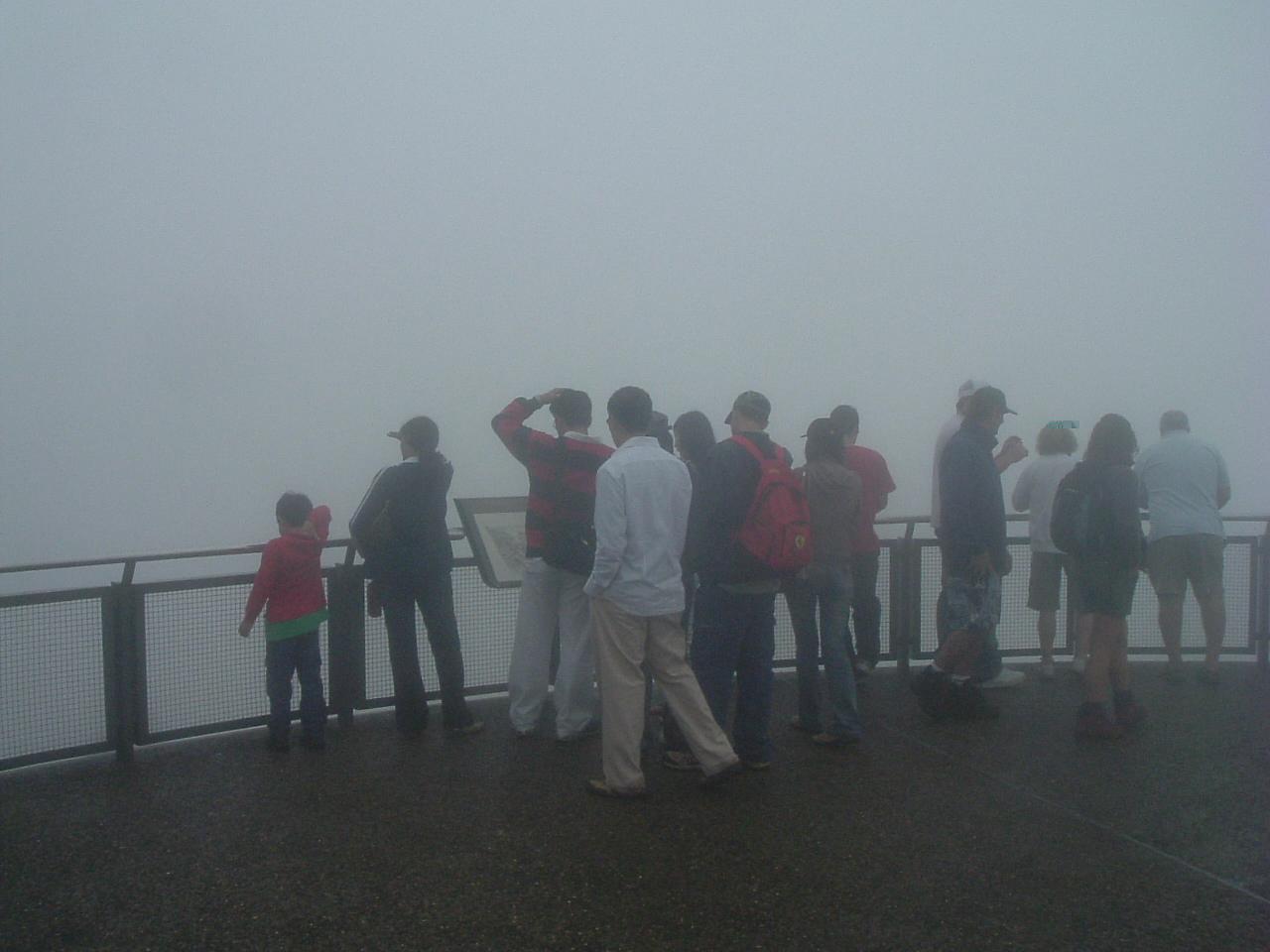
Travel Fails: When Weather Obscures Famous Viewpoints
Purchases made through some links on this page may provide The Detour Effect with commissions (at no extra cost to you). Thank you!
It’s a traveler’s worst fear. You’ve saved up money, requested time off work, and maybe even trained for months to prepare for the physical effort of reaching a famous viewpoint or landmark. After traveling to a new corner of the earth, you finally arrive in person. Expecting to take in the iconic panorama you’d only ever seen in pictures, you’re instead greeted with…nothing. The entire site is completely obscured by bad weather, a city construction project, or some other unexpected aberration.
Unfortunately, I’ve had numerous experiences of arriving at a supposedly beautiful viewpoint after making a laborious effort, only to find the landscape completely obscured by fog. This happened to me when hiking to Vršič Pass in Slovenia, in the Roan Mountains in North Carolina, the Monteverde Cloud Forest in Costa Rica (to be expected), and most devastatingly, during my Tour du Mont Blanc attempt in 2019. Recently when visiting Château d’Amboise in France, I arrived when Da Vinci’s tomb was entirely covered in scaffolding and temporarily inaccessible.
Misery loves company. In an effort to make myself feel better, I’ve asked travel bloggers to share their own experiences with arriving at famous viewpoints in bad weather. Are these places still worth visiting in poor conditions? How can you plan around a foggy forecast, or make the most of it?
Machu Picchu, Peru
By Kris of Nomad by Trade


A few years ago, I planned a trip to Peru with the main goal of fulfilling my long-standing dream of visiting Machu Picchu. As luck would have it, we woke up the morning of our visit to the only rain we experienced on our entire trip. Aguas Calientes, the village outside Machu Picchu, was shrouded in thick clouds that obscured the peaks around us. Nevertheless, we boarded the bus that would take us up the mountain hoping we’d climb higher than the clouds. When we arrived, it was obvious that that wasn’t the case. The view we were treated to when we entered nearly brought tears to my eyes – just not in the way I would’ve expected. It was a wall of fog completely hiding the entire archaeological site.
Our guide assured us that the clouds would dissipate so we pressed on with our tour. Fortunately, he was correct and by the time we’d finished the circuit, things had cleared up enough that we could enjoy the view. It wasn’t exactly what I’d envisioned, but the remaining clouds hugging the sides of the mountain gave Machu Picchu a fascinating and slightly eerie appearance.
If you encounter the same weather on your trip, definitely still do the tour! Even if the fog never clears up to give you the panoramic views you’re dreaming of, you’ll still be able to learn a lot and see structures up close as you walk through the site. In order to maximize your odds of having a good view, try booking an afternoon ticket as our guide said that mornings tend to be more foggy. If you have time in your schedule, you can also plan to spend an extra night or two in Aguas Calientes so you can visit on a couple different days if needed.
Volcano Maderas, Nicaragua
By Susan Gleissner of This Big Wild World


Volcano Maderas is one of two volcanoes on Ometepe Island in Lake Nicaragua. Hiking this volcano was at the top of my Nicaragua bucket list. Why this particular volcano? Volcano Maderas may be a bit shorter than the other volcano, but because it is extinct you can hike down into the volcano!
The trail to reach the top of Volcano Maderas winds through lush forest that takes you to incredible viewpoints across the island and eventually up above the clouds. Because of this, rain is relatively common and the trail can be quite muddy.
When you reach the summit of Volcano Maderas, the trail leads you down a steep descent inside the rim of the volcano. On the day I hiked, the rain persisted off and on most of the morning and upon arriving inside the volcano it was like a scene straight out of The Walking Dead. A low fog made it chilly and virtually impossible to see more than 5-10 feet in front of you. On a clear day, this is a great place to eat a picnic lunch and play in the water and mud inside the volcano before hiking back down.
As disappointing as it was to have whiteout conditions at the top, there was a silver lining. The forest along the trail is home to capuchin and howler monkeys. My guide knew just how to call them and soon dozens of curious faces were staring down at us from the trees. It was magical! Also, there are several side trails to stunning viewpoints of the other volcano, Concepcion.
Nicaragua has unpredictable weather, especially in the elevated forest areas so rain and fog are inevitable parts of exploring the country. Regardless, hiking Volcano Maderas was one of the highlights of my time in Nicaragua!
Eiffel Tower, Paris, France
By Martha, who May Cause Wanderlust


The Eiffel Tower is such a big draw in Paris: its iconic shape dominates the skyline and attracts the gaze from miles around. I’m often on the lookout for it when I’m exploring the city, my eye drawn to it like a magnet.
So, on a recent trip to Montmartre in Paris, when the opportunity came to have a room with a view of the Eiffel Tower, my interest was piqued… It cost more money than I normally spend, but I was feeling frivolous so I went for it! Sometimes you’ve got to treat yourself, right?
Imagine my disappointment, then, when I checked into my room only to find no sign of the Eiffel Tower at all. You see, it was January and the cold air over Paris was thick with moisture, obscuring that expensive view. There are lots of great things to do in Paris in winter, but, as I discovered, enjoying views for miles across Paris is not one you are guaranteed to be able to do.
It wasn’t all bad, though: the Terrass Hotel was very stylish and comfortable, and on the last day, the air was slightly clearer, so I did enjoy the view as I had my breakfast in the rooftop restaurant.
Tip for avoiding a similar disappointment in Paris: if you want that Eiffel Tower view, maybe try a hotel closer to it, where there’s less air that can be cloudy between you and it. Better still: splash your cash on that classic view in Spring, Summer or Autumn, when there’s better chance of good weather, clear skies and an uninterrupted view of that elegant tower.
Mutianyu, Great Wall of China
By Steve of Biggsy Travels


Back in 2009 I was fortunate to be made redundant, and with no dependents, mortgage or significant other “upped sticks” for 6 months to travel to New Zealand via SE Asia. First port of call was China with my good friend Rob, with The Great Wall of China up high on our bucket list.
We’d organized the trip via a tour company, to drop us off at the start of the day and subsequently pick us up again further along the wall. Rob had researched the best locations and decided on the stretch at Mutianyu…and this was the fantastic view that greeted us! Now, the two German guys on the same trip only had that one single day to view the wall so this cloudy view was all they ever saw. Rob and I however, more through luck than judgement, had decided to spend two days in the region.
So there’s the tip! If you’re able to build in some contingency time and “slow travel” you get the chance to try again another day. Although this generally isn’t a luxury we all have, especially if it’s a compact fortnight break with a tight schedule. So as we knew we had a second bite of the cherry we enjoyed our cloudy day out on the wall, scaling the surprisingly steep sections, on all fours in some instances, but didn’t really resent the weather.
The next day we returned to a slightly different stretch – between Jinshanling and Simatai – and on the clearest of sunny days. So ok, we never did see that exact same Mutianyu view, but the ones we did see instead were pretty epic!
Goatfell, Isle of Arran, Scotland, UK
By Steven Neish of Finding a Neish

The view was well worth the effort, or so I’d been told. It was as fine a June day as you’re likely to get on the west of Scotland when I decided to climb Goatfell on the Isle of Arran. It was so summery, in fact, that halfway up the Corbett – a mountain between 2,500 and 3,000 feet high – I became so uncomfortably hot that I was forced to change out of my jeans and into the only shorts I had to hand: a pair of trunks I’d forgotten to unpack at the hotel and which were still languishing at the bottom of my bag. I searched for the nearest cairn and changed self-consciously into them, praying nobody passed before I’d finished, or ideally until after I’d changed back.
This being Scotland, you never get just one season in any 24-hour period and, as I neared the summit, a thick haar swept across the island and cut the mountain off from the view below. With visibility reduced, though sadly not enough to hide my Speedos, I arrived at the trigpoint and surveyed my surroundings.
Just about the only thing that was visible aside from my legs, the trigpoint, and the mountain itself was an anvil. Not only had it beaten me to the top – dragged uphill over the preceding 26 days to raise money for charity – but it had also beaten the haar.
I’ve never been back to Goatfell but I have returned to Arran, where the anvil now sits outside The Douglas Hotel, which has named a cocktail after it. At 874 metres, the view from Goatfell must be incredible; but the sight of a 120-kilogram anvil at the mountaintop is arguably even more so. I just wish I’d taken more photos on the ascent. And dressed accordingly.
Three Sisters, Katoomba, Australia
By Keith Kellett of Travel Rat

We’d just spent an enjoyable couple of days exploring the Jenolan Caves, an extensive underground system in Australia’s Blue Mountains. We checked out of the hotel and considered if there was anything else we might do before returning to Sydney. One suggestion was the imposing rock formation, the Three Sisters, at Katoomba, which wasn’t far away.
We’d been there before in the “way back when,” but I wanted some digital imagery. Our last visit had been long before the introduction of the digital camera, and all I had was some transparencies and some analogue video.
But, as we approached Katoomba, the mist began to close in. Soon I was on headlights and fog lights. When we got to the “lookout” from which are the most popular views, we could see nothing…apart from a few hardy souls peering into the murk.
In his book Down Under, Bill Bryson describes a similar experience, but he stayed nearby and found almost ideal conditions the following day. We couldn’t; we had to be back in Sydney that evening. So, we just had a coffee and an “Aussie Pie” at a nearby food truck before departing.
In mountain areas, they often say, “If you don’t like the weather, wait a minute”. We hadn’t driven far before we were out in bright sunshine again. So, if you encounter similar conditions, and you have time… stick around a while. And, I always counsel, have a Plan B in place so you aren’t too disappointed.
Snowdon, Wales, UK
By Kylie of Between England and Iowa


At 3559ft/1085m, Mount Snowdon is the highest mountain in Wales, UK. Some people are fine just climbing a mountain for the challenge, but it’s always an added bonus when you get to enjoy great views from the top. Of course the best way to summit Mount Snowdon is to have some flexibility in your plans and do it on a day when you know the weather conditions will be in your favour. It takes between 3-4 hours to reach the top using the Llanberis Path.
However, an alternative way to get to the summit is to take the Llanberis Railway. The Heritage Steam Experience is popular for a trip up the mountain, as it uses a steam train that dates back to 1896. The trains only carry around 34 people at a time and in the summer season it is recommended to book in advance as they often sell out. This does mean that you need to take a chance with the weather.
On the day of my visit, typically the very top was in a cloud. The summit marker is on the top of a pile of rocks, so the last section is a bit of a scramble. The clouds did obscure the view so in reality there could have been a sheer drop either side of me and I wouldn’t have had a clue. Luckily it was only the summit that was attracting the clouds and after just a short walk down the visibility did open up. With the train they do only allow passengers 30 minutes at the summit, but it is possible to take the train up one way and then walk back down, giving you time to enjoy the views.
National Elk Refuge, Wyoming, USA
By Kari of Nature Tech Family


Although we have been to the Grand Tetons a few times in the summer, we had heard about an incredible late winter experience in nearby Jackson, WY, at the National Elk Refuge. Visitors can reserve a time to take a sleigh ride out into the refuge to view thousands of wild elk before they migrate back north toward Yellowstone in the spring. We made our reservations and on the first weekend of March 2018, and headed west. It had been a warm and dry winter near Jackson compared to most seasons, and the refuge staff told us that less elk were still at the refuge as many had already migrated. Thursday evening it started to snow – those big, heavy, fluffy flakes that are so magical. This would normally be charming and enjoyable except…it never stopped snowing. For three days.
Our sleigh ride was scheduled for Saturday morning, so we tried to drive and see some other parts of the refuge the day before and catch a glimpse of the Tetons, to no avail. They were socked in to the cloud layer the whole weekend. Our morning came to take the sleigh ride, and the guides assured us that they would still take us out, despite the literal blizzard we were caught in that day. Sure enough, we were able to finally locate some of the smaller herds of elk and take a few photos, and in the end some of the images came out mysterious and unique. But most importantly, for a family adventure, this is one trip our kids remember and still talk about often, because of the incredible amount of snow we had to keep brushing off ourselves during the ride!
The good news on this trip was our travel days there and back were clear, once we got out of the mountains, and we did get just a few glances at the mighty Teton range on the way out, which made for some surreal feeling photographs for our memories. Despite what the weather can be in Jackson, this experience is 100% worth the effort, and we still recommend it to everyone!
Stoodley Pike, England, UK
By The Barefoot Backpacker


Stoodley Pike is quite distinctive. It’s a hill on a ridge in West Yorkshire; the cliff edge below it drops 140m. At the top, around 400m, is a 37m tall tower called the ‘Monument Tower’, built in the 1850s to commemorate the surrender of Napoleon.
It’s visible from afar, serving as a useful signpost for hikers. It stands directly on the Pennine Way footpath, and close to several other paths. In the valleys below are the towns of Todmorden and Hebden Bridge; the trek up is quite steep.
When you’re hiking this part of the Pennine Way you need all the moral help you can get – it’s a tough walk through remote, bleak countryside with little around to break the monotony. Stoodley Pike provides a psychological ‘finish line’; once you reach it, it’s literally downhill all the way to the Calder Valley.
You’d’ve thought, then, hiking the Pennine Way in the middle of June, would lead to glorious views across the ridge and out towards Manchester. And you’d be completely wrong.
We reached it after 2½ days of constant rain, mist, and low cloud. Our visibility across the moorlands was measurable in metres. We met the ridge and … was that the tower? In the distance? A dark shadow against the cloud? We walked on, and it vanished like a ghost, only to reappear around the next corner. The view to the west was non-existent; all we could see were the stones in front of us. The tower flittered in and out of view, but regardless how many steps we took, it seemed to get no closer; was it a mirage?
Even when we reached it, it barely seemed real, a darker shade of mist in a sea of cloud. Only by touching it did we accept it.
It’s possible to climb up it and have an unobstructed view towards Lancashire. We did, and just about had an unobstructed view of the ground at the bottom of the tower.
We set off next morning in marginally clearer weather. After a few km we looked back. Yep, we could see the monument of Stoodley Pike quite clearly. Exactly the sort of place you’d expect to get a great view from.
Waimea Canyon, Kauai, Hawaii, USA
By Justine Frederiksen of That Was Cool


Waimea Woes: In my early 20s I went to Hawaii for the first time with a boyfriend. The island we visited, Kauai, was beautiful, but I was miserable because we fought over everything, including whether I could drive the rental car just a couple of miles to get myself a decent cup of coffee in the morning.
The worst fight was over Waimea Canyon, Kauai’s “Grand Canyon,” which he did not want to see. But I was determined to go, and eventually he relented and drove us out to the park. He stayed in the car while I headed up the stairs to see this gorgeous view I had battled all morning to see and… there was nothing but fog!
I was very disappointed at the time, looking out at a sea of gray instead of a tropical Grand Canyon featuring a waterfall, but now I look back at that day as funny and very instructive — it taught me to never travel with someone who won’t allow me to see and do what I want.
Better yet, that day inspired me to travel by myself, which I recommend wholeheartedly to anyone who doesn’t yet. Because I don’t regret that Waimea Canyon was shrouded in fog the day I visited, but I do regret spending five days on Kauai fighting over how to spend my time instead of soaking in as much of that gorgeous green paradise as I could.
Mount Pelée, Martinique, France
By Melinda of Mel on the Go


Martinique is known for many things, including French cuisine, beautiful beaches, and an active volcano. We anchored in the northern bay of St. Pierre, Martinique, admiring the imposing Mount Pelée that dominates the landscape. Every morning we’d look up at the top of the volcano and vow to hike it.
Our plan was to rise early in the morning and drive to the base parking lot to conquer the volcano before the heat of the day. After a few hours of uphill climbing, we’d savor views of our anchorage and all of Martinique from the peak of this historic deadly volcano.
The day we’d arranged a rental car for the excursion was not ideal for the hike, but our time was limited. That peak we saw so clearly while anchored in the water below was impossible to see soon after we put out feet in motion. In fact, we became invisible to each other from a few feet apart when the mist rolled in.
The 4500+ foot Mount Pelée climb is popular and we didn’t suffer alone. We huddled from the worst of the wind near the summit with other disappointed view seekers in a sheltered but smelly hut. The view improved slightly but was nowhere as clear as all the days we stayed at ground level.
We enjoyed our foggy hike up Mount Pelée and all our time in Martinique, despite the poor visibility that day. There is a lot of greenery along the route, and potential to see native birds and animals, if you can see. I would recommend skipping the stinky hut.
Jökulsárlón Glacier Lagoon, Iceland
By Dorothée Lefering of The Touristin


The excitement I feel as I arrive in Iceland is unbearable. From documentaries, I know that Iceland’s nature knocks you off your socks. Mountains. Volcanoes. Waterfalls. Beaches. Icebergs. I know it is probably going to be rainy and cold most of the time. I am ready to experience it all myself.
Fast forward. One morning. I get up and somebody pours down bucket loads of water from heaven. Rain, so heavy that I can hardly see Iceland. My parents taught me there is no such thing as bad weather, only the wrong clothes. That is the spirit. I leave my hotel and drive to Jökulsárlón, a lagoon, with icebergs that broke off from the Breiðamerkurjökull glacier. They are more than 1,000 years old. I ignore the rain.
On the shore of the lagoon, the rain bangs violently down on me, the icebergs are of a blue colour. A truly emotional moment. Together with the blue icebergs, the rain itself becomes the attraction of my day. I never experienced something like it and had no idea it was possible. In this cats-and-dogs rainy misery, I feel satisfied to have brought adequate clothes for my trip, and I focus on what I can see. There are seals swimming around the blue icebergs.
Luckily, I travel slow and have enough time to visit Jökulsárlón again a day later. I find myself in a pastel watercolour painting. The sky has a soft blue, the icebergs a light-dark blue, and there are even clear transparent icebergs. I discover that there is a snow-covered mountain range, which I haven’t seen previously because of that rain. Yesterday’s heavy rain is water under the bridge as the lagoon enjoys basking in the sun. We live in a beautiful world, and that is how I feel in this moment: grand.
Sintra, Portugal
By Claire of The Detour Effect


Pena Palace in Sintra, Portugal is a glorious feat of architecture and artistry. Drenched in bright colors, photos usually depict its vibrant reds, yellows, and purples popping against a clear blue sky. While exploring the Castle of the Moors, visitors should be able to see stone ramparts stretching over the Portuguese hills like the Great Wall of China.
However, it turns out Sintra has a microclimate that is quite different from nearby Lisbon. With humidity blowing in from the Atlantic Ocean and evaporating under dense forest canopies, I wouldn’t be surprised if Sintra can be categorized as a cloud forest.
I flew to Portugal on my birthday with Sintra at the top of my list and immediately took a day trip from Lisbon. It’s advised to buy timed entry tickets in advance because of crowding, so even if I had known about the fog, I was stuck with the day I chose. The forecast did not predict rain, but the air was so thick with moisture I might as well have been swimming underwater. You could see it dancing in the air. What you could not see was a single view from Palácio Nacional da Pena or Castelo Dos Mouros.
While I was disappointed, this weather did provide an opportunity to take unique, ghostly photos of Sintra. I was able to capture a new perspective on the town and appreciate its singular beauty. If you are short on time and considering skipping Sintra because of the forecast, I recommend going – it is still worth it to learn about the history! Just be sure to prepare accordingly by wearing clothes that will be comfortable for you in humid, sticky conditions (i.e., no jeans, and shoes with good traction that will prevent you from slipping).
While arriving to a famous viewpoint in bad weather might seem like a travel mistake to avoid, so many iconic destinations offer more than meets the eye. Perhaps you’ll be lucky enough to come across howler monkeys, seals, or anvils! Foggy landscape photography is its own aesthetic, and there are plenty of articles online about how to experiment with camera settings for a foggy day or what fog tracker apps to use to predict cloud cover. If you can’t avoid inclement weather conditions (and provided it’s safe), lean into them! Or, take a cue from some of the travel bloggers above and try a “slow travel” approach to allow extra time for unplanned detours. If at first you have a travel fail, try, try again (and when all is lost, there’s always trip insurance).
Pin It:

Related:



My dream is to write travel and hiking content full-time. All of my guides and itineraries are free and my travels are self-funded. If you enjoy my site and would like to support, you can donate any amount to my Ko-fi page. Thank you!!
Oh bugger! I’ve only had one negative experience when I got tickets for Banksy’s Dismaland in Weston-Super-Mare. After a 3h drive and queuing for 1h even tho I had tickets, I finally got into the park. 10 minutes later it got closed because of the rough seas. No refunds. I was so pissed! Imagine travelling to Peru and climbing all the way up to Machu and not be able to see anything. So annoying but I understand these are circumstances beyond your control.
Carolin | Solo Travel Story
Omggg I would have been so mad! Especially because you had physically been there for that entire hour beforehand, just waiting. As a sidenote I had never heard of Dismaland and just Googled it, looks cool. I hope you were able to see it another time!