
3 Day Yellowstone Itinerary for Hiking Enthusiasts
Purchases made through some links on this page may provide The Detour Effect with commissions (at no extra cost to you). Thank you!
When visiting Yellowstone National Park, hiking enthusiasts will obviously be jonesing to complete the best day hikes Yellowstone has to offer. However, one problem we dirtbags often grapple with when we have limited time and it’s our first visit to a park is that we feel we have to sacrifice one thing for the other – either the more quintessential, if perhaps touristy sights in the park, or the more exciting hiking trails. Multi-faceted hikers have plenty of interests beyond the trail; we still want to visit museums, geysers, and learn about history, geology, and wildlife too!
If you have just one long three-day weekend to spend in Yellowstone, there’s no need to compromise or lament a lack of time. You may not be able to dedicate yourself to a full backpacking excursion this go-around, but in just three days you can experience the main highlights of Yellowstone, log some solid hiking mileage, and even bag some peaks.
It costs $35 per vehicle to enter Yellowstone National Park. This allows you 7 days of entry. Alternatively, you can show your America the Beautiful Annual Parks Pass. If you don’t order a pass in advance, they can be purchased from a ranger at the entrance station.

Keep in Mind:
- It takes awhile to drive from one section of the park to another, so it’s best to dedicate yourself to a particular region each day.
- Bug spray is very necessary in the summer, especially in July and early August.
- Always hike with bear spray, and if you’re camping, store your food in a bear safe container such as a BearVault.
- Stay a good distance away from wildlife – even the animals you don’t think you’re scared of!
- Drive the speed limit and be vigilant; animals often cause traffic jams in the road in Yellowstone.
- For wildlife viewing, it’s best to have binoculars or a spotting scope. You can rent some at these locations.
Day One: West Yellowstone
For your first day in Yellowstone National Park, let’s go ahead and mark some of the busier “must-do” sightseeing locations off the list. This introductory day in West Yellowstone will help you get your bearings.
Upper Geyser Basin and Old Faithful
Trailhead: Old Faithful Visitor Center (although also accessible from Biscuit Basin Trailhead)
Length: Choose your own adventure
AllTrails / NPS


There are more geysers located in Upper Geyser Basin than anywhere else in the world! It could easily take you two or more hours to fully explore it; it took me about an hour and a half, but I skipped a few geysers.
“Yellowstone National Park has approximately half of the world’s geysers—and most of them are located at the Upper Geyser Basin. One square mile contains at least 150 of these hydrothermal wonders, making this area the most densely concentrated geyser region in the world.”
National Park Service
You don’t have to make any particular route plan while following the boardwalks around the famously punctual Old Faithful. Whichever way you choose to wander will be rich with hydrothermal features, including hot springs and mudpots in addition to geysers, and most paths converge back on each other eventually. It’s hard to miss out. That said, do try to prioritize walking all the way down to the colorful and slightly hellish looking Morning Glory pool, perhaps a portal to a netherworld.
Check the predicted eruption times for Old Faithful, Daisy, Castle, Beehive, and other Upper Geyser Basin points of interest here or here, but don’t fret if you miss one. By the time you’ve finished your walk, you will have seen enough geyser activity to make you happy, and you might be returning to your starting point in time for the next eruption anyway. I tried to arrive when Old Faithful was erupting but missed it by a couple minutes; by the time I walked back to Old Faithful on my return from Morning Glory, I was able to catch the next hour’s eruption.
Mystic Falls Loop Day Hike
Trailhead: Biscuit Basin Trailhead
Length: 3.5 mile lollipop
AllTrails / NPS


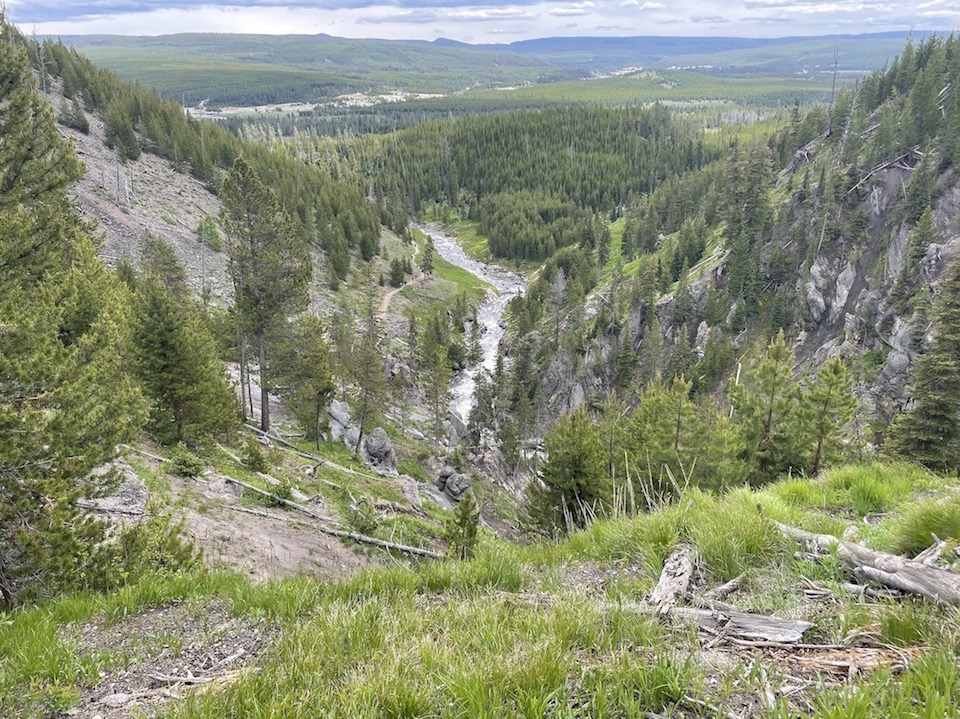


If you only have time to do one hike in West Yellowstone, make it Mystic Falls Loop. I found it much more impressive than the hike to Fairy Falls.
First you’ll view more hot pools at Biscuit Basin. The day I was there, bison were exploring the hot pools too! Then you’ll reach a fork in the trail to begin the Mystic Falls Loop. If you hike clockwise, you’ll hit Mystic Falls pretty quickly and then ascend up above the waterfall for expansive views over the park, followed by a long downhill that’s less scenic. If you hike counterclockwise, you’ll hit Mystic Falls late in the game and in my opinion the initial “reveal” as you approach the waterfall is not at the best viewing angle. It’s partially hidden by trees until you snake your way down. I liked the clockwise direction better since you get slapped in the face with a great view of the waterfall front and center.
If you don’t want to do the whole loop, you could do an out-and-back to Mystic Falls if you go left at the fork.
Fairy Falls and Grand Prismatic Overlook Day Hike
Trailhead: Fairy Falls Trailhead
Length: 4.8 miles out-and-back (or 6 miles with geyser add-on)
AllTrails / NPS


There’s an incredible view of Grand Prismatic Spring from the Fairy Falls trail, so some people just hike that far and then go back to the trailhead. Personally I think if you’re strapped for time, you’re not missing much by only going to the Grand Prismatic Overlook and skipping Fairy Falls. The rest of the trail to Fairy Falls is flat and under tree cover; it’s not scenic at all. If you do decide to hike all the way to Fairy Falls, make the effort to go a little further on to Spray and Imperial Geysers to make it worth it. That would add an extra 1.2 miles for a total of 6 miles.
Where to Camp for Free Near West Yellowstone

There are two free campsites that I know of near West Yellowstone, here and here. I stayed at the Targhee Creek spot and it was perfect! There were already a few other car campers set up there when I arrived, but I drove further down was able to find my own secluded clearing with a view of a pretty meadow. I even had pretty solid Verizon cell signal.
If you’re not into camping, read about hotel options in West Yellowstone or search them here, and find budget hostels here.
Sign up for a 7-day free trial of The Dyrt PRO here to find free dispersed campsites; PRO allows offline access, plus more advanced search features and map layers.
Day Two: North Yellowstone
Now that you’ve gotten your feet wet, it’s time to crush some miles. Today’s itinerary will focus on hiking and exploring the northern mountainous region of Yellowstone closer to the Gardiner entrance.
Bunsen Peak Day Hike
Trailhead: Bunsen Peak Trailhead
Length: 4.4 miles out-and-back
AllTrails / NPS


Bunsen Peak is one of the most iconic day hiking trails in Yellowstone. It’s relatively short in terms of mileage, but it packs a punch in terms of the amount of elevation change you’ll experience over that time. You’ll have plenty of peek-a-boo views out over the park as you snake your way up to the summit, so your breathing breaks can double as photo breaks. There is a building at the very top to welcome you to 8,564ft, but it’s a communications/radio building rather than a fire tower.
It’s a good idea to get to Bunsen Peak Trailhead somewhat early in the morning to find parking, although I found that it wasn’t necessary to arrive at the crack of dawn. In other national parks, I try to arrive by 6am or 7am because the parking lots fill up ridiculously fast, but I was able to park at Bunsen at 9am in late June and there were only a few other cars.
Hellroaring Creek Day Hike
Trailhead: Hellroaring Trailhead
Length: 4 miles out-and-back
AllTrails (this GPX track does not go the full distance. GAIA has full route) / NPS


The Hellroaring Trailhead is just north of Tower Junction and is generally less busy than all of the other hiking trails on this itinerary, though I did see a few other people. The most memorable part of the trail for me was the vast fields of purple, yellow, and white wildflowers dancing in the wind!
On this route, you’ll drop down via switchbacks to a suspension bridge over the Yellowstone River, then continue through meadows and one forested area to reach Hellroaring Creek. When you reach a small pond, you’ll skirt around the left side of it on a faint trail in the grass in order to reach the creek. Another option is to go right at the fork just before the pond to reach the bridge that crosses over Hellroaring Creek. If you seek out the bridge, this will double the overall mileage of the whole hike.
Some hikers ford Hellroaring Creek near the pond, especially overnight backpackers. You’ll be able to see where the trail picks up on the other side, but the day I was there, the water was high and fast and I didn’t bring proper equipment for crossing the creek.
Mammoth Hot Springs
Trailhead: Lower Terraces North Trailhead (or Middle or South) or Upper Terrace Loop Parking Lot
Length: 2.2 mile loop
AllTrails / NPS


As you make your way towards Gardiner to camp for the evening, you’ll have to pass through Mammoth Hot Springs, one of the most popular sightseeing destinations in Yellowstone. The geothermal features here have a totally different aesthetic quality than the hot springs throughout other sections of the park. You’ll follow boardwalks, but will not feel as if you’re doubling up on what you already saw in Upper Geyser Basin.
The travertine terraces of Mammoth Hot Springs look like multi-layered steps or fountains where water drizzles from the uppermost mesas down onto the lower foundations. They’re reminiscent of the famous Pamukkale hot springs in Turkey. Colors range from pristine pearly white to a burnt, golden copper, with shades of volcanic ash in between. Where water coats the terraces they look reflective, and mist slowly hovers and dissipates into the air to spread that sulfuric Yellowstone smell.
Albright Visitor Center Museum
While you’re in Mammoth Hot Springs, dip into the Albright Visitor Center to check out museum exhibits on local wildlife, geology, and the history of settlement and the National Park Service in Yellowstone. There is some information about indigenous tribes as well, but it’s not extensive. Other museums such as the Yellowstone Gateway Museum in Livingston, Montana or the Buffalo Bill Center of the West in Cody, Wyoming have more thorough information about Native Americans.
Where to Camp for Free Near North Yellowstone


There are two free campsites that I know of in Gardiner, Montana, here and here. I used the one at Travertine Road and it was incredible! It’s very quiet and has great mountainous views. At night I could see tiny distant headlights as cars weaved their way out of the national park and into Gardiner via the north entrance. I had a full five bars of Verizon cell signal. The drive is a little rough; you do want four wheel drive to handle the washboard road.
If you’re not into camping, find hotel options in Gardiner here and a budget hostel here.
**A quick food recommendation in Gardiner – I loved the Wonderland Cafe! Their jalapeño cornbread was to die for.
Day Three: Central Yellowstone

You’ve now experienced the West and North sections of Yellowstone National Park. Today we’ll head further down to the Tower Junction and Canyon Village areas of central Yellowstone.
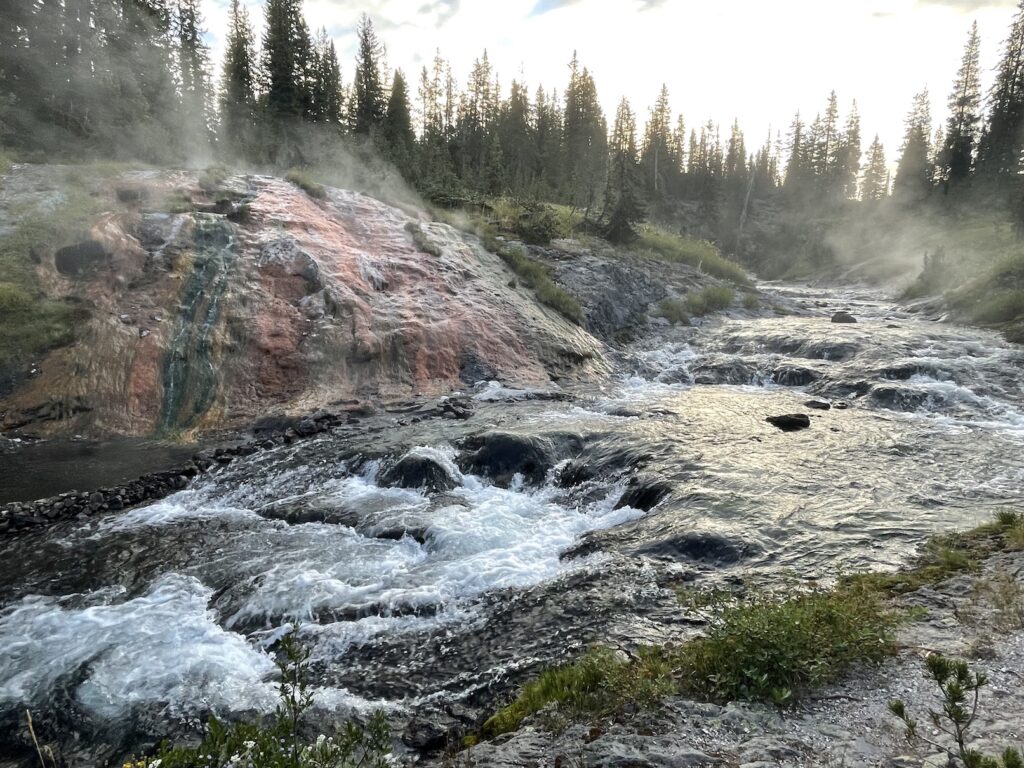
On your way to Dunraven Pass, make a quick stop to view Tower Fall! It will hardly take any time out of your drive. From the Tower Fall parking lot it’s only about a 2 minute walk to the waterfall viewpoint. As a pro-tip, while heading south from Tower Junction, just before the Tower Fall parking lot there is a small pull-off on the left side of the road where you’ll have an awesome view of water swirling around jutting rock formations. I liked this viewpoint more than the Tower Fall viewpoint.
Mount Washburn Day Hike
Trailhead: Dunraven Pass
Length: 6.8 miles out-and-back
AllTrails / NPS


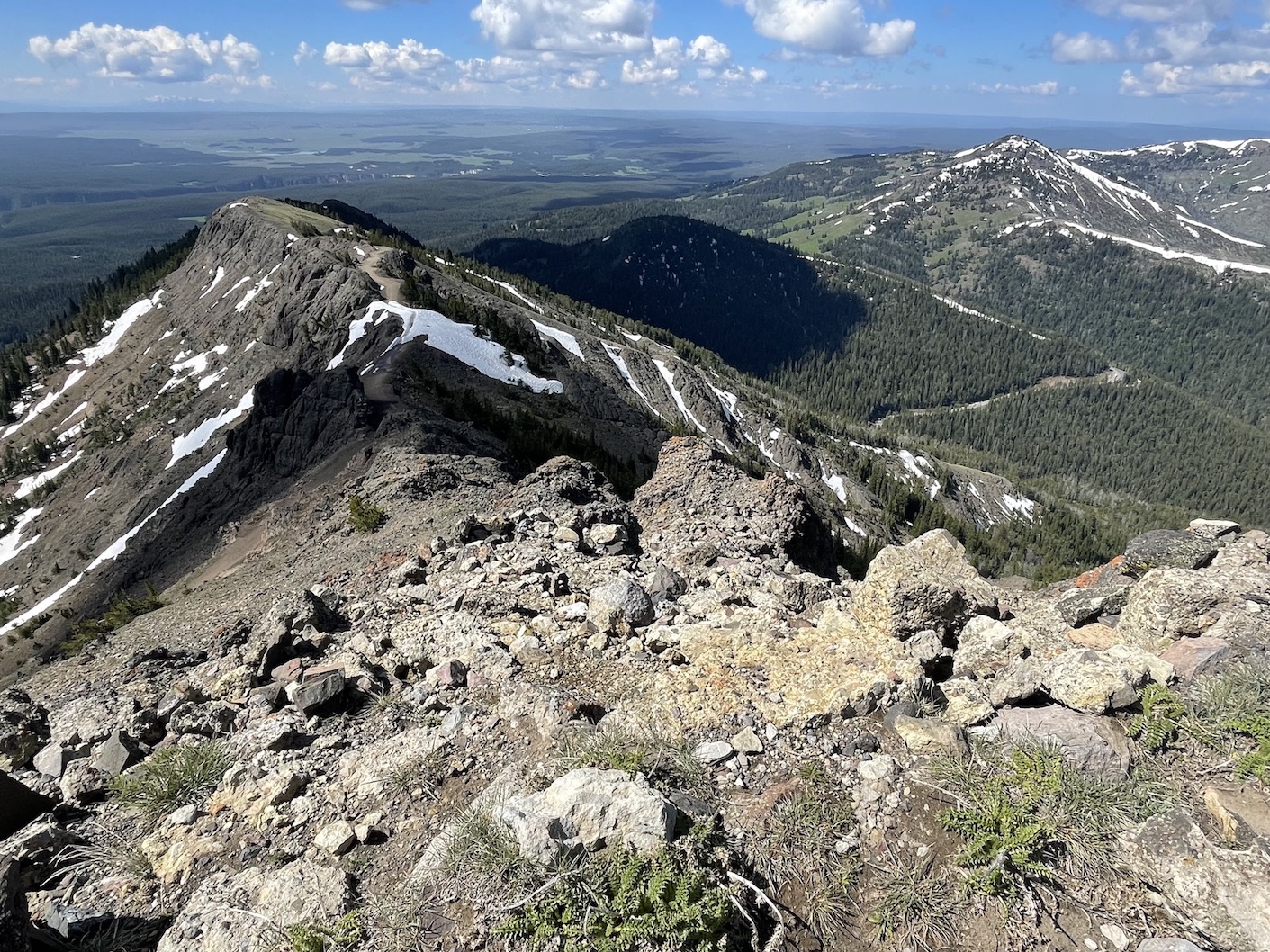
Mount Washburn is usually listed as the number one “best” day hike in Yellowstone, and for good reason. You’ll have fabulous 360 degree views in every direction once you reach the fire tower at the summit, which sits at 10,219 feet. From the tower you can spot Yellowstone Lake, the Tetons, Grand Canyon of the Yellowstone, and countless mountain peaks. The day I hiked it, I was lucky to see a herd of bighorn sheep!
Even though Mount Washburn is taller and the hike is longer, the trail is not as strenuous as the trail to Bunsen Peak because the elevation change is more gradual. That said, the Mount Washburn trail is more likely to still have some snow patches further into the summer, whereas snow should be mostly clear from Bunsen Peak in late June. I got my trekking poles out to steady myself for the short snowy stretches on Mount Washburn, but never felt it necessary to put on microspikes.
I arrived at the Dunraven Pass Trailhead at 9am and had no trouble parking, but by the time I completed the trail, the lot had filled up.
There is another trailhead you can start from called Chittenden Road, but trail reviews say it’s just a service road moreso than a hiking trail. If you wanted to experience both routes you could hike from Dunraven Pass to Chittenden Road or vice versa instead of doing an out-and-back to and from Dunraven, but you’d need to park one car at each trailhead so you have a way to return.
Grand Canyon of the Yellowstone
Trailhead: Many options; I parked at Artist Point Parking Lot
Length: Choose your own adventure
AllTrails / NPS


Continue South after finishing the Mount Washburn hike. Pass by Canyon Village and park at the Artist Point Overlook on South Rim Drive. It’s a short, paved walk to the Overlook, where you’ll have an unbelievable vantage point to admire the massive waterfall that carves into the Grand Canyon of the Yellowstone. It’s difficult to make your brain grasp the magnitude of what you’re looking at. Can you imagine coming across this landmark in early pioneer days before the area was developed?
From Artist Point there are walking trails that follow the rim of the canyon either northeast or southwest. The northeastern direction can take you to Point Sublime or Ribbon Lake. The southwestern direction can take you to viewpoints for Upper Falls. I chose to check out Upper Falls and was rewarded with vistas of the inner gorge marked by paint palette streaks of color.
Some people prefer to park on the opposite side of the gorge at the Brink of the Lower Falls Trailhead, Crystal Falls Overlook, or Canyon Lookout Point off North Rim Drive. From Brink of the Lower Falls you can hike switchbacks down into the canyon! If you park at the Glacier Boulder Trailhead on the North side of the canyon, you can hike a much longer and more remote trail down into the canyon via Seven Mile Hole.
You could even connect Mount Washburn to the Grand Canyon of the Yellowstone. After hiking from Dunraven Pass to the summit, instead of retracing your steps back or continuing towards Chittenden Road, you’ll take Mount Washburn Spur Trail towards Grand Canyon of the Yellowstone and connect with Seven Mile Hole trail. It all depends on how much time you have.
Mud Volcano
Trailhead: Mud Volcano Parking Lot
Length: 0.8 mile loop
AllTrails / NPS


Your legs are likely feeling the burn by now, so it’s a good idea to close out the final day of our Yellowstone 3-day itinerary with a gentle sightseeing walk. Take Grand Loop Road further south until you reach the Mud Volcano Trailhead, which is a huge parking lot with plenty of space. This is another easy boardwalk stroll to explore geothermal features, but this time the focus is mainly mudpots. My favorite was the Dragon’s Mouth Spring, which does encourage the imagination to suspect there might be some ancient beast hiding underground whose breath is responsible for the emanating steam and undulating waves.
You’ll pass through Hayden Valley on your way to the Mud Volcano, so you may want to pull over and whip out the binoculars or spotting scope. Hayden Valley is a prime wildlife viewing area.
You’re now very close to Yellowstone Lake, so if West Thumb Geyser Basin interests you, head there after Mud Volcano if you have the time, or replace Mud Volcano with West Thumb Geyser Basin altogether.
If You Have Time

If you have more than three days at your disposal or somehow still have extra time after doing everything on my Yellowstone weekend itinerary, head over to Lamar Valley for wildlife viewing.
While simply driving around the national park, you’re likely to see plenty of bison and maybe a coyote or even a black bear or two. If you haven’t managed to spot a grizzly or grey wolf and want to seek them out, Lamar Valley, Hayden Valley, or one of these wildlife spotting locations are promising places to try your luck. You do want to have a spotting scope or binoculars if possible, or perhaps a kind tourist will briefly lend you theirs if you start up a conversation while both parked at a vehicle pull-out.
If wildlife viewing is a priority, I found this Lamar Valley guided wildlife spotting day trip. There’s also a badass winter tour that picks up from Bozeman that focuses on observing wolf packs in their natural habitat in Yellowstone.
Yellowstone National Park is so massive that there are countless other landmarks and day hikes you could swap in or add on if you have time, but this three-day itinerary is meant to help you hit the most iconic sightseeing destinations without sacrificing your passion for hiking. More remote sights and hikes can be tackled on a second or third trip, now that you’re a Yellowstone pro!
If you’re not comfortable hiking solo (the Park Service recommends hiking in parties of 3 or more in grizzly country) or prefer all the logistics to be taken care of for you, Wildland Trekking offers guided day hikes and overnight camping and lodge-based trips in Yellowstone, Grand Tetons, Wind River Range, Absaroka-Beartooths, and the Jackson Hole area. You can also find tons of awesome guided and self-guided day trips in Yellowstone that may or may not involve hiking over at GetYourGuide, including rafting trips, self-guided driving audio tours, wildlife-spotting tours, and more.
Related:




Pin It:

My dream is to write travel and hiking content full-time. All of my guides and itineraries are free and my travels are self-funded. If you enjoy my site and would like to support, you can donate any amount to my Ko-fi page. Thank you!!
It was so fun to reminisce about past times in Yellowstone by reading this. Also lovely to see some new ideas for hikes. The last time I think I was in Yellowstone was to lead a 3.5 week backcountry skiing/winter camping trip in January. It’s incredible to see all this under many feet of snow. Thanks for the ideas on free camping too.
I hope I can come back in the winter, I hear so many stories about how idyllic it is!
Thanks so much for this — you’ve made my life so much easier with this post, haha. I’m going in a couple weeks and haven’t even partially started planning yet (yay, work), This will definitely be super helpful! Mystic Falls Loop looks gorgeous! <3
We're probably gonna start off in North Yellowstone + I'm hoping to have enough time to also go to North + Central Yellowstone as well, but since we're trying to tack on Grand Teton and possssibly also Craters of the Moon as well, we will have to see (fingers crossed!). I'll keep an eye out for Wonderland Cafe! :]
I saw your recent facebook post from Grand Teton, I’m glad you made it there! How’d Yellowstone go?
I hope I make it to Craters of the Moon myself. Man there is really so much to do in this region of the country it’s overwhelming.
Yeeees! This post is so flipping useful Claire! You could make SUCH a helpful series with posts like this for different parks.
I am really glad that Marc and not the only mad-uns who attempt 2-3 short hikes in a day so we can see more sights. I mean with scenery this interesting, I’d want to cover all the bases. I like long, epic day hikes too… but sometimes it is just great to do a bunch of snack-sized adventures like this.
Thanks Josy! That’s a great idea, maybe I’ll do a similar one for the Grand Canyon and some other parks. I think there’s a big difference between a “best hikes in Yellowstone” type of post vs. a “best hikes you can reasonably fit into a certain timeframe” lol, and the second one is probably more helpful than the first for most people.
Exactly, I’d feel like I was really being stubborn if I prioritized long strenuous hikes in a park that has so much to offer on the sightseeing front. Imagine coming all the way to Yellowstone and being “too cool” to see the geysers!
This is so helpful! I like how you split it up by the entrance point. The park is so big, it really helps when you focus on an area. I had my dog with me when I went recently so we were limited on where we could explore. I want to go back so I can do some of these hikes!
Gotta divide and conquer!
I hope Hank enjoyed the areas of the park he got to visit! When you go back I think you’ll really love Mount Washburn especially.