

Catacombs of Paris vs Rome: Should You See Both?
Purchases made through some links on this page may provide The Detour Effect with commissions (at no extra cost to you). Thank you!
Even for those travelers who don’t consider themselves “dark tourists” in search of the macabre, a fascination with archaeology and history will inevitably lead down darkened corridors. History is inherently metal and morbid, despite the glossy sheen on some of the most touristed cities in the world.
While in France, visiting the Catacombs of Paris was at the very top of my must-do list, and during a recent visit to Rome I prioritized the Catacombs of San Callisto. It turns out that not all catacombs are created equal. These underground crypts in Paris and Rome are really nothing alike, neither in construction nor intention. If you have already visited catacombs in one of these two great European cities, it would not be redundant to schedule a visit to the other.
Catacombes de Paris (Paris, France)




The Fascinating History of the Paris Catacombs
You’d be forgiven for assuming that the Catacombs of Paris were built for the purpose of interring the dead, but in fact only 5% of the subterranean mining network is used for this purpose, and only relatively recently.
Long before Paris, the same land sustained the settlement of Lutetia, built by ancient Romans after conquering the Gauls. In order to make this humble Gaulish swampland more Romanesque, its conquerors built quarries to access abundant limestone. A Roman arena now known as Arènes de Lutèce was built using this limestone and can still be visited today in Paris.
When the quarries began to encroach upon useful farmland, diggers went deeper instead of wider. Over the centuries, limestone from the quarries was used to create the Paris we know today, including famous buildings like Notre-Dame and the Louvre.
On December 17, 1774, a long abandoned quarry collapsed beneath the weight of Paris. A quarter mile of a street coincidentally called Rue d’Enfer (the Road of Hell) was destroyed as it sank below ground, becoming known as the Mouth of Hell. It took two years for an Inspector of Quarries to be appointed so the problem could be addressed on a larger scale. On Charles-Axel Guillaumot’s first day of work as Inspector, he was held up in traffic because yet another street had collapsed!
Guillaumot attacked the increasingly hazardous issue with precision and dedication. After his excavation team cleared away rubble, his masonry team shaped the rubble to reinforce the quarry walls and roofs. His cartography team set to work at numbering passageways, adding directional signs, and mapping the tunnels. They built over 200 miles of reinforcements that would stand the test of time and increased weight as Paris continued to grow above-ground. Their impressive maze wouldn’t remain empty for long.
On May 30, 1780, following a long bout of spring rains, the retaining wall of Holy Innocents’ Cemetery burst. It could no longer hold the remains of two million Parisians, some of which grotesquely spilled out into the basement of an adjacent building.
Louis XVI decided to move the corpses from Holy Innocents and other overcrowded Parisian cemeteries into a section of empty quarry, marking the beginning of its use as an ossuary. For many years, laborers loaded skeletons and corpses in all states of decomposition onto horse-drawn carriages for nighttime transport to the catacombs. Chanting monks held torches while following along with the processions.
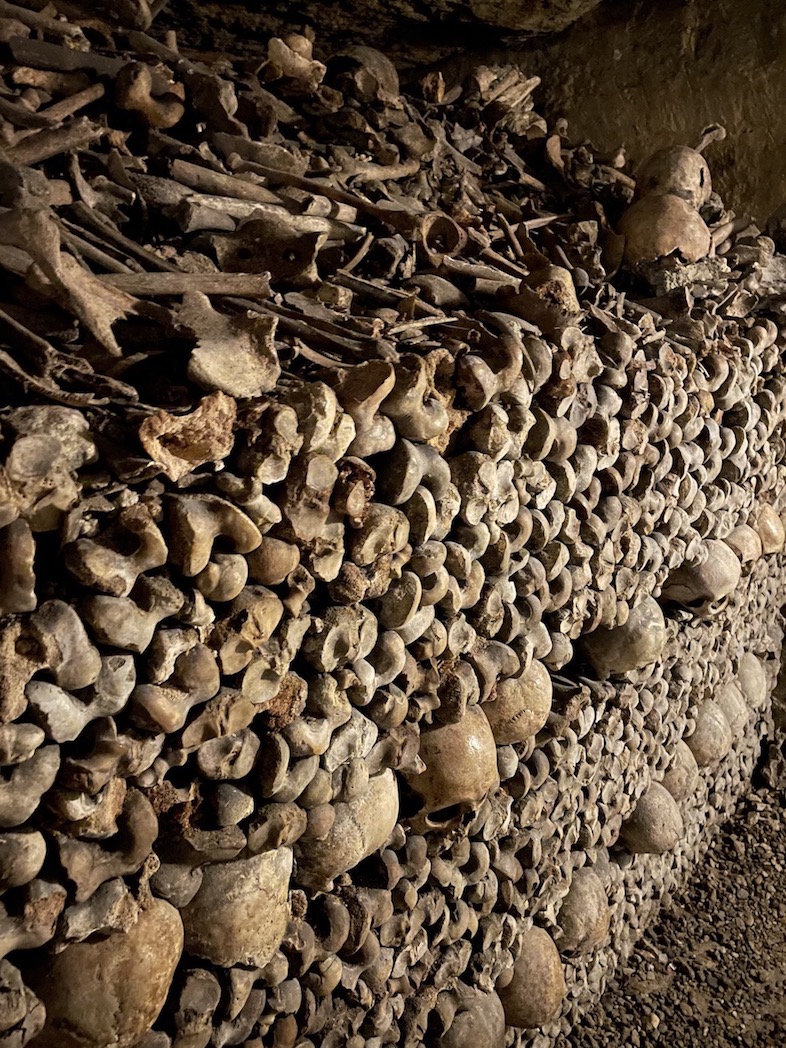
Upon arrival at their final resting place, bones from different centuries were mixed together, creating a morbidly poetic collage of every era of French history. Victims of the French Revolution such as Robespierre may have also ended up in catacombs, and eventually Charles-Axel Guillaumot himself. In the early 1800s, Inspector Héricart de Thury led the effort to arrange the haphazard piles of bones into the artful decorations that tourists can see today. The Catacombs of Paris were opened to the public in 1809.
The other 95% of the mines that are not part of the ossuary have storied histories of their own. Urban explorers known as “cataphiles” aim to discover them in spite of the law, and sections of the catacombs have served as secret underground meeting places for mysterious societies.
If interested in learning more, I highly recommend the Paris Catacombs episode of the Land of Desire podcast. This is a great podcast for all things weird and unusual in French history. You can also find it on Spotify.
Things to Know About Visiting the Paris Catacombs
Timed entry tickets to visit the Catacombs of Paris must be booked online in advance. A self-guided entrance ticket to visit the Paris Catacombs is €29 at the time of this writing (reduced rates are available for students, children, teachers, 18-26 year-olds, and other demographics). Audioguides are available in multiple languages. The Catacombs are NOT included in the Paris Museum Pass.
Guided tours are offered in French only. There are no English-speaking tour guides bookable directly through Paris Musées, but there are third party tour options available through TripAdvisor or GetYourGuide.
When you arrive at the entrance in the 14th arrondissement, there will be a line outside the building. Even though you have a timed entry ticket and might be arriving close to your assigned time, there will be many other visitors with the same timed entry slot as you, so you’ll likely need to stand outside in the queue for awhile regardless.
Suitcases and large bags are not allowed in the Catacombs. Bags can be no larger than 40x30cm and must be carried in front of your body or in your hand. There is no coat room or luggage storage.
There are 131 steps to go down and 112 steps to climb up. There can be uneven ground, dim light, and narrow hallways. The temperature is about 57°F (14°C). The Paris Catacombs are not wheelchair accessible. Camera tripods and baby strollers are not allowed. Eating, drinking, and touching anything in the ossuary are prohibited. You can read more about the guidelines and access conditions here and here.
Pros and Cons of Visiting the Paris Catacombs
What I enjoyed most about the Paris Catacombs is the ability to get up close and personal with the bone arrangements. While using human anatomy to create “art” may be of questionable taste and invite visitors to wonder whether these souls are having a very restful slumber, it also inspired me to reflect on French history. I considered what the lives of those interred must have been like. Did the person whose skull I’m beholding experience the French Revolution? The reign of Charlemagne? The Merovingian era? Since I am not French, malheureusement, it was also a tangible demonstration and reminder of how much world history has occurred that has nothing to do with me at all. The ossuary gave me the opportunity to be a spectator of centuries upon centuries of lives; entire empires as they rose and fell, rose and fell, rose and fell; an entire culture and its evolution. It was all materially represented there before me in one small space, and “memento mori” -esque signs made it clear that such meditations are encouraged.
However, when you visit the Paris Catacombs self-guided, you will only be able to walk about 1 mile (1.5km) of the ossuary. On a guided tour, you may have access to additional rooms that most tourists don’t get to see. Still, only a very small percentage of the quarries are even used as an ossuary, and it is illegal to explore the rest of the network that is not open to the public.
As a result, my self-guided walk through the Catacombs was rather quick. I remember thinking, “was that it?” Of course, it’s a privilege to have access to them in any capacity, and I’d rather a small glimpse than nothing at all.
Other Morbid Curiosities in Paris
Père Lachaise Cemetery
The most famous cemetery in Paris is Père Lachaise, which I wrote about in my ode to Edith Piaf:

Chasing Edith Piaf in Paris
Oscar Wilde, Chopin, Molière, Jim Morrison, and tons of other famous figures from history are buried at Père Lachaise. The oldest identifiable bones in the cemetery belong to Abelard and Héloïse, who died in 1142 and 1164.
Catacombe San Callisto/Saint Callixtus (Rome, Italy)


The Fascinating History of the Catacombs of San Callisto
The history behind the Roman Catacombs is not as bizarre as that of the Paris Catacombs, but they are fascinating because of their antiquity.
The Etruscans who predated the Romans began the initial digging projects on the outskirts of modern-day Rome, creating quarries not unlike those the Romans would later dig in pre-Paris Lutetia. These excavations were expanded by the Romans to create Christian catacombs around the 2nd century AD for the express purpose of burying the dead. Some sources say there are more than 40 catacombs in and around Rome; others say 50 or 60. Regardless, only 5 Roman Catacombs are open to the public, the biggest and most famous being the Catacombs of San Callisto. This one occupies an area of 90 acres, with a network of galleries about 12 miles long, in four levels more than twenty meters deep.
The Catacombs of San Callisto/Saint Callixtus are named after Pope Callixtus I, though he was not buried there. While still a deacon, Saint Callixtus was assigned by Pope Zephyrinus to be in charge of the cemetery. It became the official cemetery of the Church of Rome in the 3rd century AD.
In those days, Roman law forbade the burial of the deceased within city limits, overcrowding and lack of land was becoming an issue, and Christians did not believe in the early Roman practice of cremation. As a result, Christians took to burying their dead in shared underground crypts outside the city limits, though Jews and those practicing the dominant pagan Roman religions can also be found buried in the catacombs. Some say the Christians were escaping persecution by covertly burying their dead in these locations and hiding out there for secret worship ceremonies, but this has been debunked.
16 Popes and 50 martyrs were buried at the Catacombs of San Callisto. Nine of the Popes were buried in a room called the Crypt of Popes, and five of their names can still be read on the original tombstones via Greek inscriptions. Another important room is the Crypt of Saint Cecilia, the patron saint of music. She was martyred in the 3rd century and was once entombed where a beautiful and somber statue of her now pays homage.
Vandals, Ostrogoths, and Lombards ransacked the catacombs during sieges of Rome. In the 8th and 9th centuries, Popes led the initiative to transfer bodies and relics from the catacombs to other cemeteries and churches throughout Rome. For this reason, and because some remains simply disintegrated with time, visitors will not see any bones when touring San Callisto.
The Roman Catacombs were largely forgotten for hundreds of years, some finally being rediscovered in the 1500s, others in the 1800s and 1900s.
Things to Know About Visiting the Catacombs of San Callisto
You are not allowed to take any photos or videos while inside the Catacombs of San Callisto, which is why the photos I’ve used here had to be sourced from the public domain.
Visits to the Catacombs of San Callisto can not be self-guided. Group guided tours are offered every 30 minutes in Italian, English, French, Spanish and German. The tours last about 40 minutes and require a minimum of two people in order to run. Joining an official tour of the Catacombs of San Callisto is €10 plus a €2 online booking fee at the time of this writing (reduced rates are available for students, children, disabled, and clergy).
Tours are also available through third party operators on TripAdvisor and GetYourGuide, though note that some of them mainly involve transportation to/from the Catacombs. You are basically hiring a driver, because the Catacombs have their own accredited guides that will take you below ground.
The temperature in the Catacombs is about 60°F (16°C). There are 50 steps to descend and ascend and there will be uneven ground. There is nowhere to sit once the tour begins. Food and drink, strollers, wheelchairs, and luggage are not permitted. Do not touch anything in the exhibits. You can read more about the Catacombs expectations and guidelines here.
The Catacombs of San Callisto are located along the Appian Way, or Via Appia, an important ancient road that connected Rome to Brindisi. The Catacombs of San Sebastiano are also located along Via Appia, so you could think about visiting both on the same day.
Pros and Cons of Visiting the Catacombs of San Callisto

One of my favorite aspects of visiting the Catacombs of San Callisto was how deep into the loculi maze the tours venture. The experience really drove home the “never-ending” aura of this dark, immense, forbidding chasm in the earth. I had a visceral reaction to the fear-inducing thought of getting lost down there, which would be quite easy. I also marveled at how tall the narrow passageways are; you can see each coffin-shaped rectangle carved out of the stone walls, one on top of the other climbing further and further above you and stretching out before you. It’s oddly reminiscent of being in a library with tall enough stacks to require a ladder. You begin to understand the reality that half a million people once rested here – half a million stories.
Because groups enter the catacombs as part of guided tours every thirty minutes, and each different language group seems to descend separately, we never ran into other people outside of our own tour. This was really special in comparison to the crowded Paris Catacombs, and it highlighted the loneliness and emptiness of this subterranean purgatory. Imagine being there alone or with a small burial procession, long before electricity?
The coolest parts of the Catacombs of San Callisto are the well-preserved frescoes. In several of the tombs you can still make out vibrant colors of artistic scenes depicting humans and animals, some painted over a thousand years ago (they are similar to the Etruscan tomb frescoes of Tarquinia, which I have included photos of below). Carvings of ancient Christian symbols and letters remain etched into stone, allowing scholars to deduce more about the identities and beliefs of the people once buried there.
There are no longer any bodies in the Roman Catacombs. Visitors will not see any kind of bone display like they would see in the Paris Catacombs. The niches in the walls are missing the marble slabs that once enclosed them, and no-one lies inside.
On the day I visited the San Callisto Catacombs, the English-speaking tour guide didn’t speak very proficient English. I liked her and she was trying, but I had a hard time following and wasn’t able to learn much during the tour (I Googled things later). When some members of the group tried to ask questions, they didn’t receive thorough responses and eventually we stopped asking.
Other Morbid Curiosities in Rome
Capuchin Crypt
If you’re interested in seeing something similar to the Paris Catacombs when visiting Rome, especially in terms of “artful” arrangements of human bones, check out the Capuchin Crypt near Piazza Barberini. Be forewarned, I found this display to be particularly unsettling. The ticket includes entrance to an interesting museum about the Capuchin friars, but the final exhibit is a crypt where mummified bodies in friar habits are propped on the walls and chandeliers made of mandibles hang directly above your head. I can’t quite explain why this one creeped me out more than any of the others, but when a window in the above-ground crypt suddenly slammed because of a strong wind, I jumped right out of my skin.
Etruscan Tombs at Monterozzi Necropolis


Visiting the Etruscan tombs requires a day trip from Rome. It’s about an hours’ drive from Rome or 20 minutes from the port city of Civitavecchia, or 1 hour 15 minutes from Rome by public transportation if you get a direct route; it could be 2 hours if a transfer is required in Civitavecchia. You could also look at guided tours to the Etruscan tombs with transport included.
The Etruscans predate the Romans, yet somehow the frescoes on display in the underground tombs at the Monterozzi Necropolis near Tarquinia look like they were painted yesterday. I was particularly struck by the creativity of the artists. One of the tombs was designed to resemble the inside of a tent, so you can look out onto the landscape with mountains and deer in the distance, but with a “fabric” roof overhead. In other tombs, scenes with dolphins and divers jumping into an ocean, especially when it’s a black ocean, may represent the journey into the afterlife. You can tell which tombs were created later because they start to incorporate Roman belief systems; whereas most of the earlier Etruscan examples show bright colors and celebrations of life, the Tomb of Two Roofs shows a dark funeral procession presided over by demons of the underworld.
There are two Etruscan Necropolises, one at Cerveteri and one at Tarquinia. I visited the one at Tarquinia which includes 6000 graves, though it’s famous for the 200 painted tombs dating back to the 7th century BC. The charming town of Tarquinia is home to a museum where you can see artifacts excavated from the tombs. There are also great farmhouse agriturismos in Tarquinia where you can try locally produced olive oil, vegetables, and wine.
“These paintings provide the only major testimony of classic artwork of pre-Roman times existing in the Mediterranean basin.”
UNESCO
In Conclusion: Main Similarities and Differences Between Paris and Rome Catacombs
In the Roman Catacombs you will view niches and burial chambers, but the bodies have been moved. Contrastingly, in Paris you will view bone displays of bodies which have been moved to the catacombs from elsewhere but have no sarcophagi.
The Roman Catacombs feature the original, well-preserved art and inscriptions that were placed there over a thousand years ago, whereas the Paris Catacombs were curated in the late 1700s/early 1800s using the displaced bones themselves as the art. In Rome you will see what ancient people created; in Paris you will see ancient people.
My memory of the Paris Catacombs involves just one floor with many connecting rooms and obvious directions about which way to walk. There are multiple stories, but you’re not aware of them while walking the section that’s open to the public. It has a low ceiling and the cramped feeling of being in a bunker. While navigating the Roman Catacombs, you are always aware of the tall multi-storied layout of the whole network because of the passageways I described, though sometimes you will exit from the narrow galleries into individual rooms.
The Paris Catacombs can be self-guided while the San Callisto Catacombs must be guided. Entrance tickets in Paris are more expensive, which might seem annoying since it’s self-guided, but their audioguide is more informative than the in-person guide I had in Rome. For Paris you should book a timed entry ticket in advance. For Rome, while it’s still a good idea to book in advance, you can probably show up day-of and hop on a tour. The Paris Catacombs are within city bounds and easily accessible via public transportation or walking. The Roman Catacombs are just outside the city, and, while public transportation is still an option, it’s more involved.
The Paris Catacombs are busy. The section that’s open to the public has been highly curated with signposts and other elements that, while helpful and very organized, always remind you that you’re a modern-day tourist. The layout of the Roman Catacombs provides an opportunity to imagine yourself there at any time throughout history – I could be a Saint, a mourner, a Vandal!
🏨 Find budget hostels in Paris and Rome, or search affordable hotels in Paris or Rome.
✈️ Coming to Europe from further afield? Use an Airalo eSIM for affordable international cell data and don’t forget to protect your investment with travel insurance.
If you’re a fan of catacombs, you’ve got your work cut out for you – the French and Roman catacombs are only two of many such examples around the world! The Odessa catacombs in Ukraine are the largest, but catacombs of all shapes and sizes can also be found in Egypt, Austria, Peru, Malta, Serbia, Spain, and more. Did you know you can even take a catacomb tour in New York City?
If you’ve been to multiple catacombs, which are your favorites and how would you compare them to Paris and Rome?
Related:


Pin It:


My dream is to write travel and hiking content full-time. All of my guides and itineraries are free and my travels are self-funded. If you enjoy my site and would like to support, you can donate any amount to my Ko-fi page. Thank you!!