
Pros and Cons of Seasonal Work vs. Remote Work
Purchases made through some links on this page may provide The Detour Effect with commissions (at no extra cost to you). Thank you!
When trying to design an adventurous travel-based lifestyle for yourself, the first and most impactful step is to figure out what type of work is going to facilitate this for you. You might be considering getting TEFL certified to teach English as a second language abroad or online. You might be considering signing up for Workaway, Worldpackers, Trusted Housesitters, or WWOOF in order to do work/housing exchanges. Or, you might be considering busking in the street for cash!
Check out a list of additional resources like TEFL, Worldpackers, Workaway, and WWOOF that can help you travel indefinitely here.
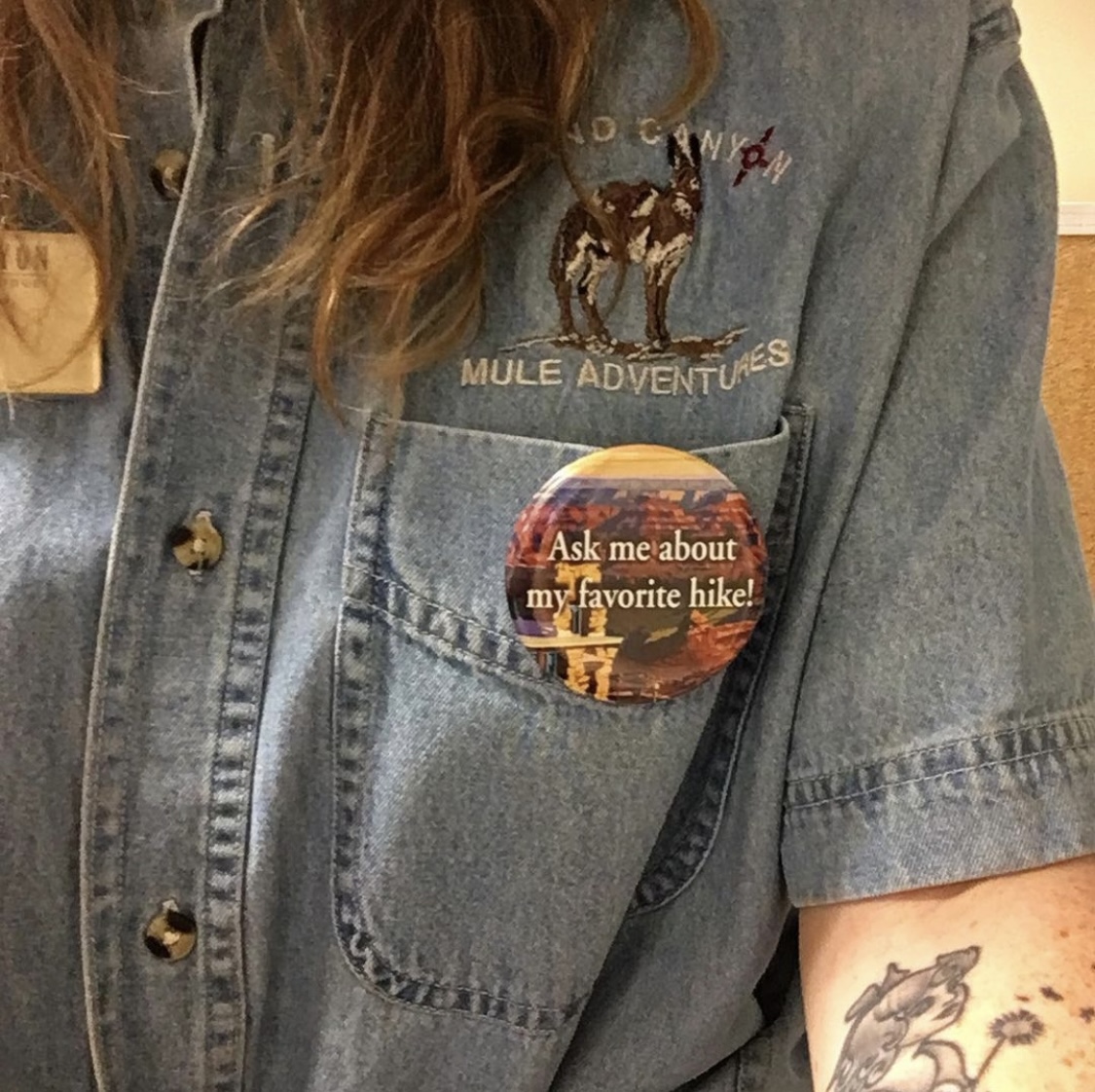
I have tried a few different approaches, but for me the top two most sustainable and reliable options have been seasonal work and online remote work. I worked at Grand Canyon National Park for a few seasons, at hostels in Alaska and Colorado, and at a ski resort. Currently, I have “normal” employment in the sense that it’s not a temporary seasonal gig, but the job is fully remote so I can work from anywhere in the States as a “digital nomad”.
Both methods offer plenty of benefits. While I have no plans to go back to seasonal work at the moment, in theory I would do so in a heartbeat. Of course, no solution is ever perfect, and both avenues to location independence also come with their fair share of drawbacks. If you’re not sure which one is right for you, try to be honest with yourself about your personality as you read over the following pros and cons of seasonal work vs. remote work. Do these sound like exciting challenges that will help you test yourself, or in practice would you find yourself annoyed and stressed in these situations?
*In my Jobs that Allow You to Solo Travel Full-Time as a Nomad post, I expand to talk about other types of jobs besides seasonal or remote work that are particularly well-suited to solo travelers and people who are interested in having the freedom to work abroad.

Jobs that Allow You to Solo Travel Full-Time as a Nomad
Remote Work Pros
Work from Anywhere

Because of the COVID pandemic, more people than ever are now working remotely, either by choice or necessity. If you’re not an “essential worker” that needs to clock in in-person, you may have already developed your own list of pros and cons in this category. If, like me, you don’t have a mortgage or a lease, working remotely offers the opportunity for permanent travel.
The best part about remote work is obviously the reason an aspiring nomad would pick this option in the first place – the ability to work from anywhere in your home country. Most remote workers are still ineligible for visas allowing them to work from other countries, but in America in particular, there is so much to explore at home. Since I began my remote job, I have traveled and worked from the North Cascades in Washington, the Smoky Mountains in Tennessee and North Carolina, the Chiricahuas in southern Arizona, Mesa Verde in Colorado, the Organ Mountains in New Mexico, and the Mighty Five national parks in Utah.
When family problems or holidays come up, I can even jet home on a moment’s notice without informing my employer. I can just work from friends’ or family’s homes if needed. If something goes wrong with a trip and I get stranded in a particular city unexpectedly, it’s not a big deal. I’ll just whip my laptop out and work from there.
Great for Introverts
Like Tame Impala, I consider myself a proponent of “lonerism”. I used to work in a typical office environment and I have not missed the social interactions at all. Gone are the days of being interrupted by office mates stopping by my desk for a chat. If I’m tired or grumpy, I don’t have to fake a happy face the second I walk in the door and spend the first 15 minutes in a small talk loop. Gloriously, I also don’t have to craft a different outfit every day, or worry about people noticing how often I cycle through the same shirt (or snacks).
In my current job, I do still talk to people all day via customer service phone calls. Some days, you turn the phones on at 8am and at 8:01am you’re already having a conversation. I suppose there are very few jobs where you can be a true hermit; perhaps coding or being an author.
Opportunity Cost
An oft-sited benefit of remote work is the lack of commuting. Depending on how far away your office had been, you might even be shaving multiple driving hours off of your day. That’s a lot of gas money and opportunity cost. With that saved time, you can make a real breakfast, go for a run, do laundry, or catch up on sleep. After being given this additional time in their day, most people can’t fathom returning to a typical office. This has shown true even for people who are not interested in a travel-based lifestyle. As a traveler, the extra time to explore or get settled in a new place is astronomically important.
Even at seasonal jobs, there may be some commuter time. When I worked at the ski resort, I was living the next town over. Plus, with each new gig I also had to learn my new responsibilities all over again. This creates some extra studying time when off the clock.
If you’re nomadic like I am now, you’ll still have commuting time as you dart around the world in between work days, but that is by choice and not necessity. Instead of spending money on rent and having to drive the same monotonous route every day, I spend my money on gas and flights to explore new places, and temporary housing like AirBnBs or campsites.
The stability I feel from having a steady paycheck from my remote job also frees me from worrying over where my next seasonal gig might be. That’s a lot of time saved when it comes to job applications and research.
Remote Work Cons
Confinement

Once I get to a new destination and it’s time to sit down for my next work week, I may not leave that bedroom for days at a time (for reference – I can’t work in public spaces like cafes or libraries because I take lots of noisy phone calls). When the weekend rolls around I am off to explore, but during the week I go from staring at my screen all day for work to staring at my screen all night for blogging or watching movies. You start to ask yourself when was the last time you saw a different set of walls? I might go to restaurants or shows in the evening occasionally, but the cost of entertainment adds up. If I want to live nomadically long-term, I have to treat it like real life and do things like eat my own groceries when possible. As a result, I try to reserve my bigger adventures for the weekend.
You end up feeling like you live in some kind of hermit cave as you sink further and further into the couch, and your mind gets lodged in strange insular ruts. By the last day of my work week I don’t even remember what species I am. “Despite all my rage I am still just a rat in a cage”.

How to Work Remotely While Living Out of Your Car
Living on a Screen
While it’s not a super valid “complaint” considering I get to have plenty of real-world adventures on the weekend, one thing that does really bother me about digital nomad life is the constant attachment to screens. When I worked seasonal gigs, I often had duties that didn’t involve computers. With my current remote gig, I stare directly at my computer screen for 8 hours a day. I barely move. With that comes eye strain, headaches, carpal tunnel, and muscle atrophy (which is especially a bummer for someone who wants to be strong for hiking, which is half the point of being nomadic for me). By the end of the work day, I’m such a pile of mush that I can’t fathom doing any activities that require even an ounce of dedicated focus.
If I don’t want to spend unnecessary money on going out in the evenings, then often the only thing left to do is swap to my personal computer and continue staring there. The best solution I’ve found is to go for walks or go to a gym after work, depending on how accessible these things are in my location.
No Boundaries
While I have tons of physical privacy, people can still access me at any moment because of today’s hyper-connected world. An upset customer can essentially come into my bedroom (virtually) and create negativity in my own space. Thankfully upset customers are rare, but it’s bound to happen with any kind of work.
Going from waking up leisurely and having a warm coffee to start my day, to fielding inquiries from customers right there in the same room, starts to confuse my sense of personal boundaries. In effect, there are none, and no space is sacred.
By the time my work day is over and I’ve spoken to hundreds of different people and taken on the emotional burden of all their various moods, the idea of further social interaction isn’t particularly attractive and the “hermit cave” element described above gets further reinforced.
Seasonal Work Pros
Always Something New to Look Forward to
Mentally, seasonal work is refreshing because you always know in the back of your mind that you can expect to leave at the end of the season (or whenever you and your employer agreed that your contract is up). A huge part of the existential dread of normal jobs is that you look ahead at your life and think, “is this going to be my routine forever?”
I love having an end date. It makes my world feel full of endless possibilities for the future. I like researching other seasonal gigs that I might head off to next, even though the uncertainty can be stressful. Or, if I am really enjoying the gig, usually it’s no problem to stay on for additional seasons or return in a few years’ time. Another option if I’ve managed to save up enough money during the season is to take a couple months off to do a long thru-hike, which is how I was able to pull off Project Multi-Trek.
Going somewhere different every season also expands your experience and knowledge base. If you’re a “parkie”, someone who cycles through working at various national parks, then each new park will teach you about local terrain, culture, and wildlife.
Free Housing

This is a big one. The rule of thumb is to spend 30% or less of your income on rent, but that idea is laughable to millennials today. More and more people are forced to spend over half of their income on rent alone.
When working seasonal gigs, employee housing is often included for free or for a negligible fee. At the Grand Canyon I think my cabin was like 43 cents per month. While my hourly income was very low, nearly 100% of it went straight into my pocket. It also felt cool to live in a historic structure, like I was truly a pioneer of the Old West.
At national parks, the employee housing leaves a lot to be desired in terms of quality, but I suppose you get what you pay for. I think this is a bigger problem for actual Park Service employees who need to be there year-around to do more high level ranger jobs. Affordable housing is impossible to find near many parks, so something really needs to be done to ensure our rangers have livable conditions. As a temporary concessionaire employee, though, I mostly didn’t mind.
Employee housing also means you will get to live somewhere that even the wealthiest parasites may not be allowed to live. If you are not an employee, you cannot live right there on the rim of the Grand Canyon itself (or below rim at Phantom Ranch) – but I did! I woke up to the canyon every day. Plus, through my job I got to do activities like helicopter and rafting rides for free.
I would have never been able to afford to live in Vail, or probably even vacation there for a few days, if I was trying to rent or buy a place on my own. However, as an employee at a local hostel I lived for free for a whole winter, and I even got a free ski pass at the resort because of my Ski School job. I would not be able to justify buying an expensive ski resort pass on my own dime.
*Technically Grand Canyon National Park is actually a bit of an exception. There is a small neighborhood community in Kaibab National Forest a bit away from the rim, and the Grand Canyon is the only national park that has a school on premises that graduates 15-20 kids per year. However, a lot of these modest homes are inhabited by basically “tenured” employees, so it’s still almost like employee housing. Nobody wants to vacate these homes and they don’t ever go on the market. They are also not directly on the rim like the concessionaire free employee housing is. Still, the sentiment stands – most people cannot actually live inside the bounds of a national park, so being an onsite employee is a very special privilege. This is one luxury that people can’t just buy their way into. If you are scrappy, you can live and work in spectacular places that most people only visit on short trips, barely scratching the surface.
Meet Like-Minded People
The other employees you’ll meet through seasonal work are often like-minded individuals who are trying to see the world and live a full, exciting life. Depending on the location, they may have similar hobbies to you, like hiking or snowboarding.
I’ve had some of the most enlightening and reassuring conversations with people that I’ve met at hostels. When I was at Basecamp Anchorage in Alaska, the employees and guests would sit around a bonfire at night and talk about how experiences are more important than material things. They’d tell stories about fording rivers, hitchhiking, or living in yurts and schoolies.
Meeting these folks adds some validation to your decision to live an alternative lifestyle. While I am fully dedicated to continuing to live haphazardly, and I’m grateful to have the ability, every once in a blue moon there are times when I question myself. When I speak with people who are doing adventurous things without looking back, I come back to center and remember my purpose.
You also get to meet guests and visitors from around the world, and the job is usually going to be in-person, so this solves the issue with digital nomadism where you’re secluded and staring at a screen all day. However, it may be less appealing for the introverts or folks who are feeling cautious about COVID.
Physical Exercise

Some seasonal jobs involve forest management, fire management, or hiking trail maintenance through a conservation crew. You could become a seasonal backcountry guide if you get the proper Wilderness First Responder certifications, a ski instructor, or even a mule wrangler in a place like the Grand Canyon.
None of my positions where ever that physical, but my seasonal jobs definitely involved more movement than my remote job. At the canyon I would at least have to stand up all day at an information desk. At hostels, part of my day was spent cleaning. Cleaning isn’t any deep passion of mine, but at least it forced me to get off my butt and kept the blood from pooling in my body. Sitting and working on a laptop all day is seriously much more taxing on my mind and body than I ever expected.
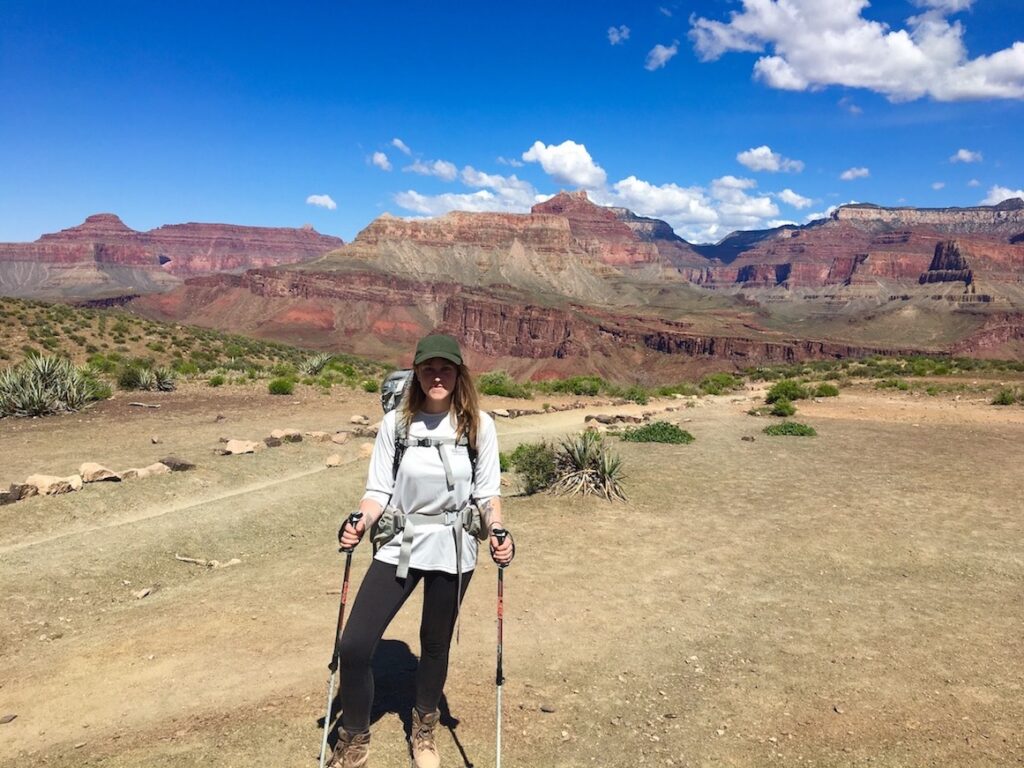
Free Download | Self-Guided Rim to Rim in the Grand Canyon
My favorite time in my life was when I worked at the Activities/Transportation Desk at the South Rim of Grand Canyon National Park in Arizona. I explained tours, activities,…
Seasonal Work Cons
Parkie Culture
Of course, not everyone is like-minded.
A “parkie” is someone who cycles through different seasonal gigs mainly at national parks. They may work at Death Valley one season, then Yellowstone the next.
Sometimes parkies are actually cool dirtbags and hikertrash kids who are focused on climbing rocks or hiking different trails around the country, but sometimes people have other motivations. The culture varies by park.
In the Grand Canyon, I got the feeling that a lot of folks are there because they ran out of other options in life. They didn’t care about nature or the outdoors at all, and just needed free housing and any job they could get. While I have respect for all workers and I don’t think people have to have the same interests as me, you’d think that at such a natural wonder your colleagues would all at least share a respect and awe for the park. This was not a lot of people’s focus.
There is a big party culture amongst parkies, and sometimes a drug culture as well. I haven’t been interested in binge drinking or going to parties ever since I left New York. For me, my outdoors lifestyle doesn’t really combine these two worlds.
At the Grand Canyon, random dude employees would hit on me all the time and even come into my cabin unannounced or show up at my work station while I was trying to help customers. While living at the Grand Canyon was maybe one of the best seasons of my life because of the hiking, creepy employees played a big part in why I left.
Working at hostels, you’ll interact with travelers from all over the world. Some of them expect to find a “party hostel”, even if your business is marketed as an outdoor adventure outpost. While I met some of the best people at my hostel gigs, I also met some of the weirdest freaks imaginable. Plus a few fugitives.
Lack of Privacy
I mentioned that random other employees at the Grand Canyon used to just come in my cabin unannounced to chat with me and my roommate.
This year, the FBI also contacted me and many other women who have hiked in the Grand Canyon because they arrested a park employee who had been secretly filming women’s toilets in the park for multiple years.
A lot of people ask me what it’s like to live at a hostel. At hostels, you won’t usually have your own room. You’ll share some sort of bunk room with other hostel employees. I actually don’t mind the bunk setup in general, since having a luxurious mattress is not a priority of mine. However, being constantly surrounded by dozens of people has its tolls.
You might hear some…noises…coming from other bunks.
If you have any guests who are at the hostel looking for a party, the voices and music can get loud. If you are on duty that night, then you are sort of forced to participate. Thankfully when I was working at hostels, I was still in a mode in my life where I didn’t mind this and I enjoyed staying up with everyone most of the time. Today, I would absolutely hate this.
Less Mobility
While you can move around to a different location each season, you are still stuck in one place for at least a few months. This may or may not be a pro/con for you.
I prefer slow travel, so I like to spend a few months in each location I visit anyway. However, sometimes just a month or two is all it takes before I’m ready to move on. Unfettered freedom is my top priority, so I like being able to take off on a whim.
Instead of just doing a short day trip from my “base” location and then returning back in time for work, which is what is necessary during seasonal employment, as a digital nomad with a remote job I can sometimes post up somewhere during my next work week. For instance, while I stayed in the North Cascades for a month, each week I picked a different region to work from. Contrastingly with in-person seasonal gigs, you must always return back to the base location again.
Income and Insurance
My salary is much better with my current remote job than it ever was at any seasonal gig. My seasonal jobs were basically minimum wage. The hostel jobs did not pay (though this is not always the case), so it was just a tradeoff for free housing and then I would get a second job (like at the ski resort) for an income. The Grand Canyon situation was good because it included both the employee housing and an income in the same job.
A huge portion of my income these days goes to housing solutions, so I’d be interested to do the math and compare how much I used to pocket in comparison to now. It might end up evening out to be about the same. I can live very cheaply by living out of my car and working from campsites, but I’m not aggressively dedicated to that. I do it on and off, but if I start to tire I have no problem allowing myself to stop and get an AirBnB for a few months. I don’t always have enough mental bandwidth to fret over whether I’ll have enough cell signal to work a day job from a BLM dispersed campsite.
Still, my remote job also comes with benefits and health insurance. I can take on more hours if needed. I always know I will have a paycheck and there is not going to be an off-season of a few months where I don’t know what to do next. There is more general stability.
I did have basic health insurance through seasonal jobs, but in some cases that doesn’t kick in until you’ve worked a few weeks or months. You can end up going without healthcare for a time. These employers are also not going to offer the best packages, considering the seasonal turnover rate is so high.
You could think about getting travel insurance as an alternative. Travel insurance policies often have medical and evacuation clauses. You can search Travel Insurance Master to compare plans from different companies.
Spot Insurance can cover you in case of outdoor injury as well. Spot starts at $25 a month and covers you up to $20,000 each time you’re injured.
These solutions are probably not going to suffice on your taxes though. There used to be a federal penalty fine you had to pay if you didn’t have health insurance. I believe this was eliminated at the federal level, but your state may still charge a penalty on your state tax return.
The Brent and Michael are Going Places article “How Does Health Care Work for a Long-Term Traveler?” is a great deep dive of options.
Like any other type of job, there are plenty of pros and cons of seasonal work and remote work and it ultimately comes down to which benefits are going to outweigh which drawbacks for you. What is your top priority as you seek to design a location independent lifestyle, and what are you willing to put up with to get it? None of us are in this game for comfort, but we all have varying degrees of tolerance when it comes to income, privacy, mobility, uncertainty, and physical vs. mental vs. emotional labor.
Have you tried both of these lifestyles? Which one was more sustainable for you in the long run?
Related:








Pin It:

My dream is to write travel and hiking content full-time. All of my guides and itineraries are free and my travels are self-funded. If you enjoy my site and would like to support, you can donate any amount to my Ko-fi page. Thank you!!