
3 Day Grand Teton Itinerary for Hiking Enthusiasts
Purchases made through some links on this page may provide The Detour Effect with commissions (at no extra cost to you). Thank you!
Grand Teton National Park in Wyoming has a lot to offer different kinds of travelers, from cyclists to history buffs, kayakers, families with young children, and wildlife viewers. That said, as a hiking enthusiast I’m biased; I think the best thing to do at Grand Teton is hit the hiking trails!
On a first visit to a national park and when I’m strapped for time, one thing I struggle with as a dirtbag hiking enthusiast is that I may not be able to commit to a longer overnight backpacking trip, and I can’t even mark every “best day hike” in the park off the list. What you can do if you have a long weekend to spend at Grand Teton is experience all the main highlights of the park while still logging some solid hiking mileage. In just three days you can hike to a handful of the pristine alpine lakes Grand Teton is famous for, go for a swim, check out historic buildings, and pull over at famous viewpoints. If you’re lucky like me, three days in Grand Teton is also enough time for bear and moose sightings!
Just keep in mind that if you follow my three day Grand Teton hiking itinerary, you’ll quickly become obsessed with this area of the country and be inspired to return time and time again. I suppose no amount of time in Grand Teton will ever truly be enough. Don’t blame my itinerary, Blame it on the Tetons.
This is a self-guided Grand Teton itinerary. If you prefer a guided tour, check out this half-day Grand Teton tour from Jackson, a Grand Teton full-day tour including the Jenny Lake boat ride, or other Grand Teton day trips. For guided backcountry hiking trips, I recommend Wildland Trekking.
FAQ:
Day One: Cascade Canyon, Jackson, Historic Homesteads
The most popular region of Grand Teton National Park is Jenny Lake. It will be pretty crowded, but it’s beautiful; you can’t visit Grand Teton and not see Jenny Lake! We’ll scratch this itch first thing on day one, which will leave the rest of our weekend open to exploration. To make it a little more exciting for hiking enthusiasts, we’re going to hike past the initial crowds and into one of the Teton Range’s famous glacial-carved canyons.
Cascade Canyon
8 miles out-and-back to the fork


What is there to see on Cascade Canyon Trail in Grand Teton?
Cascade Canyon trail begins with a hike to Hidden Falls and Inspiration Point, then continues past these landmarks into the canyon. As you traverse along the bottom of Cascade Canyon, you’ll be following Cascade Creek as mountains sandwich you on either side. If you’re there in summer, you’ll notice waterfalls coming off the mountain and down into the creek as a result of snowmelt. It’s like you’re in a protected oasis with its own micro ecosystem full of wildflowers, foliage, and wildlife. I saw a moose grazing near the creek and a black bear rooting around in the forest not far off the trail!
There is some elevation change to get up to Inspiration Point, which is a viewpoint that looks out over Jenny Lake, but after that the whole hike is pretty flat. From then on out, any difficulty really only comes from the distance. A solid day hiking distance would be to hike to “the fork” and back, which would be a little over eight miles roundtrip (that’s assuming you are taking the boat shuttle to and from the trailhead; if you walk back to your car via Jenny Lake Loop trail, that adds mileage). If you’d like to hike further, you can continue all the way to Lake Solitude or even into Paintbrush Canyon. I only hiked to the fork and I thought the trail got a bit monotonous towards the end; I wish I had hiked all the way to Lake Solitude so there would be a special destination point. If you do hike to Lake Solitude, you won’t have much time for anything else today unless you start really early.
How to get to the Cascade Canyon Trailhead

To reach Cascade Canyon trailhead, first you’ll park at the Jenny Lake Visitor Center. From there, tourists will corral themselves to Hidden Falls and Inspiration Point by taking the boat shuttle on a ten minute ride across Jenny Lake. The boat costs $12 one-way or $20 roundtrip and will drop you at the trailhead for Inspiration Point, which is also the trailhead for Cascade Canyon. You do not have to purchase boat tickets in advance and can decide when you get there. If you don’t want to take the boat, you could do a flat lakeside walk around Jenny Lake for two miles to reach the trailhead instead.
Aside from the price of the boat and the potential length of the line to board it, a deciding factor in whether or not to take the boat is how far up Cascade Canyon you want to hike. By not walking around Jenny Lake, you’ll save yourself four miles (two there and two back). You might want to save your energy for Cascade Canyon by taking the boat.
The hike to Inspiration Point and back is 1.8 miles and this section will be very crowded. Once you pass Inspiration Point there will be less and less people in the canyon, though it’s still well trafficked.
Thankfully I got in line to take the boat shuttle pretty early so there wasn’t much of a wait, but on the way back after finishing my hike, the line to board the returning boat was absolutely ridiculous. It didn’t end at the boat dock and wrapped up the trail. Most of the people in the line only came across to do Inspiration Point and then went back again, so I found myself getting very cranky at them. I thought that if you’re only going to hike 1.8 miles, you should really walk around Jenny Lake to get there and let us 8+ mile hikers have the boat. If you decide to take the boat shuttle, be a better person than me and have some patience.
Jackson, Wyoming
I had never been to Jackson before, so it was important to me to swing through at some point even if it was just for a meal and museum, only to return back to the park. You could leave Jackson out of the itinerary to avoid extra driving if it’s not a priority for you (or, you may have already driven up through Jackson to get to Grand Teton at the start. I came through Yellowstone).


Where to Eat in Jackson, Wyoming
Jackson can be a fancy place but I’m not a very fancy person. I had lunch at Jackson Drug, which has a varied menu of American fare that’s more creative than the usual diner-esque options, including some healthy dishes that I was grateful to fuel up with after a hike. In advance of my trip I had noted a few different breakfast spots in Jackson, Wyoming that look amazing and are open until 2-3pm, including the Virginian Restaurant and Cafe Genevieve. You may still make it in time to visit one of these and they also serve lunch.
Jackson Hole Historical Society and Museum


This museum in Jackson, Wyoming is a bit overpriced for what you get, though there are some cool relics worth seeing. It’s $10 and the museum is just one room. On display are Native American artifacts that were found in Jackson Hole, including an effigy of a human and a crescent moon carved from rock. I was also fascinated by a bow (as in, bow and arrow) made out of the horns of bighorn sheep instead of wood. The museum has homesteading and cowboy-era antiques with a particular focus on how dude ranches increased tourism and made Jackson a sought-after vacation destination.
I overheard the woman at the front desk saying that they will be moving the museum to a different building later in 2023, so perhaps they’ll be expanding in size as well. *Update: their website now says “We will reopen at our new History Museum Campus on East Broadway in June 2024.”
Parking in Jackson, Wyoming
There are a handful of free public parking lots all throughout Jackson, Wyoming, which was super convenient and surprising. I expected an expensive town like this to gauge me on parking. Simply search “parking” on your Google or Apple Maps to find them, or read about the options here. One of them is across the street from the museum. If the regular parking lots are full, there’s also a large multi-level free parking garage on Millward St and Simpson Ave.
Historic Homesteads in Grand Teton
As you’re finishing your day and driving back to the campsite, you’ll pass turnoffs for the following historic districts. If you don’t have time to visit them on Day One because you spend too much time in Jackson or hiking all the way to Lake Solitude, you could tack this onto Day Two.
Mormon Row Historic District


Mormon Row is a still-standing but abandoned collection of homesteads built in the 1890s by Mormon settlers in what is now Grand Teton National Park. This region of Wyoming was one of the last to be settled in general because of the remoteness, harsh winters, and difficulty in crossing mountain ranges. However, Mormon Row provided access to the Gros Ventre River, fertile soil, and protection from the elements due to Blacktail Butte.
If you’ve seen pictures of Grand Teton National Park, inevitably at least one of them was likely taken from Mormon Row. Some of the wooden buildings have unique architectural shapes, and one is a bright pink! They sit in a wide open plain but are flanked by the Teton Range, so photographers find this location quite scenic.
Menor’s Ferry Historic District
If you still have time, there is another historic homesteading district near Mormon Row that is less visited. There’s an old general store and a replica of the ferry that crossed the Snake River at the turn of the century.
“Menor’s Ferry once belonged to William D. Menor who came to Jackson Hole in 1894, taking up a homestead beside the Snake River. Here he constructed a ferryboat that became a vital crossing for the early settlers of Jackson Hole Valley…In dry months the river could be forded safely in several locations, but during periods of high water even the most reliable fords were impassable. After 1894, Menor’s Ferry became the main crossing in the central part of Jackson Hole.”
National Park Service
Where to Camp for Free in Grand Teton National Park


Usually when I use The Dyrt to find free dispersed campsites near the national parks, the campsites end up being somewhat remote and I can find a secluded spot all to myself. In Grand Teton National Park, do not expect this.
I saved the coordinates of three different dispersed backcountry campsites in the Bridger-Teton National Forest and ended up visiting two of them. The first one at Shadow Mountain was completely full, though I half expected this since I arrived in the late afternoon/early evening. If you want to prioritize staying at a particular campsite, you might consider going there first thing before your hike up Cascade Canyon and pitching a tent to save your space for later.
The next one I tried was Upper Teton View, aka Toppings Lake/Spread Creek area, and I was able to find a space here with an incredible view out of the Tetons. It really is pretty special. However, tons of tall RVs running loud generators were also parked there, some of them blocking the view. The second night I chose a different parking place in the same region thinking it would be quieter, but at 10pm a hoard of kids pulled up in 6+ vans and boxed me in by parking in a square formation directly behind my truck so they could party in the middle space between their vans. It was my worst nightmare and I didn’t fall asleep until midnight. If you’re more social than me, maybe you’ll enjoy finding yourself in a party atmosphere.
I am not sure if the other sites would have been any better; during the busy summer season you may just need to accept the crowding and be grateful that at least it’s free. That said, a friend of mine visited only two weeks after me and said the Upper Teton View campsite barely had any people in it. Maybe I just chose a particularly popular week? I think he was also there on a Monday-Wednesday while I was there a Thursday-Saturday.
As I was driving throughout the park, I noticed signs for other dispersed camping areas that I hadn’t saved coordinates for. There are actually a lot of options, which is pretty cool; other national parks don’t always accommodate campers in this way. Here’s more information from the Forest Service about the various dispersed camping locations in Grand Teton.
Of course, you could always pay for a designated campground with more amenities like those at Colter Bay or Jenny Lake, or look for a hotel or hostel in Jackson, Wyoming.
Day Two: Taggart and Bradley Lakes, Colter Bay Swim Beach, Famous Viewpoints
Today will be the easiest hiking day of the three (if you only want to do challenging trails, this would be the day to deviate from my itinerary and choose something harder that you’ve researched on your own), but this will leave you with lots of time to explore other corners of the park in the afternoon. It gets very hot by the afternoons, so you may be grateful to get off the trail and do some sightseeing.
Taggart and Bradley Lakes
6 mile loop, or you could go out-and-back


What is there to see at Taggart and Bradley Lakes in Grand Teton?
Taggart Lake and Bradley Lake are both great examples of the alpine lakes Grand Teton is famous for, and they are relatively easy to reach. One difference between these lakes in comparison to Delta Lake (tomorrow’s hike) is that Delta Lake has a pearly, milky, turquoise shade from the glacial flour, whereas Taggart Lake and Bradley Lake are more clear and reflective. You can get some awesome photos of the mountains mirrored in the lakes.
The grade remains mostly flat throughout, so you should be able to bang this one out pretty quick. It’s largely forested and under tree cover. Going clockwise will bring you to Taggart Lake first. There were a lot of families with young children hanging out on some good sitting rocks at Taggart Lake. Contrastingly, I didn’t see any other hikers on the stretch between Taggart Lake and Bradley Lake, and this is where I saw another black bear. Luckily I was singing to myself as a warning of my approach, so it heard me and shuffled away as I came near. This stretch definitely looked very “bear-y” with lots of dense low-lying shrubbery; you’ll know what I mean. There are a lot of bear sightings logged on recent trail reports, which makes sense because this section of the hike between Taggart and Bradley is like a land bridge between two bodies of water; it must be a great place for all different kinds of wildlife to congregate.
There wasn’t anyone else at Bradley Lake when I arrived, though a few other parties came later while I was relaxing lakeside. After you reach the lake, continue along the trail just a bit further in order to find the wooden bridge that stretches across it. The water is so clear and inviting here; it would be a good place for an alpine swim if you’re up for it.
How to get to the Taggart and Bradley Lakes Trailhead
The Taggart Trailhead is on Google Maps here, it’s pretty straightforward. There is a parking lot with a pit toilet restroom. It’s a good idea to arrive early for a space, but I was surprised that I didn’t need to get there that early. I parked at 8am on a Friday in July and there was still plenty of room.
Swim Beach at Colter Bay

Since this was a lighter hiking day, you’ll have plenty of time to drive over to Colter Bay’s Swim Beach to take a refreshing dip in Jackson Lake! There is a very large parking area, and then it’s a short walk to the beach where you’ll find picnic tables perched in the shade of forest trees a few yards back from the water. Snag a picnic table or lay down a towel and take in the scenery! You’ll be swimming with a full view of the mountains in the distance, and when I was there the water wasn’t particularly cold since Colter Bay is lower elevation than the alpine lakes you’ll find on hiking trails. This is one of the prettiest places I have ever swam and it will remain a fond memory.
If you’re not cooking your own camp food, at some point during your trip consider visiting the Pioneer Grill at Jackson Lake Lodge near Colter Bay, where you can order huckleberry pancakes for breakfast or a huckleberry milkshake, slice of pie, or a Huckle-Brownie at lunch!
Scenic Viewpoints in Grand Teton
Oxbow Bend


As you’re driving back to the campsite from Colter Bay, you’ll pass Oxbow Bend. This is a popular viewpoint because of the photogenic way the Snake River curves, and because wildlife can often be seen grazing here. Look for moose, otter, or pelicans!
Snake River Overlook
Another popular viewpoint as you make your way south is the Snake River Overlook (depending on where you camp, it could be more en route to stop here on your way to the Taggart Trailhead in the morning). This pullout is famous because it’s where landscape photographer Ansel Adams captured an iconic view of the Teton Range and Snake River.
Day Three: Delta Lake
Now that you’ve got your trail legs, you’ve hopefully worked yourself up to being ready for the most strenuous and rewarding day hike on my Grand Teton three day itinerary! We’re going out with a bang. If you are a beginner hiker or simply prefer a more leisurely trip this time around, you might want to deviate from my itinerary and choose a less difficult trail for this day.
A day hike to Delta Lake could take quite a few hours, and this itinerary assumes you’ll need to start driving onto your next destination at the end of Day Three, so Delta Lake is the main focus of this day.
Delta Lake
7.5 miles out-and-back


What is there to see at Delta Lake in Grand Teton?
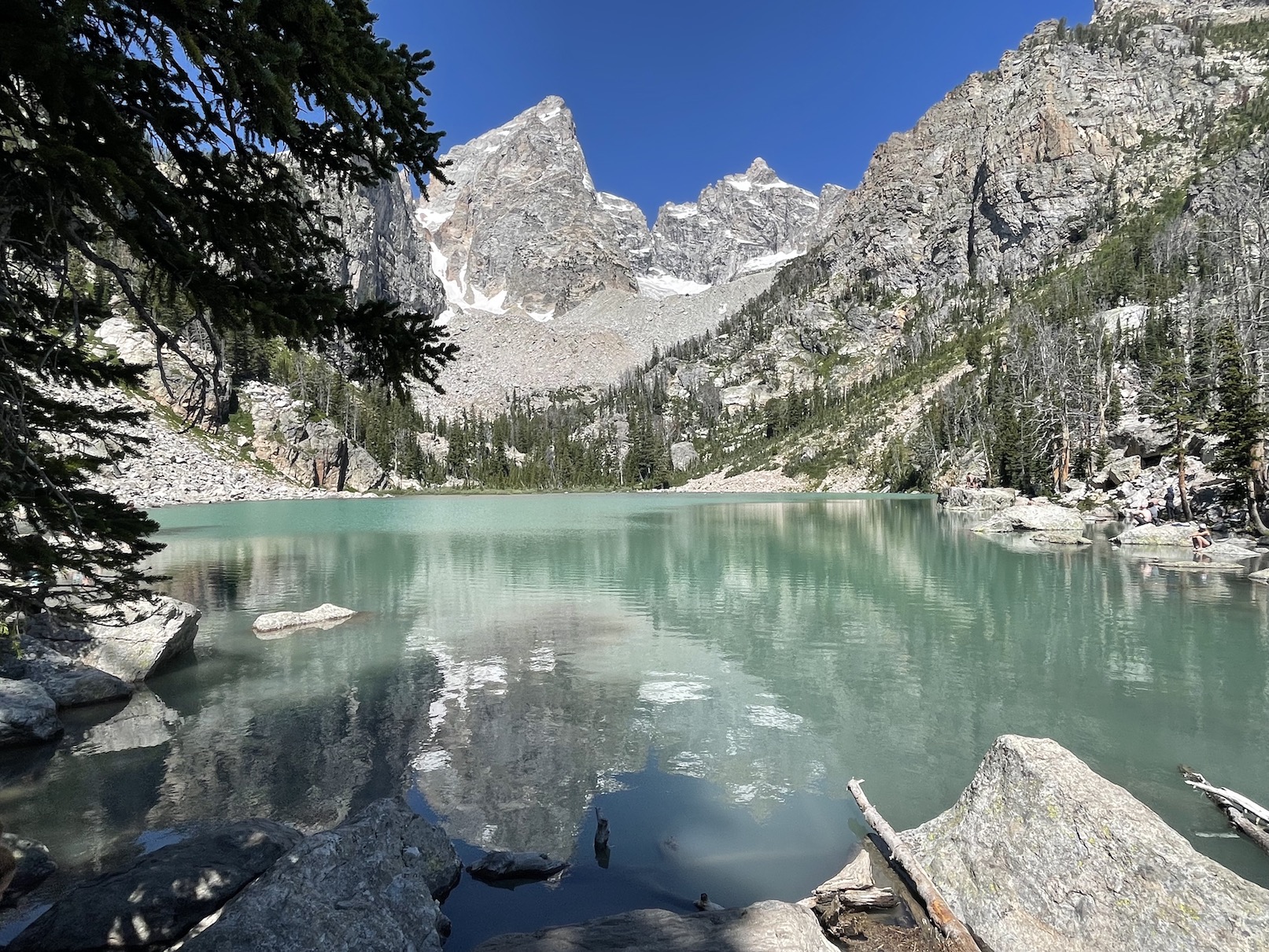
Delta Lake is the best Grand Teton day hike on my itinerary and is consistently rated as one of the best day hikes in the park in general. I absolutely loved this trail and the endpoint destination, and I’m pretty hard to please. Delta Lake is stupidly gorgeous. You’ll have a front row view of Grand Teton itself, which forms the backdrop to the pearly, baby blue colored water. The water was icy cold and I could only keep my feet in it for a few seconds, but I saw other bionic adventurers going for a full swim. On the way up to the lake you’ll follow switchback after switchback through open wildflower meadows with views of Bradley and Taggart Lakes from above, which is fun to see if you followed my itinerary and did that hike the day before.
Some of the hike to Delta Lake will be under tree cover, but a lot of it is fully exposed to the sun and you’ll want to prepare by wearing sunscreen and a hat and carrying adequate water.
For once I agree with the online difficulty ratings that list this trail as “hard.” It was a full body workout because of the scramble across the multiple boulder fields towards the end. You’ll need to get your hands on the rocks to help steady you as you make your way across. Normally I hate scrambles because they’re often on loose scree that falls away beneath your steps, but that’s not the case on this trail. I was never afraid of slipping or falling off any cliffs, so it was actually really fun. If you fell, you might scrape your knee, but you’re not falling down the mountain.
Some people think the initial ascent with all the switchbacks is hard; I saw people taking a lot of breaks and I’ve read trail reports that said the elevation change is difficult. I did not find this part difficult, but I also pride myself on crushing ascents in general. I cut my teeth in the Grand Canyon so I eat ascents for breakfast. However, there is a brief section just before you reach Delta Lake that is, as one AllTrails report put it, “laughably steep.” This section is made of very fine slippery sand and it goes practically straight up, so even though you’re not on a boulder field during this section, you’re still having to find footholds and use your hands to hoist yourself. Me and some new friends I made on the trail dubbed this section “the Hellslide.” We decided that it would really suck to descend the Hellslide on the return, so we opted to descend on the boulders instead, and this turned out to be a great decision. Since the boulders are directly next to the Hellslide, you can always see where the dirt trail is and can shimmy back over onto it whenever you’re ready to get off the boulders.
If I’m making it sound like a route-finding nightmare, don’t worry too much. Prior to this hike I read a lot of blog posts about how to find the trail because technically it is considered unmaintained, and people made it sound like you could get lost. In actuality I made it worse by trying to follow previous hikers’ instructions. One blogger wrote about what to do at “the first boulder field” and “the second boulder field,” but when you get out there, there’s like 5 different sections of boulders and I kept asking myself, “is this the second boulder field?” I tried to cross from the boulders to the lake in some weird unintuitive way that doesn’t make sense because of their post. Once you get out there, your options unfold and become apparent and you can figure it out your own way. It was also extremely crowded and I was able to follow in others’ footsteps. I know in many cases, this can be like the blind following the blind, but in this case I wasn’t led astray. I would still recommend downloading an offline map on GAIA before heading out there though.
If you want to extend your hike, there is an option to also see Amphitheater and Surprise Lakes. You’ll retrace your steps back from Delta Lake until you come to a fork in the trail, then head back up into the mountains on a bunch of switchbacks. It’s about another 1.3 miles one-way to add these on, or 2.6 miles out-and-back from the fork. Unfortunately there is no connecting trail to bring you directly from Delta Lake to Amphitheater and Surprise Lakes; when looking at a map you’ll understand why this would be very convenient.
How to get to the Delta Lake Trailhead
The Delta Lake day hike in Grand Teton starts from the Lupine Meadows Trailhead. There is a pit toilet at the trailhead. On a Saturday in July, the main parking lot was completely full by 7:30am. Luckily there is a ton of overflow parking, but this will be full by 9am. You really need to get there as early as possible. You’ll be glad you did anyway because of the heat.
Grand Teton National Park has torpedoed its way onto my list of favorite national parks, and that’s saying a lot considering I typically prefer the desert! I would love to come back and try the hike to Table Mountain or do one of the overnight backpacking or llama-supported treks offered by Wildland Trekking, though I do feel that my Grand Teton three-day itinerary provides a thorough introduction and overview of the different types of terrain and activities available in and around the park. Leave a comment if you have a favorite hike in Grand Teton that’s not on my itinerary; maybe readers who have 4+ days at their disposal can use your suggestions!
Coming to Wyoming from further afield? Use an Airalo eSIM for affordable international cell data and don’t forget to protect your investment with travel insurance.
Related:




Pin It:


My dream is to write travel and hiking content full-time. All of my guides and itineraries are free and my travels are self-funded. If you enjoy my site and would like to support, you can donate any amount to my Ko-fi page. Thank you!!
This page was incredibly helpful in planning my trip here for next summer. We are somewhat on a time crunch and will only have a day and a half at Grand Teton. We will probably omit the Jackson Hole and other historic stuff from our itinerary, as we want to mainly focus on hikes and being out in nature.
Do you think doing the Cascade Canyon and Taggart & Bradley Lakes hikes can be done in the same day? We are looking to do the Delta Lake Trail in half a day before heading up to Yellowstone. Thank you for all you do!
Awesome, thanks Alex I’m so glad it was helpful! You’re in for a great trip. Yeah I think you could definitely do Cascade Canyon and Bradley/Taggart Lakes in the same day, especially if you don’t take Cascade Canyon all the way to Lake Solitude and just turn around at the fork or earlier. Bradley and Taggart are pretty easy, hardly any elevation change at all.
We are going to Grand Teton this summer and this blog post was very helpful! Thanks!
Awesome, thanks Santina! I hope you guys have an amazing trip, I really fell in love with it
I love your photos! My boyfriend and I are planning on heading out to Grand Teton next summer and I will definitely refer back to this. Great post, thanks for sharing!!
This place looks lovely- definitely a dream hike experience for nature lovers!
By the look of your pictures, Grand Teton National Park is stunning. Thank you so much your detailed post with so much information on visiting this part of the world. Hopefully I will get there on day. Great article!
I definitely need to go back without my dog so I can explore these trails – especially Delta Lake! Beautiful photos. I’m glad you were proactively singing through the “bear-y” section, best to let them know you’re there.
I wonder what Hank would do if he saw a bear! Small dogs always seem to think they’re fierce guard dogs lol.
Wow your photos are stunning, Grand Teton looks so beautiful. I would love to do the Delta Lake hike. It sounds like a great way to spend 3 days. And LOL at the 1.8 mile hikers who don’t deserve to ride the ferry, I hear ya! My patience would be thin too.
My approach to sharing the hiking trails has me on a constant pendulum between radiating a vibe of inclusiveness vs. extreme irritation and selfishness lol. I make myself feel better by remembering that people still like Edward Abbey even though he was cranky about crowds in the parks.
OMG squeeee this is all looks amazing! I’ve been liking all your insta posts, but it is great to hear more about these fabulous trails, especially Delta Lake!
We do the same thing when we first visit a park, try a mix of the most popular/obvious trails and sneak in a couple of longer/more obscure trails. The grand tetons look like the kind of area where doing this for a long weekend would just make me plan a longer holiday!
You made me laugh with the “I cut my teeth in the Grand Canyon so I eat ascents for breakfast.” It makes me wonder what you’d think of the trails here – they must be less steep than the Grand Canyon, but they are pretty bad when the trail builders forget the concept of switchbacks!!
Yeah I’ll sometimes end up running myself a bit ragged trying to do it all in a short span of time, but I wouldn’t have it any other way!
Lol sometimes I hear hikers complain about switchbacks but I’m like….the alternative is so much worse. Switchbacks are a blessing!