
Folklore, Legends, and Mysteries of Flagstaff, Arizona
Purchases made through some links on this page may provide The Detour Effect with commissions (at no extra cost to you). Thank you!
In many places I’ve lived or traveled to, almost immediately upon arriving I would become the latest receiver in a game of telephone where urban legends and local folklore from the city’s history would be passed to my ear. Here in Flagstaff, Arizona they either don’t play telephone, or I missed the call. As a result I’ve found myself wondering about The City of Seven Wonders’ place in the Wild West.
I know Flagstaff had a large lumber industry (the word “sawmill” adorns many place names) and that a railroad runs through town (the sound of trains lulls me to sleep at night), but did we have gunslingers and cattle rustlers like in Phoenix and Tombstone? Arizona was the very last territory in the continental United States to become a state, the 48th, on February 14, 1912, and Flagstaff became an incorporated city in 1928, less than two years after Route 66 was completed. Our rather late official cityhood, and the state’s late admission to the Union, must mean that northern Arizona maintained a bit of roguishness well into the 20th century, right?
We are a rugged high desert bridge between the country’s eastern origins and western manifest destiny, or as Kerouac might have put it, “halfway across America, at the dividing line between the East of my youth and the West of my future.” We were built atop the ancestral lands of multiple Native American Nations. Collisions must have occurred, and epic/tragic stories born of those collisions. Who are the legendary outlaws and figures of Flagstaff’s early history? What myths grew from the dark shadows cast by the largest ponderosa pine forest in the world? Or, because we remained a territory for so long, are our stories mostly undocumented? Lord knows how many Native tales were lost to the wind and never shared, and now perhaps those of early colonizers too.

It turns out, Flagstaff did have a raucous period. The easiest era to find information on is around the time the railroad reached us in August of 1882. Since rails ran on wooden ties, E. E. Ayer’s lumber mill created tons of jobs and we transformed into a Wild West boomtown, complete with gunfights and brawls. According to John S. Westerlund, multiple men were typically killed every week in Flagstaff’s saloons, particularly between July 1882 and November 1883. Tired of it, Flagstaff’s citizens once “rounded up nine men — card sharps, holdup men, thieves, and camp robbers — and left them dangling from a large branch of Flagstaff’s ‘hanging tree’, near the west end of Cherry Avenue and today’s city park”. Most of the legends, mysteries, and myths below will focus on this time period, give or take a few years.
I’ve elected not to include Native legends. In my research of Navajo Skinwalkers I came upon a note that these stories are often kept within the culture and not shared with those who are not trusted. I went back and forth, because I would love to include different voices in this roundup of narratives from northern Arizona’s past, but ultimately some of them are not my stories to tell, and I probably couldn’t do them proper justice. I also don’t want to conflate sacred beliefs with the concept of “myth”. So, all aboard the Amtrak Southwest Chief wayback machine to Arizona Territory, first stop: Old Town Flagstaff!
The Wild West
Elden Murder Mystery
The first hike I ever did in Flagstaff was the Elden Lookout Trail to the fire lookout tower on Elden Mountain, so I was immediately familiar with the moniker. Its namesake is the pioneer John Elden, who was also a pioneer of Alaska and ran a store at Chilkoot Pass. He was born in Maine, became a Union Army soldier, was shot in the neck but recovered, and then made his way west when the United States government put the Homestead Act (1862) into place, which offered 160 acres to those who would settle and till western lands.
“He likely traveled by railroad to the Mississippi River, then by horse or wagon down the Santa Fe Trail, and across the well-traveled Beale Wagon Road along the 35th Parallel through Northern Arizona Territory, just south of the San Francisco Peaks, and on to the Colorado River. He ended up in Bakersfield, California around November 1869….By 1872, reports from travelers— or perhaps his own memories of abundant grazing land along the Beale Wagon Road — drew him back to northern Arizona”.

He married Susan Higgins in California and together they arduously herded a mass of sheep back to northern Arizona to begin their new homestead, arriving in February 1877. This was extremely soon after the very first settlements in Flagstaff began, as apparently a saloon was opened on the wagon trail by Edward Whipple in 1871 and Thomas F. McMillan began the first permanent settlement in 1876. John Elden built a log cabin against the southernmost mountain of the San Fransisco Peaks. They nourished a successful flock of 2,000-2,500 sheep, began a family, and became prominent figures in local society. Elden even discovered the ruins of a native Sinagua pueblo two miles northeast of their cabin, which you can visit today. It’s recognized by the Hopi people as an ancestral village, occupied from A.D. 1070 to A.D. 1275. Elden contributed a metate found at the site to the 1884 World’s Fair, “perhaps the first international display of a prehistoric Flagstaff artifact”.
Legend has it that one day while Mr. Elden was away, a muleskinner named Robert (Bob) Roberts rode by the homestead and asked Mrs. Elden if his mules could drink from her spring. Water was scarce at the time and there was barely enough for her own family, so she told him to move along. Angry, the man began an argument and ultimately fired a shot that hit one of the children, six-year-old Johnny Jr, who tragically died. Upon his return, John Elden and a posse of local men tracked the mule herd down and killed the man in an act of vengeance. Today, a gravesite does sit at the base of Elden Mountain. You can visit the homestead, spring, and gravesite along the Forces of Nature Trail. See below for my pictures; the final one is from my visit to the pueblo site.
However, there is no record of the murder of a child, which would have been major news considering Elden was a prominent local figure. Shortly after this incident, in late October or early November 1884 (the same year Old Town Flagstaff burned down), Elden moved his family back to California. There is scarce mention of him again in Arizona records. One of his daughters, Helena, did return in the 1920s to be honored as the first non-Native child ever born in Flagstaff, and she didn’t reference any story of a murdered brother. Her sister Delia did once vaguely mention a sibling that had died young. Descendants of the Elden family have done extensive genealogical research and believe the story is false or exaggerated, and that perhaps the child simply died of disease. If it’s a made up story, whoever started the rumor could have at least come up with a better name for the muleskinner than “Robert Roberts.”


Commodore Perry Owens and the Owens-Blevins Shootout

I’m intrigued by this dude and it’s not just because of his hair, but it is a lot because of his hair. Fabio of the West. Also, his actual name was Commodore, that’s not a title. That’s already a badass move on his mom’s part before he was even sentient.
Commodore Perry Owens was born in Tennessee, his family moved to Indiana, and then he ran away from home sometime between the ages of 13-16 years old to become a cowboy in New Mexico and Oklahoma. He also hunted buffalo for the railroad, which is how he became a skilled marksman. He arrived in northeastern Arizona around 1880 and was later elected Sheriff of Apache County (about 80-90 miles east of Flagstaff), taking office in January 1889. According to author Larry D. Ball, “at the time of Owens’ arrival, an explosive mixture of peoples — Anglos, Hispanios, Mormons, and Indians — vied for political and economic position in northeastern Arizona.”
Immediately upon taking office, he set his sights on bringing two gangs to justice. One was the Clanton Gang who had been involved in the O.K. Corral shootout with the Earp brothers and Doc Holliday in Tombstone in 1881 and were now wreaking havoc up north, and the other was the Canyon Creek Gang led by Andy Blevins, who were accused of murder, cattle rustling, destroying a church, and horse theft. The famous “Holbrook Shootout” or “Owens-Blevins Shootout” for which Owens is most known refers to his epic takedown of the Canyon Creek Gang.

The Pleasant Valley War between the Graham family on one side and the Tewksbury family on the other side had been like northern Arizona’s own Hatfield and McCoy feud, with a cattlemen vs. sheepherder dispute at its core. Andy Blevins was on the Graham side, and was overheard bragging about killing Tewksbury men. Already onto him for other offenses, Owens used this as an excuse to finally go after the Blevins gang. He rode to the Blevins house in Holbrook to serve a warrant, but was met with resistance. A gunfight ensued in which Owens singlehandedly killed three men and wounded a fourth, and walked away unscathed.
You can visit Commodore Perry Owens’ grave at the Flagstaff Citizens Cemetery. The house where the Blevins shootout took place still stands in Holbrook, as does the gravestone commemorating the three outlaws who died. The general store Owens ran after his retirement from law enforcement also still stands in Seligman.
Jesse Jefferson “Bear” Howard
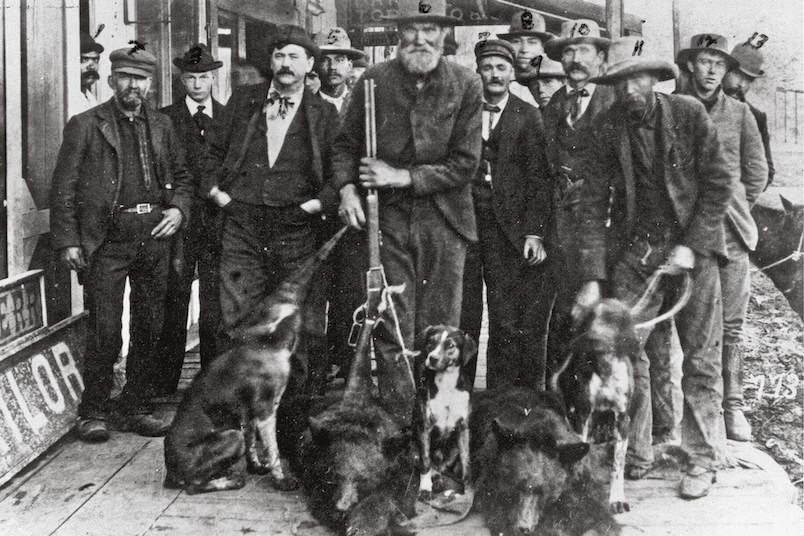
Bear Howard is exactly the kind of guy Hollywood tries to imitate in Westerns, but that they would never be creative enough to dream up. He’s the 6-foot-4 behemoth surrounded by dogs, black bears, and guns in the middle of this picture taken in downtown Flagstaff, which I have to imagine is unanimously considered by everyone, including the Smithsonian and Jesus, to be The Coolest Photo Ever Taken.
He was a trapper and San Quentin escapee who settled in Oak Creek Canyon in Sedona from 1880-1910 via squatters’ rights. It’s the remains of his homestead that you’ll find at the start of West Fork Trail, which is on my list of Best Hiking Trails in Sedona. He hunted bear, mountain lion, deer, and elk, and sold game to merchants in Flagstaff with much success. It’s reported that by July 4, 1885, he’d already killed 12 bears that season. It was a lucrative but dangerous business. This would have been around the same time bear hunter Richard Wilson, for which Wilson Mountain is named, was killed by a bear in Oak Creek Canyon.
Before settling in Arizona, he also took a bullet to the shoulder while fighting in the Mexican-American War. It remained in his body until 54 years later when he was drinking at a local saloon and on a whim allowed a Flagstaff doctor to dig it out – with no anesthetic.
Bear Howard continued his adventurous lifestyle well into his last days, and died at 93 years old. He’s buried at Mountain View Cemetery in Prescott.
Buried Treasure of Flagstaff
The Lost Dutchman’s treasure isn’t the only hidden cache in Arizona! With all the robberies and Wild West heists occurring in the 1800s and early 1900s, people got in the habit of burying their fortunes for safe keeping, both outlaws and honest businessmen alike. Maybe I shouldn’t be telling you this so that I can go out and search for the loot myself and become rich, but I can’t help but share a good story. If you find one of these, can I have 10% as your agent? And then maybe we need to toss a coin to Legends of America, where I found most the information here, here, here, and here. They’re repeated here and at other treasure hunter forums on the internet, though I’m having trouble finding definitive origins for these stories, such as newspaper articles about the robberies or citations in scholarly journals; another issue is lack of census information for the Territory before it was officially a state. Of the list below, I found the most independent information about famed Alcatraz and Leavenworth inmate Roy Gardner, and about the well-documented Ashurst pioneer family.
Flagstaff Trading Post – An estimated $250,000 of Hermann Wolf’s profits over 30 years (1869-1889) as the owner of a Trading Post were buried in jars around the property. Some of the gold and silver coins were supposedly found in 1901 and 1966 (I can’t find record of this), but only a small fraction. As an interesting aside – his grave is the only one still left in Canyon Diablo.

Ashurst Ranch – William Ashurst (father of Senator Henry Ashhurst, the “Silver-Tongued Sunbeam of the Painted Desert”) allegedly buried five- and ten-pound cans of gold coins on his property 25 miles southeast of Flagstaff, which were never recovered after his death. I can’t find where this rumor started, but I did find the true story of his horrific end – he was pinned to the ground by a giant falling rock and died of thirst a few days later. His body was found in the Grand Canyon by the man, the myth, the legend, John Hance, after whom the New Hance Trail is named.
Rogers Lake – As the story goes, outlaws Henry Corey and Ralph Gaines stole eight large gold bars and robbed a stagecoach of $25,000 of gold and silver coins in 1881, which they hid in wooden kegs and lowered into icy Rogers Lake. Gaines was later killed and Corey imprisoned. When he returned 24 years later, he couldn’t find the loot, and neither has anyone else. I can’t find any record of a “Henry Corey” or “Ralph Gaines”, except in various retellings of this story.
Mormon Lake – Four outlaws (or was it seven? The book Lost Mines and Buried Treasure of Arizona by W.C. Jameson mentions Henry Tice, Tom James, and Guppy O’Reilly banding together with another group of four additional riders) are said to have robbed two stagecoaches in 1879 for the hefty sum of $265,000 in gold coins, $60,000 in other currency, and 22 gold bars. King Woolsey’s posse caught up with them, killing some of the outlaws, and others were killed shortly thereafter in brawls. The loot is thought to be somewhere near Mormon Lake and Flagstaff according to some sources, or Buck Mountain according to W.C. Jameson.
Veit Spring – $125,000 stolen from a Wells Fargo stagecoach was never recovered from a cabin hideout at Veit Spring after the bandits were hunted down and killed in a shootout in May 1881. The book Historical Atlas of the Outlaw West by Richard M. Patterson alleges that a report about it was made by the officer in charge at the time, Captain Edmund Clarence Hentig, who was a real person (he died in the Battle of Cibecue against Apaches in August 1881, lots of information on him here and here). Art Miller wrote this as well in Gold: Historic Western Trails vol. 2 in 1995. I’m not sure where to find this “officer’s report” to verify that the robbery took place.

Great American Train Robber – $16,000 in gold coins, a small fraction of outlaw and escape artist Roy Gardner’s greater steal from the 1910s and 20s, may be hidden in the cone of an extinct volcano near Flagstaff. Gardner’s exploits also brought him to California and Washington, and the history does put him in Arizona. Find newspaper clippings here and here about his crimes in Phoenix. Where the rumor about a Flagstaff cache began, I’m not sure. Maybe he said it in his autobiography Hellcatraz? I am not paying $549.99 to find out.
Beale Springs – In 1880, a stagecoach containing $200,000 in gold disappeared near Kingman (a little far west to be included in a post about Flagstaff but what the hell). Right before his death at the wrong side of a lawman’s gun, bandit “Hualapai Joe” Desredo admitted to holding up the stage and burying the gold, but said he let the driver continue on his way. This story has another interesting element, in that a local named Max Bordon claimed in 1940 to have found the stagecoach crashed into a wide fissure in the earth nearby. A map of the general area in relation to Bordon’s tale was published in Arizona Highways in 1994. I can’t find the name “Desredo” in any other context except in relation to this story.
Pine Springs – The Henry Seymour gang robbed a stagecoach of $225,000 worth of coins in 1879 and hid it near Pine Spring Station. The stagecoach driver Mose Stacey rounded up a posse and ambushed the gang, setting fire to the building. The coins were never found. This is also described in Arizona Highways and Historical Atlas of the Outlaw West. I can’t find the name “Mose Stacey” anywhere else, but I imagine this must be the same Henry Seymour stagecoach robber known as the “Ghost Bandit” in Gillett.
>>Truth or Fiction?
Gladwell Richardson, aka Maurice Kildare (he had many pseudonyms as an “Arizona Historian”), seems to be the origin of the Pine Springs story. He wrote about this in Frontier Times March 1968 issue. He is also the person that Max Bordon supposedly contacted when he found the vanishing stagecoach in the Beale Springs story. According to George Shaw, an archivist at the Arizona State Railroad Museum, and also according to Marshall Trimble at True West Magazine, Kildare was mostly a spinner of tall tales. I found references to Hermann Wolf made by Kildare in this Navajo bibliography, which makes me wonder…Wolf was real, but how much of his hidden gold was? And how many other stories from Arizona’s past can be traced back to Kildare’s imagination? Is there any truth to the insane stories behind the Apache Death Cave at Two Guns or the Canyon Diablo abandoned ghost towns, which seem to have been first written about by Kildare but live on as fact today?
Oddities and Hauntings
Ghosts and Hauntings of Flagstaff
There’s an entire blog dedicated to chronicling Flagstaff-area ghost stories, which are so abundant that every October there are guided Haunted Walking Tours (here and here and here) you can join in downtown Flagstaff. I want to go next Halloween!
They include the haunting of the Orpheum Theater, Hotel Monte Vista (which also has cool Prohibition history), Hotel Weatherford (where they sometimes host murder mystery theater), Riordan Mansion, Northern Arizona University’s Morton Hall and McConnell Hall, the underground Flagstaff Tunnels (which are beginning to inspire modern legends as well), the Doris Harper-White Playhouse, the Milligan House, the Public Library, the Railroad Station, the Museum Club, and the NACOG Head Start Administration Building.
Mogollon Monster: Bigfoot of Arizona
Sightings of Arizona’s very own Bigfoot date back to 1903. I found an Arizona Republican article about the “Grand Canyon Wild Man” from June 1903 here.

Alien Abduction
The earliest reference to a UFO sighting in Arizona I could find was the January 1998 issue of Aviation History which mentioned many states across the Southwest, including Arizona, witnessing a machine in the sky in 1897. Today, Travis Walton lives to tell the tale of his alien abduction in 1975 near Heber, Arizona, southeast of Flagstaff. He also lived to see himself become the inspiration for 1993 movie Fire In The Sky.
These are my favorite myths and legends from Flagstaff’s history, but I’ve only scratched the surface of northern Arizona folklore. Every story leads me to another story, until I’m so far down the rabbit hole I don’t remember where I started! You could look further back towards the Franciscan Friars who named the San Francisco Peaks after St. Francis Assisi, or further still to the Spanish Conquistadors. You could look forward a few years into the Jazz Age and spend hours listening to interviewees talk about their memories of Flagstaff during WWI, the Depression, or Prohibition via the Flagstaff Public Library Oral History Project, for instance (it was also during this era that Pluto was discovered here at Lowell Observatory). You could study how the Great Migration brought many African Americans to Flagstaff for the lumber industry.
You could stick with the outlaw era but follow the Beale Wagon Road further east or west, or track outlaws as they left Flagstaff behind and made their way towards Phoenix, Tombstone, or Yuma. You can follow your curiosity into the Grand Canyon itself, brimming with enough mystery and rugged pioneer spirit to fill countless books. But something about the high profile and well-known lore of those places, where stories are told into the ground and often milked for all they’re worth, makes me proud to be a Flagstaff resident. In our sleepy mountain town, despite the growing pains of recent years, our stories have been allowed to percolate beneath the surface and take on lives of their own. While the Wild West slowly fades into kitsch around the country, here in Flagstaff you often still feel as if you have one foot in Old Town.
If you have plans to visit Flagstaff, you can check out historic downtown buildings using this free walking guide published by Discover Flagstaff. Also don’t miss the public street art described in my Roadside Attractions: 10 Stops in Northern Arizona post, and my favorite trails and restaurants in my Best Hikes and Sights in Flagstaff, Arizona post!
Are you aware of any Flagstaff mythos I haven’t touched on? Please share in the comments, I am fascinated by the fact that Flagstaff’s history is so elusive!
🏨 Find Flagstaff hotel options or search for free or paid campsites in Flagstaff.
✈️ Coming to Arizona from further afield? Use an Airalo eSIM for affordable international cell data and don’t forget to protect your investment with travel insurance.
Related:







Pin It:

My dream is to write travel and hiking content full-time. All of my guides and itineraries are free and my travels are self-funded. If you enjoy my site and would like to support, you can donate any amount to my Ko-fi page. Thank you!!
As you probably noticed, I have regularly come back to this article to read a section. It is simply too much to absorb at once and I loved the stories I was reading. This is exactly what I would be interested in when visiting this part of the US. (How did you guess 😉 ). I love it when travelling through an area and visit locations that apart from being beautiful or queer, have a backstory to tell. This is like a treasure trove to me and one of the main reasons to keep following all your detours. Loved also the addition of ghost and ufo stories. Real fun. One more thing: Woman you are thorough in your research. Well done!!!
I lived in Flagstaff for 30 years and didn’t hear about most of these stories. I am thankful for this article and I shared it with tons of person that I know that has lived in Flagstaff. This is truly fascinating stuff.
That’s awesome, and exactly what I was hoping for – thanks so much for sharing! It seems like Flagstaff’s stories don’t get told, even among those who live here. Was hoping to kind of light a fire under them so they can get passed along. I hope your friends enjoy!