

Things to Do in Mesa Verde National Park in Winter
Purchases made through some links on this page may provide The Detour Effect with commissions (at no extra cost to you). Thank you!
Mesa Verde National Park in Colorado is famous for its 600 Ancestral Puebloan cliff dwellings, plus additional pithouses and pueblos, all built between 550-1300AD. While the park is open year around, most people visit in the spring, summer, or fall to avail themselves of the many hiking trails throughout the park. A less crowded but equally magical time to visit Mesa Verde is in the dead of winter, when snow blankets kivas, icicles overhang the natural alcoves of sandstone cliff dwellings, and vast swaths of land become available for secluded snowshoeing opportunities. I would wager that visiting Mesa Verde in winter actually gives us a better idea of the utility and advantages of these ancient living arrangements, which remain dry and unbothered by the snowy conditions atop the mesa.
That said, parts of the park are inaccessible in the off season, and there are unique things to do in Mesa Verde in winter that will influence preparations for your trip. While I’m usually all for “winging it” and taking unexpected detours, in Mesa Verde it’s worth doing some research in advance of a winter visit so you can make the most of it.
It costs $20 per vehicle to enter Mesa Verde National Park in winter (October 23-April 30). This allows you 7 days of entry. Alternatively, you can show your America the Beautiful Annual Parks Pass. If you don’t order a pass in advance, they can be purchased from a ranger at the entrance station.
What Parts of Mesa Verde are Closed in Winter?

Every year the Park Service will make different decisions about what parts of Mesa Verde should remain open vs. closed based on seasonal conditions. Be sure to check their Conditions and Alerts page instead of relying solely on this post. My aim is to provide context about what the usual closures actually mean in terms of your ability to see “the best” features of the park.
The most regular and impactful Mesa Verde closure in winter is Wetherill Mesa Road, which is typically open to drivers from May to September. Closure of this road means you will not be able to visit Long House, Step House, Kodak House, Nordenskiöld, the Badger House community, and a couple pull-over-and-park viewpoints.
Morefield Campground is open mid-May to mid-October, though when it’s closed in winter you are still allowed to park there and snowshoe or cross-country ski around the trails that start from the campground.
Far View Lodge is open from late April to late October.
There are not any guided ranger tours offered in winter, neither the interpretive Cliff Dwelling tours nor the evening programs.
Lower Petroglyph Point Trail is closed in winter, but the upper trail can be snowshoed. I still avoided the upper trail myself because it’s described as having steep drop-offs and scrambles, which I wasn’t sure about in snowy conditions.
Year-around: The Chapin Mesa Museum is closed for renovations until 2025, and Spruce Tree House has been closed since 2015 due to rock fall danger, though you can still see Spruce Tree House from afar.
What Parts of Mesa Verde are Open in Winter?
Fret not – there is still plenty to do in Mesa Verde in winter! All of the Main Park Road is still open, which means you can drive the Mesa Top Loop to see a handful of pithouses, Sun Temple, Sun Point View, Square Tower House, Navajo Canyon View, and my favorite, the spectacular Cliff Palace.
The short paved road to Cedar Tree Tower will likely be closed, but you are allowed to park at the gate and snowshoe the rest of the way. The same is true for the Far View Sites, including Coyote Village, and Park Point, the highest elevation point in the park.
Despite the Chapin Mesa Museum being closed for the next few years, you can still park there to use the restroom and check out Spruce Tree House from an overlook.
The Cliff Palace Loop Road is closed for driving, but you may park at the Chapin Mesa Museum and snowshoe or ski in to get a closer look (though you can already get a pretty good look at Cliff Palace from Mesa Top Loop).
All of the easy pull-over-and-park viewpoints along the Main Park Road should be accessible, including Geologic Overlook, Montezuma Valley Overlook, and Mancos Valley Overlook.
Main Park Road is quite winding. Typically I don’t like Colorado mountain roads that are narrow with steep drop-offs, but I didn’t mind Main Park Road at all. That said, you’ll want to drive slowly in some places. There may be ice on the road. It’s a good idea to have snow tires and four wheel drive. Note that the gas station inside Mesa Verde is not open in winter.
What is There to Do in Mesa Verde in Winter?
If you’ve never visited Mesa Verde National Park, all of this may sound like gibberish to you so far. I’ve set out to visit all of the open winter season sites at Mesa Verde myself so I can give you a better idea of what to expect and prioritize, whether you prefer to be more active or if you’re not the biggest fan of wintertime sports.
*Note – the Luminaria lantern event at Mesa Verde has been cancelled the last couple winters 🙁
Prefer a guided tour of Mesa Verde? Durango Rivertrippers & Adventure Tours are the only company offering small group tours and private tours with archaeologist-trained guides.
Sightseeing in Mesa Verde in Winter
If sightseeing is more your speed as opposed to skiing or snowshoeing, the best thing to do in Mesa Verde in winter is drive the incredible Mesa Top Loop. This one-way 6 mile loop will bring you to 11 ruins or viewpoints where you can get out of the car to experience history up close. You’ll be tracing the years chronologically by starting at the remains of a pithouse built in 600AD and ultimately ending at a collection of cliff dwellings built between 1260-1280AD. From the Mesa Verde Visitor and Research Center, you’ll drive Main Park Road for about 21 miles to reach the first pithouse on the loop.
Before your trip, download the “Mesa Top Loop Audio Tour – A Pueblo Perspective on Mesa Verde” for offline listening on Spotify or wherever you get your podcasts. It’s a self-guided tour narrated by TJ Atsye, a former park ranger and descendant of the Ancestral Puebloan people. You can listen as you drive, or keep your earphones in while walking around the sites. There’s also a paper brochure available at the first pithouse you’ll stop at, with a suggested $1 donation box.
Pithouses


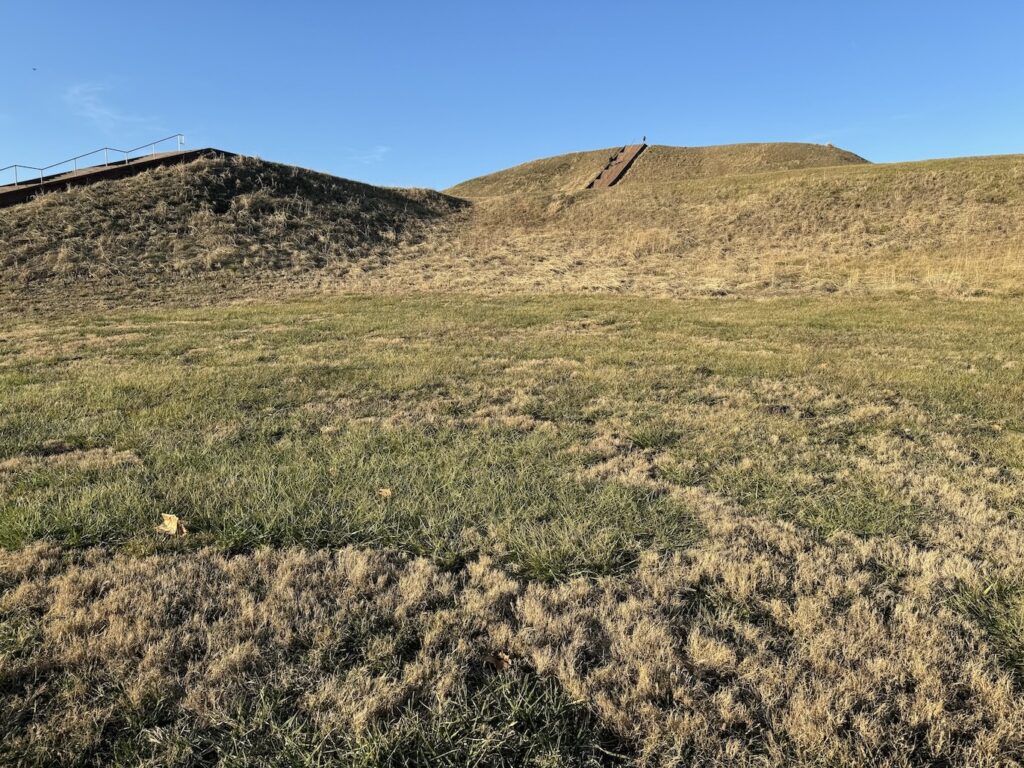
The earliest examples of Native American dwellings that you can visit today in Mesa Verde National Park are pithouses and pueblos built from 600-1100AD. Pithouse dugouts in the earth were designed for keeping warm in cooler temperatures and cool in warmer temperatures. A ventilation shaft was often incorporated for letting smoke out from their fires. Ground-level latticed wooden beams sealed with mud would have formed the roof, with a ladder descending through it leading down into the living quarters.
In later years they began to build above-ground rooms made of jacal, which was wood plastered with mud and supported by large stones at the base. Then came single-stone-wide masonry walls, which allowed for bigger rooms and larger villages. According to the Park Service, the building of one new village around 1075 was “a major innovation with its use of double-stone, rubble-core masonry – two outer walls with soil and rock fill between them. This sturdy construction allowed for the building of large multi-story room blocks and towers.”
Wandering these sites, we’re retracing the exact steps of people who lived here hundreds of years ago, although we follow a paved path now. At each site I found myself wondering what unexcavated artifacts still hide beneath the surface, maybe just under the road where I parked, or beneath my very feet.
Cliff Dwellings


The cliff dwellings are the crown jewel of Mesa Verde National Park, and the main feature visitors come to see. Thankfully, some of the most incredible examples of cliff dwellings in the world are viewable along Mesa Top Loop in the wintertime!
The cliff dwellings you’ll see on Mesa Top Loop include Square Tower House, Cliff Palace, Fire Temple, New Fire House, Oak Tree House, and the 30+ cliff dwellings tucked into the canyon walls at Sun Point View. My favorite examples were Square Tower House, the first cliff dwelling on the loop, and Cliff Palace, the last one on the loop.
Square Tower House includes the tallest standing structure in Mesa Verde. At four stories and 27 feet tall, you can probably pick it out from my pictures in the gallery above. Square Tower House has been stabilized by archaeologists but is still 90% original (as is Spruce Tree House, another very well-preserved dwelling near the museum); it has original roof beams and ancient rock art. As you walk towards the overlook, before the dwelling comes into view you won’t realize you are already walking just above it. It’s easy to understand why this would have been a good hiding place from whatever might be lurking atop the mesa.
Cliff Palace has 150 rooms and 21 kivas, making it North America’s largest cliff dwelling. It looks like an entire city unto itself and must have been a cultural center for the many family groups living in pueblos and cliff dwellings throughout Mesa Verde. It’s fun to imagine what it must have sounded like with voices echoing across the canyon, or looked like at night with fires glowing in the dwelling windows.
Visiting Mesa Verde in winter is a great way to understand what life must have been like for the Ancestral Puebloan people during their occupation of the cliff dwellings. Everything else in the national park is blanketed with snow, but the dwellings remain dry, cozy, and untouched in their alcoves. In my picture of Spruce Tree House, icicles threaten from above and snow piles up from below, but the buildings are none the wiser. In comparison to the pithouses of earlier centuries, which would have required maintenance after every bout of rain or snow, the cliff dwellings are certainly a savvy upgrade.
Snowshoeing in Mesa Verde in Winter
In winter, you can snowshoe to Park Point, Cedar Tree Tower, Far View Sites, Cliff Palace Loop, and around Morefield Campground, including Prater Ridge Trail, Point Lookout Trail, and Knife Edge Trail. You can cross-country ski at Cliff Palace Loop and Morefield Campground, including Morefield Campground Trail and Meadow Bliss Trail. Throughout my time snowshoeing at Mesa Verde, I never shared the “trails” (sometimes I was the first person to make a trail on fresh snow) with anyone else. This is such a peaceful park to visit in winter for those who seek true solitude.
You can rent snowshoes and poles for free from the Visitor Center, which is open from 8:30am-4pm. You must return the snowshoes by 3:30pm. You’ll just need to fill out a form that asks for your name, driver’s license number, car make/model, and intended trails.
A note about etiquette from the Park Service: “Snowshoers must travel on designated snowshoe trails, or fresh snow (ungroomed surface). If a groomed trail is designated as mixed use (snowshoe and ski) snowshoers must travel at the edge of the trail opposite the classic ski tracks. Classic ski tracks are set to the edge of the groomed trail and will have two parallel tracks about 8 inches apart running parallel with the groomed trail. Walking without snowshoes is not permitted on any groomed trails.”
Park Point


Park Point is the highest elevation point in Mesa Verde National Park at 8,572ft. It’s an out-and-back trail (1 mile each way in the winter, because of the parking situation) where your ultimate destination is a fire tower, from which you have 360 degree views in every direction. On a clear day, you can see Colorado, Arizona, Utah, and New Mexico. We are in the Four Corners, after all! Keep an eye out for a mountain formation called Sleeping Ute. Can you tell which mountain in the photo gallery above resembles a man lying down on his back, arms folded over his chest?
Parking: In summer, you would pull off of Main Park Road onto a side road which leads to a large parking lot. In winter, this side road is closed, so instead you will park right off of Main Park Road itself. The Park Service plows a little area so you can pull over safely. When I was there, there was just room enough for one car. If you are not able to park there because another car already took it, I was told by a ranger that further up the road is another larger pull-off area. It wasn’t designed for this purpose, but you’re allowed to use it for Park Point parking if needed.
You’ll snowshoe up the road that folks normally drive, eventually reaching the parking lot. From here you’ll actually “begin” the trail. It’s a quick incline up to the fire tower, and you will also find two viewpoints with telescopes to your right and to your left. The fire station is not manned in winter. I felt like the only person left in the world.
Far View Sites


The Far View Sites are above-ground pueblos and kivas making up a mesa-top farming community, including five villages and a reservoir. Coyote Village, Pipe Shrine House, and Megalithic House are the most impressive. I was surprised that sites like these are left out in the open and under the elements so that snow can pile up around the ruins, and you can simply walk right up to them on a self-guided tour. I noticed some previous snowshoe tracks walking all inside the villages, which doesn’t seem like a good idea. I’d imagine the Park Service would prefer if you just walk up to the outer edge of the ruins and don’t tramp on top of them.
While a few people had clearly come before me and I was able to follow their tracks to Coyote Village, I had to make my own trail when snowshoeing out to Megalithic House. Luckily I have the GAIA navigation app on my phone and it was clear how to find it without any trail or signs. After weaving around to all the sites, I had only snowshoed about a mile, though it felt like a workout in the thick snow.
Parking: In the summer you could pull off of Main Park Road onto a side road leading to a parking lot for Far View Sites, but in winter this side road is closed. You’ll park outside the gate instead, where there’s room for maybe 2-3 cars, and snowshoe the rest of the way in.
Cedar Tree Tower


There were no previous snowshoe tracks whatsoever to Cedar Tree Tower, though there were a ton of animal prints! At first I thought they were bobcat, but a friend reminded me you wouldn’t be able to see claw marks on cat prints. It must be coyote or fox. Whatever it was, it was having a grand time, leaving a maze of tracks intersecting each other and a big hole where it must have been digging for a rodent.
I wasn’t wearing good snow boots this day and was getting soaked, so I didn’t finish exploring this area. I aim to return and get some good pictures of the kiva! But from looking ahead of me down the trail I could tell that it is extremely straightforward and flat.
Parking: Again, in the summer you could pull off of Main Park Road onto a side road leading to a parking lot for Cedar Tree Tower, but in winter this side road is closed. You’ll park outside the gate instead, where there’s room for maybe 3 cars, and snowshoe the rest of the way in to the Farming Terrace Trailhead.
Cliff Palace

Read above in the “Sightseeing” section for more information about Cliff Palace as part of the Mesa Top Loop drive.
Cliff Palace Loop is closed for driving in the winter, but snowshoeing or skiing in brings you to a viewpoint of Cliff Palace that is much closer than the one you’ll achieve by simply driving the Mesa Top Loop. I haven’t snowshoed it myself yet, so the photo above is from the drive. While I was taking photos, I heard voices and spotted two skiers or snowshoers who had managed to get much closer (the only other people I ever saw on any trail), and was totally jealous.
Parking: As a snowshoeing excursion, you can reach Cliff Palace by parking at Chapin Mesa Archaeology Museum. You’ll snowshoe over Main Park Road to reach the start of the Cliff Palace Loop drive, then continue on to reach a viewpoint for Cliff Palace. Or, this is also how you could reach Soda Canyon Overlook Trail. Soda Canyon roundtrip would be about 5 miles, and Cliff Palace Loop would be about 6.5 miles. When I spoke to a ranger they suggested it might be more like 4 miles; I suppose it depends on when you decide to turn around.
Morefield Campground
While there is no camping allowed at Morefield Campground in the winter, you can still park there and go snowshoeing on Point Lookout Trail, Prater Ridge Trail, or Knife Edge Trail. While I was there, Knife Edge Trail was closed due to avalanche danger.
Things to Do Nearby Mesa Verde
Mesa Verde National Park is the most popular attraction in this southwestern corner of Colorado, but it’s not the only attraction! The Ancestral Puebloan people didn’t draw a boundary line that ends at the park.
You will be very close to the towns of Cortez, Mancos, and Dolores, and about 40 minutes from Durango.
I’m not a big foodie and rarely include “best places to eat” suggestions, but I’ve heard from multiple people that I’ve got to swing by Absolute Bakery in Mancos, Colorado!
Canyons of the Ancients National Monument


Canyons of the Ancients National Monument is home to thousands of archaeological sites and it’s just next door to Mesa Verde. It’s very secluded and they call it an “outdoor museum” experience. Some of the sites, especially those with standing walls, are obvious. Others are mounds of rubble or depressions in the earth. Be careful not to step on anything important!
The most popular hike is Sand Canyon, which features Sand Canyon Pueblo and could also be combined with Rock Creek trail and East Rock Creek trail. Painted Hand Pueblo and Lowry Pueblo are also of interest, and easier to simply drive to.
The Canyons of the Ancients Visitor Center is not inside the National Monument, but rather in the town of Dolores. The visitor center is truly worth visiting because of its extensive collection of Native American artifacts and exhibits that help you understand how the pueblo people lived.
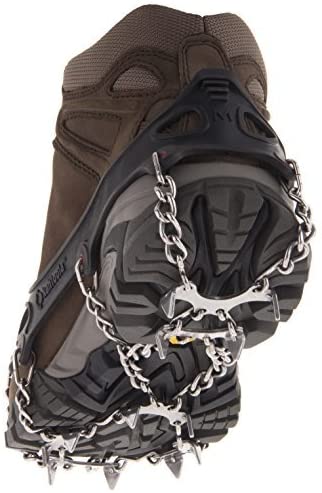
I spoke to the staff to ask their advice about whether I would need snowshoes for the trails or if I could get away with just microspikes. They mentioned that, at the time, many trails were really more muddy than anything, and they prefer for people not to slosh around on mud and create damage to the trail system. When there are paved areas, it’s fine to snowshoe on top of those, but when there are dirt trails, they’d prefer if people wait until there is enough snow to truly snowshoe, or for enough snow to melt off for hiking. The difference in snowy conditions here in comparison to Mesa Verde comes down to the difference in elevation.
Snowshoes can be rented at the Dolores Outfitter shop.
Another way to see Canyons of the Ancients is to book a horseback riding tour with Canyon Trails Ranch, although they don’t typically open until April.
Yucca House National Monument
Yucca House National Monument is an unexcavated pueblo near Mesa Verde and Cortez that is sitting on someone’s private land. Visiting can be a strange experience since there is no signage or Park Service infrastructure whatsoever. This article provides a good explanation about how to find Yucca House. Personally I think it’s a good idea to wait for some snow to melt if you can, since this site and the walkway could easily be covered and unidentifiable under heavy snow.
Hovenweep National Monument
Hovenweep National Monument is on the border of Colorado and Utah and includes six prehistoric villages built between 1200-1300AD. Most of the walks are very short, including the popular Square Tower Loop trails. An exception is the Ruins Trail to Holly Pueblo, Horseshoe Pueblo, and Hackberry Pueblo, though you can abridge this route but simply doing the Hovenweep Ruins Trail to Tower Point or the Holly Group Trail. Be sure to read the National Monument’s advice about visiting in winter.
Durango Hot Springs
There are hot springs locations all throughout Colorado; I mentioned them in my post about Leadville in Winter as well. Apparently this is due to the geologic forces that created the Rocky Mountains. Thermal springs more likely to exist in mountainous areas as opposed to the flat Midwest. 45 minutes from Mesa Verde National Park, Durango Hot Springs has a spa and 28 mineral water pools at varying temperature levels.
Cat Skiing with Purgatory Snowcat Adventures
If you enjoy backcountry skiing and you’re bleeding money, Purgatory Resort is about an hour’s drive from Mesa Verde National Park:
“Purgatory Snowcat Adventures runs the largest cat skiing operation in Colorado, with 35,000 acres of breathtaking terrain, outside of the resort boundaries. Guests can expect an average of 8-10 runs and 10,000′ of vertical depending on skier ability and terrain conditions. With exceptional views of the Northern and Southern San Juan Mountains all to yourself, this will be a day of skiing you’ll remember forever!
Your day of snowcat skiing or snowboarding includes avalanche gear, lunch and water (bringing your own water bottle is recommended). Morning orientation begins at 8:00am in the Purgatory Snowcat Adventures office located in the Village Plaza. Our highly trained guides will make an assessment of up-to-date snow conditions and skier ability to choose from three primary zones in our 35,000-acre terrain area. Skiers must be comfortable skiing black diamond runs consisting of deep powder, tight trees, steep pitches and unmarked hazards.”
Durango & Silverton Narrow Gauge Railroad
This sightseeing train service through the San Juan Mountains offers a 5.5 hour winter tour called the Cascade Canyon Winter Train from mid-November to early May, as well as a 2 hour Polar Express Christmas train ride from mid-November through December. You’ll ride in heated coaches and experience what it was like to travel the West by train in the 1800s. Trains depart from Durango, where there is also a free Railroad Museum.
The Four Corners region of the United States is a great winter destination overall; further afield you’ll find Bisti Badlands, Aztec Ruins National Monument, Canyon de Chelly, Chaco Canyon, Shiprock, Acoma, Hawikuh, and Monument Valley. In Northern Arizona there are a ton of Native American historical sites and even some cliff dwellings, like those I listed in my Northern Arizona Road Trip Itinerary. What’s your favorite place to visit in the Four Corners?
🏨 Search budget hostels in the Cortez/Mancos area or standard hotel options in Cortez.
✈️ Coming to Colorado from further afield? Use an Airalo eSIM for affordable international cell data and don’t forget to protect your investment with travel insurance.
Related:



Pin It:

My dream is to write travel and hiking content full-time. All of my guides and itineraries are free and my travels are self-funded. If you enjoy my site and would like to support, you can donate any amount to my Ko-fi page. Thank you!!